1. Introduction: A Free Registration That Halves Your Filing Fees
There is a ten-minute, zero-cost, entirely online government registration that cuts the statutory cost of protecting your brand by half. Most Indian businesses that qualify for it either do not know it exists, or hold it and never think to mention it to their trade mark attorney.
That registration is Udyam, and the mechanism by which it reduces trade mark fees is worth understanding precisely, because the connection is indirect. Udyam registration does not itself grant any trade mark benefit. What it does is establish, on a government-issued certificate, that your enterprise falls within the MSME classification. The Trade Marks Rules, 2017 then define a concessional fee category by reference to that classification. The Trade Marks Registry, in turn, accepts the Udyam Registration Certificate as the proof required to claim the concession.
The chain runs: Udyam certificate → MSME classification under the MSMED Act, 2006 → “Small Enterprise” under Rule 2 of the Trade Marks Rules, 2017 → concessional fee in the First Schedule.
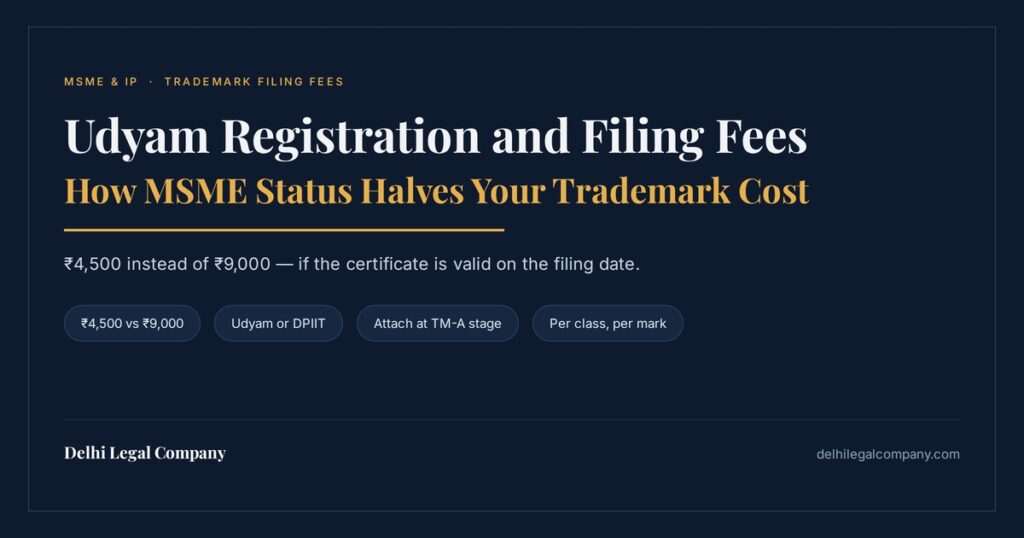
Break any link in that chain — wrong entity name, no certificate at the time of filing, a certificate held by a promoter rather than the applicant — and the concession disappears. Get all four right and a five-class filing costs ₹22,500 instead of ₹45,000.
This article deals with the practical mechanics: what Udyam registration is, who actually needs it for trade mark purposes (and who does not), exactly how it feeds into the fee calculation, how to obtain and maintain it, the name-matching and timing errors that cause claims to fail at the Registry, and what happens when an enterprise grows past the thresholds.
This is general information on Indian practice as of 2026, not legal advice. MSME thresholds, portal procedures and trade mark fee schedules change. Verify against udyamregistration.gov.in and ipindia.gov.in before filing.
2. What Udyam Registration Actually Is
Udyam Registration is the Government of India’s official MSME registration system, administered by the Ministry of Micro, Small and Medium Enterprises through the portal at udyamregistration.gov.in.
Its defining features:
- Free. There is no government fee. The official portal charges nothing.
- Paperless. No documents are uploaded. The system reads PAN, GSTIN, Aadhaar and income-tax data directly from government databases.
- Self-declaration based, anchored on Aadhaar OTP verification and validated against tax records.
- Permanent. It issues a Udyam Registration Number (URN) and an e-certificate carrying a QR code for verification. The certificate has lifetime validity — there is no renewal and no annual fee.
- Self-updating classification. The Micro/Small/Medium category is re-assessed automatically each year based on the previous year’s GST and income-tax return data.
It replaced the earlier Udyog Aadhaar Memorandum (UAM) and the older EM-I/EM-II filings. Businesses still holding legacy registrations should migrate to Udyam, since the older documents are no longer the accepted proof.
2.1 Who Can Register
Every business form is eligible: sole proprietorships, partnership firms, HUFs, LLPs, private and public limited companies, co-operative societies and trusts. For companies and LLPs, the entity’s own PAN is used; for proprietorships, the proprietor’s PAN.
2.2 What the Certificate Contains
The Udyam Registration Certificate sets out the enterprise name and URN, the type of organisation, the major activity, the NIC code, the office address, the date of incorporation, the date of Udyam registration, and — critically for trade mark purposes — the MSME classification as Micro, Small or Medium.
That last field is the one the Trade Marks Registry looks at.
2.3 A Warning Worth Reading
The official portal is udyamregistration.gov.in and it is free. A large number of private websites with confusingly similar domain names charge fees of several hundred to several thousand rupees for what is a free government service, and some collect Aadhaar and PAN data in the process. Use the government portal directly, or a professional adviser you already engage.
3. Who Actually Needs Udyam for Trade Mark Fee Purposes
This is the first question to ask, and it saves a great deal of unnecessary effort.
The concessional fee category under the Trade Marks Rules, 2017 covers three groups: Individuals, Startups, and Small Enterprises.
| Applicant type | Route to the concession | Udyam needed? |
|---|---|---|
| Individual | Qualifies automatically as an individual | No |
| Sole proprietor | The applicant is the individual, so qualifies automatically | No |
| DPIIT-recognised startup | Qualifies via the Startup route | No — use the DPIIT certificate |
| Private/public limited company | Only via Startup or Small Enterprise route | Yes (unless DPIIT recognised) |
| LLP | Only via Startup or Small Enterprise route | Yes (unless DPIIT recognised) |
| Partnership firm | Only via Startup or Small Enterprise route | Yes (unless DPIIT recognised) |
| HUF, trust, society, co-operative | Only via Small Enterprise route | Yes |
| Foreign entity | Udyam is not available to foreign entities | Not applicable |
The practical upshot: if you are filing in an individual’s name — including as a sole proprietor trading under a business name — you already get ₹4,500 per class and do not need Udyam registration for this purpose at all. Udyam matters for incorporated and non-individual applicants: companies, LLPs, partnership firms, HUFs, trusts and societies.
This is also where a common false economy arises. Some founders file in their personal name specifically to capture the concession, when the operating business is a company. That saves ₹4,500 per class today and creates an assignment obligation tomorrow — a deed, stamp duty, a Form TM-P recordal, and a chain-of-title entry that every future opponent examines. If the company can obtain Udyam registration, it should file in its own name at the same concessional rate.
4. The Legal Chain in Detail
4.1 Link One: The Trade Marks Rules
Rule 2 of the Trade Marks Rules, 2017 defines “Small Enterprise” as:
- for an enterprise engaged in the manufacture or production of goods — one where the investment in plant and machinery does not exceed the limit specified for a medium enterprise under clause (a) of sub-section (1) of Section 7 of the MSMED Act, 2006; and
- for an enterprise engaged in providing or rendering services — one where the investment in equipment is not more than the limit specified for a medium enterprise under clause (b) of that sub-section.
Rule 10 and the First Schedule then prescribe the two-tier fee.
4.2 Link Two: The Word “Medium”
Read that definition again, because it is the single most consequential fact in this area and it is almost universally misread.
Although the category is labelled “Small Enterprise,” the Trade Marks Rules define it by reference to the medium enterprise ceiling under the MSMED Act.
Consequence: micro, small and medium enterprises all fall within the concessional trade mark fee category.
An enterprise whose Udyam certificate says “Medium” still qualifies. This is not an aggressive interpretation; it is the plain text of Rule 2. It is also why so many mid-sized Indian companies pay full trade mark fees unnecessarily — they read the label and stop.
4.3 Link Three: The Current MSME Thresholds
Because Rule 2 cross-refers to Section 7(1) of the MSMED Act, the trade mark threshold moves whenever the MSME classification moves. It last moved on 1 April 2025, under Ministry of MSME Notification S.O. 1364(E) dated 21 March 2025, which superseded Notification S.O. 2119(E) of 26 June 2020 and raised investment limits by 2.5 times and turnover limits by 2 times.
| Category | Investment in plant, machinery or equipment | Annual turnover |
|---|---|---|
| Micro | up to ₹2.5 crore | up to ₹10 crore |
| Small | up to ₹25 crore | up to ₹100 crore |
| Medium | up to ₹125 crore | up to ₹500 crore |
Features of the current framework:
- The test is composite — both investment and turnover must remain within the band. Exceeding either moves the enterprise up a category.
- It applies uniformly to manufacturing and services; the earlier sectoral split is gone.
- Exports are excluded from turnover, so a strong export year does not push an enterprise into a higher bracket.
- Under Section 8(6) of the MSMED Act, where classification changes through reclassification or actual change in investment or turnover, the enterprise remains in its current category until the end of the financial year.
Combining these: an enterprise with investment up to ₹125 crore and turnover up to ₹500 crore can hold a Medium classification on its Udyam certificate — and still claim the concessional trade mark fee, because Rule 2 uses the medium ceiling.
4.4 Link Four: The Registry Accepts the Certificate
The Trade Marks Registry does not audit your balance sheet. It requires the Udyam Registration Certificate, in the applicant’s name, uploaded with Form TM-A. The certificate states the classification; the classification satisfies Rule 2; the concessional fee applies.
This is why the pragmatic advice is always the same: get the certificate, and let the certificate do the arguing.
5. What the Concession Is Worth
5.1 Application Fees (Form TM-A)
| Applicant category | E-filing (per class) | Physical filing (per class) |
|---|---|---|
| Individual / Startup / Small Enterprise | ₹4,500 | ₹5,000 |
| Others | ₹9,000 | ₹10,000 |
5.2 Expedited Processing (Rule 34)
| Applicant category | Fee |
|---|---|
| Individual / Startup / Small Enterprise | ₹20,000 |
| Others | ₹40,000 |
5.3 The Per-Class Multiplier
Section 18(2) of the Trade Marks Act, 1999 charges fees per class, so the saving multiplies:
| Classes | With Udyam | Without | Saving |
|---|---|---|---|
| 1 | ₹4,500 | ₹9,000 | ₹4,500 |
| 2 | ₹9,000 | ₹18,000 | ₹9,000 |
| 3 | ₹13,500 | ₹27,000 | ₹13,500 |
| 5 | ₹22,500 | ₹45,000 | ₹22,500 |
| 10 | ₹45,000 | ₹90,000 | ₹45,000 |
For a company protecting a brand across five classes, ten minutes on the Udyam portal returns ₹22,500 in statutory fees. That is among the highest hourly returns available in Indian corporate administration.
5.4 What the Concession Does Not Cover
Budget honestly. The concession is front-loaded. It applies to a small number of First Schedule entries — principally the application and expedited processing. Do not assume a concessional rate for renewal (Form TM-R), opposition (Form TM-O), rectification, most Form TM-M requests, or the well-known mark determination under Rule 124 (a flat ₹1,00,000). Check the current Schedule entry before quoting any figure.
6. How to Obtain Udyam Registration
6.1 What You Need on Hand
- A mobile number linked to the Aadhaar of the proprietor, partner, karta, or authorised signatory
- The PAN of the business (for companies, LLPs and other registered entities) or the proprietor’s PAN
- GSTIN, where the business is GST-registered
- The correct NIC code matching the principal business activity as it appears in the Memorandum of Association or the entity’s registration record
- Previous financial year figures for investment in plant, machinery or equipment and turnover
6.2 The Steps
- Go to udyamregistration.gov.in — the only official portal.
- Select the correct registration route: new registration for those not yet registered as MSME, or the migration route for those holding a UAM.
- Enter the Aadhaar number of the authorised person and verify by OTP.
- Enter the entity’s PAN; the system validates it against the tax database.
- Enter enterprise details — name, type of organisation, address, NIC code, number of employees, bank details.
- Declare the prior year’s investment and turnover. The portal auto-validates these against GSTR and ITR data after submission.
- Submit. The URN and e-certificate are typically generated within minutes, though processing can take up to a couple of working days.
Nothing is uploaded. The system reads directly from PAN, GSTIN, Aadhaar and ITR records.
6.3 The Udyam Assist Platform
For informal micro enterprises without PAN or GSTIN — street vendors, individual artisans, and similar — the Udyam Assist Platform at udyamassist.gov.in, launched in 2023, provides a separate route through Common Service Centres and designated agencies such as SIDBI. UAP holders are formally classified as Micro Enterprises and can migrate to the main Udyam portal once they obtain PAN and GST.
For trade mark purposes, note that applicants at this scale are usually sole proprietors — who already qualify for the concession as individuals, without any certificate.
7. The Name-Matching Problem: Where Claims Actually Fail
This is the most common practical failure at the Trade Marks Registry, and it has nothing to do with eligibility.
The name on the Udyam certificate must correspond to the applicant named on Form TM-A.
Recurring mismatches:
| Situation | Problem | Fix |
|---|---|---|
| Udyam in the promoter’s personal name; TM application by the company | Different legal persons | Obtain Udyam in the company’s name |
| Udyam in the holding company’s name; TM application by the operating subsidiary | Different legal persons | Obtain Udyam for the applicant entity |
| Udyam certificate shows a trading style; TM application names the individual | Registry may query the correspondence | Ensure the individual and trading style are both reflected consistently |
| Company changed its name after Udyam registration | Certificate shows the old name | Update the Udyam record before filing |
| Punctuation and abbreviation differences (“Pvt. Ltd.” vs “Private Limited”) | Cosmetic but query-inducing | Align both with the certificate of incorporation |
The underlying rule is the same one that governs the applicant field generally: the entity claiming the concession must be the entity applying for the mark.
7.1 The One-PAN-One-Udyam Constraint
One PAN can hold only one Udyam Registration. An enterprise may add multiple activities and branches under a single registration, but a group with several distinct legal entities needs a separate Udyam registration for each entity that will file trade mark applications in its own name.
Groups should therefore identify, before filing season, which entities will hold IP and ensure each of those has its own Udyam registration.
8. Timing: Before Filing, Not After
The certificate must exist and be filed with Form TM-A. The Registry mandatorily requires the MSME certificate to grant the concessional rate.
There is no reliable route to claim the concession retrospectively. Filing at ₹4,500 without the certificate produces a deficiency notice and a demand for the ₹4,500 per class shortfall — and, if unaddressed, treats the application as not duly filed.
The correct sequence is:
- Obtain Udyam registration in the applicant entity’s exact name
- Download and check the certificate — name, classification, validity
- File Form TM-A by e-filing, selecting the concessional category and uploading the certificate
Udyam registration takes minutes to a couple of days. Build it into the pre-filing checklist alongside the clearance search, rather than discovering the gap on filing day.
9. Maintaining the Registration
9.1 Annual Updation
The certificate itself has lifetime validity, but enterprises are expected to keep turnover and investment details current on the portal. The classification is re-assessed automatically each year from the previous year’s GSTR and ITR filings, so in most cases the certificate stays current without active intervention — provided the entity’s tax filings are up to date and consistent.
Where declared figures diverge from GST and ITR data, the system may flag or reject entries. Keep the declarations aligned with what has actually been filed.
9.2 Updating Details
Business name, address, bank details, GSTIN, NIC codes and contact details can be updated on the portal free of charge, with OTP verification, retaining the same URN. Note that the registered state and district are locked at original registration and cannot be changed by update.
Update the Udyam record whenever the entity’s name changes — a company that changes its name under the Companies Act remains the same legal person, but the certificate must reflect the current name before it is used to claim a fee concession.
9.3 Reclassification Within the MSME Bands
Here is a point specific to trade marks and genuinely reassuring.
Because Rule 2 of the Trade Marks Rules keys the concession to the medium enterprise ceiling, movement between the Micro, Small and Medium bands makes no difference to trade mark fee eligibility. A business that grows from Micro to Small, or from Small to Medium, continues to qualify at ₹4,500 per class.
Eligibility is only lost when the enterprise exceeds the medium ceiling entirely — currently investment above ₹125 crore or turnover above ₹500 crore — at which point it ceases to be an MSME at all.
9.4 When You Outgrow MSME Status
Once the enterprise crosses out of the medium band, the Udyam route closes. Two consequences follow:
- Future trade mark applications are filed at the “Others” rate of ₹9,000 per class.
- Applications already filed at the concessional rate were validly filed on the position as at their filing date. Section 8(6) of the MSMED Act also keeps an enterprise in its category until the end of the financial year when classification changes. The Trade Marks Rules do not contain an express clawback equivalent to that in the Patents Rules, but the two regimes are not drafted identically — confirm current Registry practice where material sums are involved.
A business approaching the threshold and planning a portfolio expansion has an obvious, entirely legitimate incentive to file before it crosses over.
10. Worked Examples
Example A — Private limited company, ₹6 crore turnover, three classes. Micro classification. With Udyam: ₹4,500 × 3 = ₹13,500 instead of ₹27,000. Saving ₹13,500 for a free ten-minute registration.
Example B — Manufacturing company, ₹40 crore investment, ₹180 crore turnover, five classes. Classified Medium under the thresholds effective 1 April 2025. Because Rule 2 uses the medium ceiling, it still qualifies. With Udyam: ₹4,500 × 5 = ₹22,500 instead of ₹45,000. Saving ₹22,500. Most companies of this size assume they are ineligible.
Example C — Sole proprietor, two classes. Qualifies automatically as an individual. No Udyam certificate needed. ₹4,500 × 2 = ₹9,000. Obtaining Udyam is still worthwhile for lending, procurement and payment-protection reasons — but it adds nothing to the trade mark fee position.
Example D — DPIIT-recognised startup, four classes. Qualifies via the Startup route on the DPIIT certificate. ₹4,500 × 4 = ₹18,000. If it also holds Udyam, either certificate serves. Expedited processing is also available at ₹20,000 instead of ₹40,000.
Example E — Company with Udyam in the founder’s personal name, three classes. Mismatch. The certificate does not qualify the company. Either obtain Udyam for the company, or file in the founder’s name — accepting the assignment cost later. Filing without a valid certificate at the concessional rate produces a deficiency notice for ₹13,500.
11. Common Mistakes
- Paying a private website for what is a free registration at udyamregistration.gov.in.
- Assuming “Medium” disqualifies you. Rule 2 uses the medium ceiling; Medium enterprises qualify.
- Working from pre-2025 thresholds. The limits changed on 1 April 2025 via S.O. 1364(E).
- Certificate in the wrong entity’s name — promoter, holding company, or sister concern.
- Filing the trade mark application before obtaining the certificate, then trying to claim retrospectively.
- Stale certificate after a company name change, not updated on the portal.
- Assuming a sole proprietor needs Udyam for the trade mark concession. They do not — individuals qualify automatically.
- Assuming Udyam covers the whole trade mark lifecycle. It affects filing and expedited processing; budget full rates for renewal and contested proceedings.
- Filing in a founder’s personal name to capture the concession when the company could have obtained Udyam and filed in its own name — creating an expensive assignment obligation.
- Declared figures inconsistent with GST and ITR data, causing rejection or later suspension of the registration.
- Forgetting the one-PAN-one-Udyam rule in group structures, so only one entity holds a certificate while several file applications.
- Choosing physical filing, which costs ₹500 more per class than e-filing and offers nothing in return.
12. Beyond Trade Marks: The Wider Value
Udyam registration is worth obtaining even where the trade mark saving alone does not motivate it. It unlocks, among other things:
- Fee concessions on patents and designs, where MSMEs and startups receive substantial rebates under the respective Rules
- Delayed payment protection under Sections 15 to 18 of the MSMED Act, with the associated interest liability on buyers, now reinforced by the disallowance mechanism in Section 43B(h) of the Income-tax Act, 1961
- Priority sector lending classification and collateral-free credit under CGTMSE
- Government procurement benefits — GeM portal registration, tender exemptions from earnest money deposit and prior turnover/experience criteria, and reserved procurement quotas
- State subsidy and incentive schemes, many of which require a Udyam certificate as the gateway document
For a business already filing trade marks, the registration is effectively free money in multiple directions at once.
13. Pre-Filing Checklist
- Determine the intended applicant entity (see the applicant-name analysis: it must match your invoices and your future litigant)
- Is the applicant an individual or sole proprietor? If yes, no Udyam needed — proceed at the concessional rate
- Is the applicant DPIIT recognised? If yes, use the DPIIT certificate
- Otherwise, does the applicant entity hold a valid Udyam Registration Certificate in its own name?
- If not, register free at udyamregistration.gov.in before filing
- Confirm the certificate name matches the certificate of incorporation and the intended TM-A applicant name character-for-character
- Confirm the classification field reads Micro, Small or Medium (all qualify)
- Confirm Udyam details are current — name, address, GSTIN
- File Form TM-A by e-filing, selecting the concessional category
- Upload the Udyam certificate with the application
- Budget full rates for renewal, opposition and post-registration steps
14. Conclusion
Udyam registration is not a trade mark instrument. It is an MSME identity document that the Trade Marks Rules happen to make decisive, through a definition in Rule 2 that keys the concessional fee category to the MSMED classification.
Three things determine whether that chain holds. The classification must fall within the MSME framework — and because Rule 2 uses the medium ceiling, an enterprise with up to ₹125 crore of investment and ₹500 crore of turnover still qualifies. The name on the certificate must be the name on the application. And the timing must be right: the certificate has to exist and be filed with Form TM-A, because retrospective claims fail.
For companies, LLPs, partnerships, HUFs, trusts and societies, that is a free registration, completed online in minutes, worth ₹4,500 per class on every trade mark application the entity ever files — plus half the cost of expedited processing, plus a package of lending, procurement and payment-protection benefits that have nothing to do with intellectual property at all.
For individuals and sole proprietors, none of it is necessary for the trade mark concession. They already qualify.
The cost of finding out which category you are in is one look at the applicant field. The cost of not finding out is ₹4,500 for every class, on every application, indefinitely.
15. Frequently Asked Questions (FAQs)
1. Does Udyam registration reduce trade mark filing fees directly?
A. Not directly — it works through a chain. Udyam establishes your MSME classification; Rule 2 of the Trade Marks Rules, 2017 defines the concessional “Small Enterprise” category by reference to that classification; and the Trade Marks Registry accepts the Udyam Registration Certificate as proof. The result is ₹4,500 per class for e-filing instead of ₹9,000.
2. How much can I actually save?
A. Roughly 50% on Form TM-A, and 50% on expedited processing under Rule 34 (₹20,000 instead of ₹40,000). Because Section 18(2) charges fees per class, the saving multiplies: ₹13,500 on three classes, ₹22,500 on five classes, ₹45,000 on ten.
3. Do sole proprietors need Udyam registration to get the concession?
A. No. A sole proprietorship has no separate legal existence, so the applicant is the individual — and individuals qualify for the concessional rate automatically, with no certificate required. Udyam registration is still worth obtaining for lending, procurement and payment-protection reasons, but it adds nothing to the trade mark fee position.
4. Then who actually needs Udyam for trade mark purposes?
A. Non-individual applicants: private and public limited companies, LLPs, partnership firms, HUFs, trusts, societies and co-operatives. These pay the “Others” rate unless they qualify through the Startup route (DPIIT recognition) or the Small Enterprise route (Udyam).
5. My company is classified as a Medium enterprise. Am I disqualified?
A. No — and this is the most commonly misread point in the area. Although Rule 2 labels the category “Small Enterprise,” it defines it by reference to the limit specified for a medium enterprise under Section 7(1) of the MSMED Act. Micro, Small and Medium enterprises therefore all qualify for the concessional trade mark fee.
6. What are the current MSME thresholds?
A. Effective 1 April 2025, under Ministry of MSME Notification S.O. 1364(E) dated 21 March 2025: micro — investment up to ₹2.5 crore and turnover up to ₹10 crore; small — ₹25 crore and ₹100 crore; medium — ₹125 crore and ₹500 crore. Because Rule 2 uses the medium ceiling, an enterprise within the medium band qualifies.
7. Is the MSME test based on investment or turnover?
A. Both — it is a composite criterion. An enterprise must stay within the investment and the turnover ceiling for its category; crossing either moves it up. Exports are excluded from turnover, so a strong export year does not push an enterprise into a higher bracket.
8. Where do I register, and what does it cost?
A. At udyamregistration.gov.in, which is the only official portal. It is completely free. Be aware that many private websites with similar names charge fees for what is a free government service and collect Aadhaar and PAN data in the process.
9. What documents do I need to upload?
A. None. The process is paperless. The system reads PAN, GSTIN, Aadhaar and income-tax data directly from government databases. You need an Aadhaar-linked mobile number for OTP, the entity’s PAN, GSTIN if applicable, the correct NIC code for your principal activity, and last year’s investment and turnover figures.
10. How long does registration take?
A. The URN and e-certificate are usually generated within minutes of submission, though processing can extend to a couple of working days. Either way, build it into your pre-filing checklist rather than discovering the gap on filing day.
11. Does the Udyam certificate expire?
A. No. It has lifetime validity, with no renewal requirement and no annual fee. The Micro/Small/Medium classification is re-assessed automatically each year from the previous year’s GSTR and ITR data, so the certificate stays current without action provided your tax filings are up to date.
12. Can I claim the trade mark concession after filing if I get Udyam later?
A. No, as a matter of routine practice. The Registry requires the certificate to be uploaded with Form TM-A. Filing at the concessional rate without it produces a deficiency notice and a demand for the shortfall — ₹4,500 per class — and if unaddressed, the application may be treated as not duly filed.
13. My Udyam certificate is in my personal name but the trade mark application is by my company. Does it work?
A. No. The certificate must be in the name of the applicant entity. A promoter’s, a holding company’s, or a sister concern’s certificate does not qualify the applicant. Either obtain Udyam for the company, or file in the individual’s name and accept the later assignment cost.
14. My company changed its name after obtaining Udyam. What should I do?
A. Update the Udyam record on the portal before filing. The company remains the same legal person, but a certificate showing the old name creates a mismatch with the TM-A applicant name and invites a query or rejection of the concessional claim.
15. Do minor formatting differences in the name matter?
A. They can cause queries. Align the applicant name on Form TM-A, the Udyam certificate, and the certificate of incorporation character-for-character — including whether the name reads “Private Limited” or “Pvt. Ltd.”
16. My group has five companies. Can one Udyam registration cover all of them?
A. No. One PAN can hold only one Udyam Registration, and each legal entity has its own PAN. A single registration can cover multiple activities and branches of the same enterprise, but each entity that will file trade mark applications in its own name needs its own Udyam registration.
17. What happens if my business grows from Micro to Small, or Small to Medium?
A. Nothing changes for trade mark fee purposes. Because Rule 2 keys the concession to the medium ceiling, movement between the three MSME bands makes no difference — you continue to qualify at ₹4,500 per class. Eligibility is lost only when you exceed the medium ceiling entirely.
18. What happens when I outgrow MSME status altogether?
A. Future applications are filed at ₹9,000 per class. Applications already filed at the concessional rate were validly filed on the position at their filing date, and Section 8(6) of the MSMED Act keeps an enterprise in its category until the end of the financial year when classification changes. The Trade Marks Rules contain no express clawback equivalent to that in the Patents Rules, but the regimes are drafted differently — confirm current Registry practice where material sums are at stake.
19. If I’m close to the threshold and planning a big filing, should I file now?
A. There is an entirely legitimate incentive to complete a planned portfolio expansion while the concession is available. Filing while eligible is not avoidance; it is using a benefit the Rules provide for the period during which you qualify.
20. Does Udyam help with expedited processing?
A. Yes. Under Rule 34, expedited processing costs ₹20,000 for Individuals, Startups and Small Enterprises against ₹40,000 for others. The 2017 Rules extended expedited processing beyond examination all the way to registration, which makes this entry considerably more valuable than it was.
21. Does the concession apply to renewals and oppositions?
A. Do not assume so. The concession is front-loaded and applies to a small number of First Schedule entries — principally the application and expedited processing. Check the current Schedule entry for Form TM-R, Form TM-O and Form TM-M before budgeting, and plan on full rates after registration.
22. What about the well-known mark application?
A. The Rule 124 determination carries a flat fee of ₹1,00,000 with no concessional tier.
23. Is it better to hold DPIIT startup recognition or Udyam?
A. Either qualifies you for the same concessional rate, so for trade mark fee purposes it does not matter which you use. DPIIT recognition additionally opens the SIPP scheme, under which the Government bears empanelled facilitators’ professional fees for recognised startups. DPIIT recognition also lapses after ten years or on crossing ₹100 crore turnover, whereas Udyam does not expire.
24. Can a foreign company obtain Udyam to reduce Indian trade mark fees?
A. No. Udyam registration is not available to foreign entities. Foreign applicants pay the “Others” rate, though Rule 2 does contain a foreign-entity limb for startups — an entity meeting the turnover and incorporation-period criteria under the Startup India notification and submitting a declaration.
25. What is the Udyam Assist Platform and does it help with trade marks?
A. It is a separate route at udyamassist.gov.in, launched in 2023, for informal micro enterprises without PAN or GSTIN — street vendors, artisans and similar — registered through Common Service Centres and agencies such as SIDBI. Holders are classified as Micro Enterprises. For trade mark purposes, applicants at that scale are usually sole proprietors who already qualify as individuals anyway.
26. I have an old Udyog Aadhaar Memorandum. Is it still valid for this?
A. Migrate to Udyam. The UAM and the older EM-I/EM-II filings have been superseded, and the Udyam Registration Certificate is the accepted proof. The portal provides a dedicated migration route for existing UAM holders.
27. Do I have to update Udyam every year?
A. The certificate does not expire, but you are expected to keep investment and turnover details current. In practice the portal re-assesses classification annually from the previous year’s GSTR and ITR data. Keep your declared figures consistent with what you have actually filed — divergence can cause rejection or later suspension.
28. Can I change my registered state or district on the Udyam certificate?
A. No. The registered state and district are locked at original registration and cannot be changed by an update. Other fields — business name, address, bank details, GSTIN, NIC codes, contact details — can be updated free of charge with OTP verification, retaining the same URN.
29. Should I file in my personal name instead, to avoid the Udyam step?
A. Usually not, if the operating business is a company. Filing personally saves ₹4,500 per class today but puts the brand outside the company, requiring a later deed of assignment, stamp duty and a Form TM-P recordal — typically costing more than the saving, and creating a chain-of-title entry that opponents and investors will examine. If the company can obtain Udyam, file in the company’s name at the same rate.
30. What non-trade-mark benefits does Udyam bring?
A. Fee rebates on patents and designs; delayed payment protection under Sections 15 to 18 of the MSMED Act, reinforced by Section 43B(h) of the Income-tax Act, 1961; priority sector lending and collateral-free credit under CGTMSE; GeM registration and tender exemptions from earnest money deposit and prior turnover or experience criteria; and access to a wide range of state subsidy schemes.
31. Is Udyam registration legally mandatory?
A. No. It is voluntary. But it is the gateway document for a substantial set of benefits, and for any non-individual entity that files trade marks, it pays for itself several times over on the first application.
32. What is the one-line summary?
A. If your trade mark applicant is a company, LLP, partnership, HUF, trust or society, get a free Udyam registration in that entity’s exact name before you file, and upload it with Form TM-A — it halves your filing fee, per class, on every application, and Medium-classified enterprises qualify just as much as Micro ones. If your applicant is an individual or sole proprietor, you already have the concession and need do nothing.