
It almost never begins as a disaster. It begins with a single missed deadline — an AOC-4 not filed, a GST return skipped, an FC-GPR forgotten — that feels minor at the time. “We’ll deal with it next month.” But Indian compliance penalties are built to compound: a ₹100-a-day fee here, 18% interest there, and a clock that never stops. What started as a small oversight quietly grows, and by the time anyone notices, the cost has multiplied into something that threatens the business itself.
And the financial penalty is rarely the worst part. The real damage shows up later — when a director is disqualified and can’t sign for any company, when the firm is struck off the register and its bank accounts freeze, or when a funding round collapses because due diligence uncovers a historical gap. In 2026, with regulators using AI-driven cross-matching across the MCA, GST, EPFO, and tax systems, the days of quietly slipping through are over.
This guide lays out the true, total cost of non-compliance — across ROC, GST, FEMA, TDS, and payroll — the escalating consequences beyond fines, the one-time relief window open right now, and a clear playbook to stay protected. Forewarned is, quite literally, money saved.
1. Why Non-Compliance Costs So Much More Than the Fine
The headline penalty is just the visible tip. The real cost of non-compliance has four layers, and they stack on top of each other:
- Direct monetary cost: late fees, interest (often 12–24% per annum), and penalties.
- Operational cost: management time lost replying to notices, preparing for audits, and firefighting instead of building the business.
- Strategic cost: blocked input tax credit, vendor blacklisting, ineligibility for tenders, and lost investor or lender confidence.
- Existential cost: director disqualification, company strike-off, and in serious cases, prosecution.
The 2026 reality: authorities now monitor compliance digitally across the GSTN, MCA V3, EPFO, ESIC, and TRACES portals, with automated cross-matching and AI-flagged anomalies. A mismatch in one system increasingly surfaces in another — so non-compliance is harder to hide and faster to catch than ever.

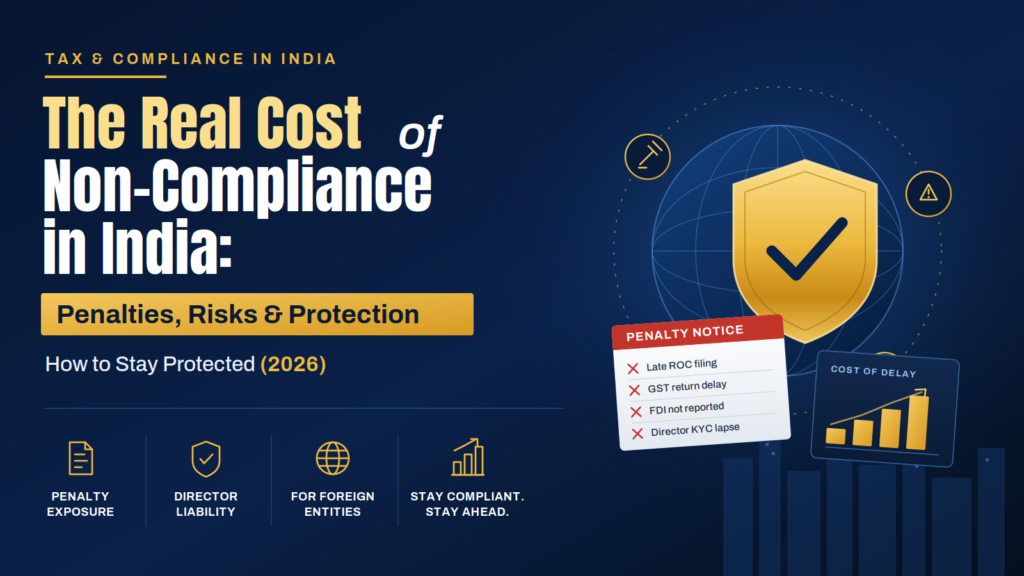
The three zones of non-compliance risk — penalties, long-term impacts, and how to stay protected — at a glance.
How a small lapse becomes a large one
The arithmetic is worth seeing rather than describing. Consider a private limited company with modest turnover that misses both annual filings for one financial year, notices eighteen months later, and decides to deal with it “next quarter” — twice.
| Time elapsed | ROC additional fees | What else is happening |
|---|---|---|
| 30 days late | ₹6,000 (both forms) | Nothing visible. Nobody has written to you. |
| 6 months late | ~₹36,000 | Still nothing visible. The meter is running. |
| 1 year late | ~₹73,000 | Company shows as non-compliant on public MCA data |
| 2 years late | ~₹1.46 lakh | Strike-off becomes available to the ROC |
| 3 years late | ~₹2.19 lakh | Every director disqualified for 5 years, automatically |
Illustrative, at ₹100 per day per form for AOC-4 and MGT-7. Adjudicated penalties under Sections 92 and 137 sit on top of these figures.
Two features of this table explain why intelligent people end up here. First, nothing happens for a long time. There is no notice at thirty days, no warning at six months. The absence of consequence reads as the absence of a problem. Second, the worst consequence arrives on a date, not after a process. Director disqualification under Section 164(2)(a) is not a penalty someone decides to impose — it operates by force of statute the moment the third year completes.
The asymmetry worth internalising: the cost of compliance is fixed, predictable and modest. The cost of non-compliance is uncapped, compounding, and back-dated. There is no version of this trade where waiting improves the position.
2. The Cost of ROC Non-Compliance
India’s corporate-filing penalty is one of the most aggressive in the world because it has no upper cap.
- Late filing of AOC-4 & MGT-7: ₹100 per day, per form, indefinitely. Miss both for a year and you’re near ₹73,000; for three years, upwards of ₹3.6–4.4 lakh — in additional fees alone.
- Adjudication penalties (Sections 92/137): separate penalties of ₹50,000 up to ₹5,00,000 can be levied on top of the daily fee.
- Director disqualification: fail to file for 3 consecutive years and every director is disqualified for 5 years — barred from any company, not just the defaulting one.
- Strike-off: the ROC can strike off a company that hasn’t filed for 2+ years; once struck off, the company ceases to exist, bank accounts freeze, and revival needs an expensive NCLT process.
The cruel catch-22: you cannot voluntarily close a company with pending filings, and once a director’s DIN is deactivated they can’t authorise the very filings needed to fix it. Doing nothing is the most expensive option of all — the meter never stops. History shows the stakes: in past clean-up drives the MCA struck off over 2 lakh companies and disqualified around 3 lakh directors.
Why doing nothing is the most expensive choice
The catch-22 above deserves unpacking, because it is the mechanism that turns a recoverable problem into an unrecoverable one.
A director whose DIN has been deactivated cannot sign filings. But the filings are what would cure the default that caused the deactivation. In a two-director company where both are disqualified, the company has no one who can lawfully authorise the very documents needed to fix it. At that point the remedy moves from a portal to a tribunal — an NCLT application, with counsel, over months.
The same logic applies to closure. Founders who conclude that a dormant company should simply be wound up discover that you cannot voluntarily strike off a company with pending filings. The backlog must be cleared first. A company kept alive on paper “until we get around to closing it” accrues ₹100 per day per form throughout, on an entity earning nothing.
If a company has stopped trading, it needs a decision, not a pause. Either apply for dormant status under Section 455, or strike it off properly under Section 248. Both routes are currently available at reduced fees under CCFS-2026 — see Section 7. Leaving it untouched is the one option that costs money every single day.
3. The Cost of GST Non-Compliance
GST penalties combine fixed fees, steep interest, and operational pain:
| Default | Cost |
|---|---|
| Late GSTR-1 / GSTR-3B | ₹50/day (₹20 for nil), capped at ₹5,000, + 18% interest on tax due |
| Delayed tax payment | 18% p.a. interest (24% on excess/undue ITC) |
| Not registering when liable | 10% of tax or ₹10,000 (non-fraud); 100% of tax for fraud |
| Wrong ITC claim | Reversal + interest + up to 100% penalty if fraud |
| E-invoice non-compliance | Up to ₹25,000 per invoice |
| E-way bill lapse | ₹10,000 or tax amount, whichever is higher; detention/seizure risk |
The strategic GST damage often exceeds the fine: persistent GSTR-2B mismatches get you flagged, your buyers’ ITC is blocked, vendors blacklist you, and prolonged non-filing can cancel your registration entirely — cutting off your ability to do business.
The part that hurts your customers, not just you
GST is unusual among compliance regimes because your failure damages other people’s finances directly, and they notice.
Input tax credit flows through the chain. When you do not file GSTR-1, your buyer’s GSTR-2B does not reflect the invoice, and their credit is blocked — on tax they have already paid you. This converts a filing lapse into a commercial dispute. Buyers who are large enough to have procurement policies routinely deactivate vendors with persistent mismatches, and the vendor usually learns about it from a purchase order that never arrives rather than from a notice.
The escalation path after prolonged non-filing runs: system-generated reminders, then a notice in Form GSTR-3A, then suo motu cancellation of registration. Cancellation is the serious one — without a live GSTIN you cannot issue a tax invoice, which for a B2B business means you cannot trade. Revocation is possible within a limited window, and requires all pending returns and dues to be cleared first.
Reconcile monthly, not annually. GSTR-2B mismatches are cheap to fix in the month they arise and expensive to reconstruct a year later, when the counterparty may have changed accountants, moved, or stopped responding. Monthly reconciliation is the single highest-return habit in GST compliance.
4. The Cost of FEMA Non-Compliance
For foreign-owned companies, FEMA breaches carry the heaviest stick of all — enforced by the Enforcement Directorate (ED).
- Penalties up to 3× the amount involved in the contravention, and higher for repeated violations.
- Late Submission Fees on delayed FC-GPR/FC-TRS filings that scale with delay.
- Ignorance is no defence — even an unintentional lapse (a freelancer who didn’t collect an FIRC, a company that took FDI without RBI reporting) is penalised.
- Frozen deals: historical FEMA gaps surface during funding or exit due diligence and can block fund repatriation entirely.
Why FEMA gaps surface at the worst possible moment
FEMA differs from the other regimes in a way that matters enormously to foreign-owned companies: there is no fixed late fee to plan around. Contraventions are regularised through a compounding application to the RBI, and the amount is determined case by case. You cannot budget for it in advance the way you can budget for ₹100 per day.
The more damaging feature is timing. FEMA lapses are silent until the moment money needs to move. When a foreign parent wants to repatriate — dividends, royalties, buy-back proceeds, or the proceeds of a share sale — the authorised dealer bank asks for the complete reporting trail: FIRCs, FC-GPR acknowledgements, valuation certificates, and tax forms 15CA and 15CB. A missing FC-GPR from four years ago stops the remittance today.
This is why the phrase used by practitioners is worth repeating: repatriation problems are almost never repatriation problems. They are old reporting problems arriving with interest, at the point of maximum inconvenience.
The same trail is examined in due diligence. A FEMA gap discovered during a funding round rarely gets waived — it converts into an indemnity, an escrow, or a price adjustment, and it delays closing while compounding is applied for.
5. The Cost of TDS & Payroll Non-Compliance
- Late TDS return (Form 24Q): ₹200 per day under Section 234E — one late quarter can be ~₹18,000; four quarters can top ₹70,000.
- Late PF: 12% annual interest plus damages of 5–25% of arrears; persistent default invites prosecution and property attachment.
- The compounding PF error: computing PF on basic alone (not basic + DA) creates a silent shortfall that surfaces as a large arrears demand on inspection.
- General payroll violations: commonly ₹10,000 to ₹1 lakh per violation, with director exposure in serious cases.
The 2026 payroll exposure most employers have not priced
The four Labour Codes, in force from November 2025, introduced a single statutory definition of wages with a 50% rule: where excluded allowances exceed half of total remuneration, the excess is added back into wages for PF and gratuity purposes.
The rates did not change. What changed is the base they apply to. A salary structure built on low basic pay and high allowances — the standard design across much of Indian industry — now under-contributes every month it remains unrevised, and the shortfall accrues quietly with interest and damages attached.
Two further payroll exposures worth naming, because both are common and neither is obvious:
- Backdated coverage. EPF applies from the day you cross twenty employees and ESIC from the day you cross ten — not from the day you register. A company that crosses in March and registers in August owes from March, and because the employee share cannot be recovered from salaries already paid, the employer absorbs both halves.
- Contractor liability. A principal employer can be held liable where a contractor fails to pay PF and ESIC for workers deployed at your premises. Verifying the contractor’s registration and collecting their monthly challans is not administrative fussiness; it is your own exposure.
Deducting and not depositing is the serious version. Late deposit attracts interest and damages. Deducting an employee’s PF share and failing to deposit it is treated as retention of employee money and carries criminal liability under the EPF Act. The distinction matters more than the amounts.
6. The Penalty Landscape at a Glance
| Area | Headline penalty | Worst-case consequence |
|---|---|---|
| ROC | ₹100/day per form (no cap) | Director disqualification, strike-off |
| GST | ₹50/day + 18% interest | Registration cancellation, prosecution |
| FEMA | Up to 3× the amount involved | Blocked repatriation, ED action |
| TDS | ₹200/day (Sec 234E) | Disallowance, prosecution |
| PF/ESI | 12% interest + 5–25% damages | Prosecution, property attachment |
Figures reflect the 2026 position and are indicative; exact penalties depend on the specific default, amount, and intent. Verify current provisions before acting.
7. A Window of Relief: CCFS-2026
There’s timely good news for companies already behind on ROC filings. The MCA’s Companies Compliance Facilitation Scheme, 2026 (CCFS-2026) is a one-time amnesty:
- 90% waiver of additional fees on overdue annual filings — a ₹3 lakh liability can drop to around ₹30,000.
- Immunity from prosecution under Sections 92/137 if filings are completed within the window.
- Open 15 April 2026, now closing 31 August 2026. The scheme was originally scheduled to end on 15 July, but MCA extended it through General Circular No. 03/2026 dated 8 July 2026, following capacity restoration at the MCA data centre after a fire incident on 5 June 2026. After it closes, full fees, prosecution and strike-off enforcement resume with no amnesty.
- Three routes, not one: clear the backlog at 10% of additional fees; obtain dormant status under Section 455 via MSC-1 at 50% of normal fees; or strike off via STK-2 at 25% of filing fees.
- No separate immunity form. Unlike CFSS-2020, CCFS-2026 requires no separate registration or immunity application — filing the overdue form is itself sufficient, with immunity operating automatically based on timing relative to any adjudication notice.
If you’re behind, act now: CCFS-2026 is the cheapest exit from accumulated penalties you will get. Filing overdue returns — even with reduced fees — is always cheaper than the compounding daily fee plus the cost of reversing a director disqualification at the NCLT.
Where immunity stops
The relief is generous but conditional, and the conditions turn on timing.
Under the proviso to Section 454(3), proceedings under Section 92 or Section 137 are concluded and no penalty is leviable where the filing is made before an adjudicating officer issues a notice, or within 30 days of such a notice. There is no immunity where that 30-day period has already expired, or where an adjudication order imposing penalty has already been passed. In those cases, filing under the scheme reduces the fees but does not erase the penalty.
Five categories are excluded from the scheme entirely: companies against which final notice for striking off under Section 248 has been initiated; companies that have already applied for strike-off; companies that had applied for dormant status before the scheme began; companies dissolved under a scheme of amalgamation; and vanishing companies.
The practical sequence, this month: pull your company’s filing history from the MCA portal, confirm you are not in an excluded category, check whether any adjudication notice has already been received, and file before 31 August 2026. Portal congestion in the closing week is predictable.
8. How to Stay Protected
Staying compliant isn’t about being clever — it’s about being systematic. The companies that never get penalised simply build a few habits:
- Maintain a master compliance calendar covering ROC, GST, TDS, PF/ESI, and FEMA, with advance reminders before every deadline.
- File even when there’s no activity — dormant and zero-revenue companies must still file. “No business” is not an exemption.
- Reconcile monthly, not at year-end — run GSTR-2B reconciliations and books reviews every month to catch issues early.
- Keep records consistent across MCA, GST, income tax, and FEMA filings — mismatches are what trigger notices.
- Assign clear ownership — who prepares, who signs (DSC), who reviews — and run an internal check 15 days before each major due date.
- Engage a professional for end-to-end compliance; the cost is a fraction of a single serious penalty.
A workable operating rhythm
The habits above become real when they attach to specific dates. For a typical private limited company, the recurring shape of the year looks like this:
| Frequency | What has to happen |
|---|---|
| Monthly | GST returns; TDS deposit by the 7th; PF and ESIC by the 15th; GSTR-2B reconciliation |
| Quarterly | TDS returns (Form 24Q and others); board meeting, keeping the 120-day gap rule in view; advance tax |
| Annually | Statutory audit; AGM by 30 September; AOC-4 and MGT-7; income-tax return; FLA by 15 July where FDI exists |
| Event-based | FC-GPR within 30 days of allotment; FC-TRS within 60 days of transfer; DIR-12, MGT-14, PAS-3, INC-22 on the event |
The event-based row is where most failures originate, because nothing on a calendar prompts them. The only reliable control is a standing rule inside the business: any change in directors, capital, shareholding, registered office or beneficial ownership gets reported to whoever handles compliance on the day it is decided, not at year end when someone is assembling paperwork.
What a compliance review actually looks for
If you are unsure of your current position, a review is a short, finite exercise rather than an open-ended audit. It checks:
- MCA master data — filing status, active or non-compliant flag, DIN status of every director
- GST — return filing history, GSTR-2B mismatches, registration status
- FEMA — whether every allotment and transfer has a corresponding FC-GPR or FC-TRS, and whether FLA has been filed each year
- Payroll — threshold-crossing dates against registration dates, salary structure against the 50% wage rule, contractor documentation
- TDS — deposit and return history, and any TRACES defaults sitting unaddressed
Most reviews of this kind surface either nothing, or something that is materially cheaper to fix today than at the point someone else discovers it.
Conclusion
The real cost of non-compliance in India is rarely the first fine — it’s the compounding that follows, and the strategic and existential damage behind it: disqualified directors, struck-off companies, frozen repatriation, collapsed deals. In 2026, with regulators cross-matching data automatically, the safest and cheapest path is simple discipline: know your deadlines, file on time, reconcile monthly, and keep your records consistent. If you’re already behind, the CCFS-2026 window is your moment to reset at a fraction of the cost. Compliance isn’t an expense to minimise — it’s the cheapest insurance your business will ever buy.
Frequently Asked Questions (FAQ)
The questions businesses ask us most often about compliance risk in India:
1. What is the penalty for late ROC filing in India?
Late filing of AOC-4 and MGT-7 costs ₹100 per day, per form, with no upper cap. One year’s delay on both forms approaches ₹73,000, and three years can exceed ₹3.6 lakh in additional fees alone — before separate adjudication penalties of ₹50,000 to ₹5,00,000 and director-disqualification risk.
2. Can directors be personally penalised for non-compliance?
Yes. If a company fails to file financial statements or annual returns for three consecutive years, every director is disqualified for five years under Section 164(2) — barred from acting as director in any company. Directors can also face adjudication penalties and, in serious cases, prosecution.
3. What happens if my company is struck off?
A struck-off company legally ceases to exist: its bank accounts freeze, contracts become unenforceable, and it can no longer operate. The ROC can strike off a company that hasn’t filed returns for two or more years. Revival requires an expensive, time-consuming NCLT process — far costlier than staying compliant.
4. Do I need to file returns if my company had no business?
Yes. ROC, income tax, and (if registered) GST filings are mandatory regardless of activity or turnover. Even dormant and zero-revenue companies must file nil returns. Assuming “no business means no filing” is one of the most common and costly mistakes founders make.
5. What is the CCFS-2026 scheme?
The Companies Compliance Facilitation Scheme, 2026 is a one-time MCA relief window (15 April to 31 August 2026, extended from the original 15 July date by General Circular No. 03/2026) offering a 90% waiver of additional fees on overdue annual filings, plus immunity from certain prosecutions if you file within the window. After it closes, full fees and strict enforcement resume.
6. How much can FEMA penalties be?
FEMA penalties, enforced by the Enforcement Directorate, can reach up to three times the amount involved in the contravention, and more for repeated violations. Crucially, even unintentional lapses are penalised, and historical FEMA gaps can block fund repatriation during a funding round or exit.
7. What is the cost of late GST filing?
Late GSTR-1/GSTR-3B attracts ₹50 per day (₹20 for nil returns), capped at ₹5,000, plus 18% annual interest on unpaid tax. Beyond money, mismatches get you flagged, block your buyers’ input tax credit, and prolonged non-filing can cancel your GST registration.
8. How does non-compliance affect fundraising or selling my company?
Severely. Investors and acquirers conduct thorough due diligence across ROC, GST, FEMA, and tax records. A missed FC-GPR, an unfiled annual return, or a GST mismatch can surface mid-deal and stall or kill the transaction — or block repatriation of funds. A clean compliance record keeps deals moving.
9. Is it cheaper to fix old non-compliance or keep ignoring it?
Always cheaper to fix it — immediately. ROC fees accrue at ₹100 per day per form with no cap, so every day of delay adds cost. Combined with the risk of disqualification and strike-off (and the expensive NCLT reversal that follows), the math never favours waiting. The CCFS-2026 window makes fixing it cheaper still.
10. How can a small company stay compliant without a big team?
By being systematic, not large. Maintain a master compliance calendar with reminders, file even nil returns on time, reconcile monthly rather than at year-end, keep records consistent across portals, and engage a compliance professional. The annual cost of doing this is a fraction of a single serious penalty.
11. Why is enforcement stricter in 2026?
Because regulators now monitor compliance digitally across the MCA V3, GSTN, EPFO, ESIC, and TRACES portals, with automated cross-matching and AI-flagged anomalies. A discrepancy in one system increasingly triggers scrutiny in another, making non-compliance far easier to detect and faster to act on than in earlier years.
12.Is CCFS-2026 still open?
Yes, until 31 August 2026. The scheme opened on 15 April 2026 and was originally due to close on 15 July, but MCA extended it through General Circular No. 03/2026 dated 8 July 2026 following the data centre disruption. A large amount of published guidance still quotes the July date. If you have pending annual filings, this is the window to use them in.
13. My company has stopped trading. Do penalties still accrue?
Yes. The obligation to file attaches to the company’s existence, not its turnover, so a zero-revenue company accrues ₹100 per day per form exactly as an operating one does. Worse, you cannot voluntarily strike off a company with pending filings — the backlog must be cleared first. If the company will not trade again, apply for dormant status under Section 455 or strike it off under Section 248; both are currently available at reduced fees under CCFS-2026.
14. Can a disqualified director be restored?
Disqualification under Section 164(2)(a) runs for five years from the date it attaches. Relief routes exist — an appeal to the NCLT, or in some circumstances regularisation of the underlying default — but they are contested, slow and fact-specific. The disqualification also disables the DIN for filings in every company the person is a director of, not only the defaulting one. Prevention is materially cheaper than any cure.
15. What happens if my GST registration is cancelled for non-filing?
Without a live GSTIN you cannot issue a tax invoice, which for a B2B business effectively stops trading. The escalation runs from system reminders to a notice in Form GSTR-3A to suo motu cancellation. Revocation is possible within a limited window but requires all pending returns and dues to be cleared first, so the cost of recovery is always higher than the cost of filing on time.
16. We discovered an old FEMA reporting gap. What now?
FEMA contraventions are regularised through a compounding application to the RBI, with the amount determined case by case rather than by a fixed late fee. The important point is timing: voluntary disclosure before the gap surfaces in a diligence exercise or a blocked remittance is materially better positioned than discovery under pressure. Since repatriation depends on the reporting trail being complete, fixing it before money needs to move is the practical priority.
17. How much does professional compliance management actually cost?
For a private limited company with straightforward affairs, annual compliance management is a modest, predictable engagement covering the two annual filings, event-based forms, board and meeting support, and registers. Set against ₹100 per day per form with no cap, plus adjudicated penalties and the personal exposure of director disqualification, the economics are not close — a single serious default typically costs more than several years of professional support.
Protect Your Business from Costly Penalties
Delhi Legal Company provides end-to-end compliance management — ROC, GST, FEMA, TDS, and payroll — with a master compliance calendar, monthly reconciliations, and CCFS-2026 filing support to clear any backlog at minimum cost. Stay protected, stay penalty-free.
 www.delhilegalcompany.com