
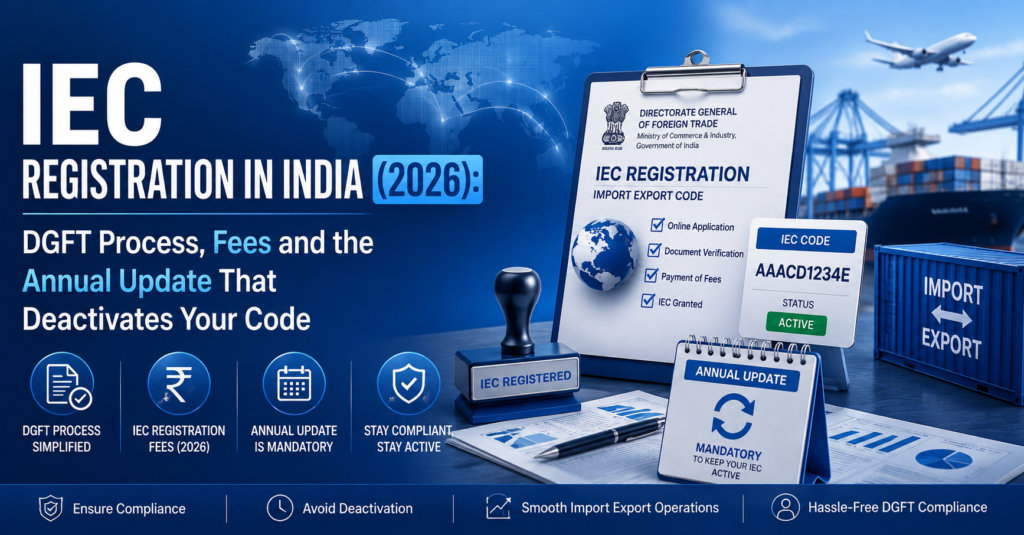
Most businesses treat the Import Export Code as a one-time formality — apply once, download the certificate, forget about it. That assumption breaks every year on 1 July, when thousands of Indian exporters discover their code has been deactivated overnight, their consignment is stuck at port accruing demurrage, and their bank will not process the trade payment. The IEC never expires. But it does switch off.
The short version
- The IEC is a 10-digit identification number issued by the Directorate General of Foreign Trade under the Foreign Trade (Development and Regulation) Act, 1992. Post-GST, your IEC number is the same as your business PAN — but having a PAN does not automatically give you IEC status; you must formally apply. TargoLegal
- The government fee is ₹500, paid once at application. The IEC is typically issued within one to three working days. RegisterKaro
- The IEC has lifetime validity and does not expire. There is no renewal fee and no expiry date on the certificate. Patron Accounting
- But: every IEC holder must complete a mandatory annual update on the DGFT portal between 1 April and 30 June each year, even if nothing about the business has changed. The confirmation itself is free. RegisterKaro
- Miss 30 June and the system automatically deactivates the code the very next day. This is not a warning and there is no grace period. Jparks
- Reactivation is possible at any time by simply completing the update — but the trade disruption in between is real and uninsured.
1. What the IEC actually is, and what it is not
The Import Export Code is a registration, not a licence. It does not authorise you to trade in any particular commodity, does not confer any incentive, and does not substitute for product-specific approvals. What it does is identify you to the customs system. Without it, a shipping bill cannot be filed against your name and a bill of entry cannot be cleared in your name.
Three practical characteristics define it:
It is PAN-linked and PAN-identical. Since the alignment with GST, the IEC number issued to you is your PAN. This has a consequence people miss: one PAN, one IEC. A company cannot hold two IECs. Additional branches, additional ports, additional product lines — all operate under the same single code.
It is entity-level, not transaction-level. You do not apply per shipment or per year. One application covers the entity for its lifetime.
It is a prerequisite, not the whole picture. Getting the IEC is step one of roughly four. Without an AD Code registered at each port and an ICEGATE registration, the IEC alone will not move a container.
A note on terminology. You will see “IEC renewal” used everywhere, including by professional firms. Strictly, there is no renewal — the code does not expire. What is mandated is an annual update on the DGFT portal between 1 April and 30 June, commonly called renewal. The distinction matters because people search for a “renewal date”, find that the certificate has no expiry, and conclude nothing is due. Something is due, every year. Patron Accounting
2. Who needs an IEC — and who genuinely does not
| Situation | IEC required? |
|---|---|
| Importing goods for commercial purposes | Yes |
| Exporting goods for commercial purposes | Yes |
| Indian subsidiary of a foreign company importing from its parent | Yes |
| Claiming export incentives (RoDTEP, duty drawback, advance authorisation) | Yes |
| Service exports, plain vanilla, receiving foreign exchange | Generally no — see below |
| Service exports where FTP benefits are claimed | Yes |
| Goods imported or exported for personal use, not connected with trade | No |
| Import/export by specified Central and State Government ministries and departments, and certain notified charitable purposes | No |
The service export position
This is the most misunderstood exemption. For basic service exports, an IEC is not mandatory simply to receive foreign exchange payments. It becomes mandatory when the service exporter claims benefits under the Foreign Trade Policy, or where the service category is notified under Section 7. In practice, most service exporters obtain an IEC anyway, to access DGFT benefits and maintain a formal trade identity. Patron Accounting
Our own view for foreign-owned Indian subsidiaries in IT, consulting and engineering services: get the IEC even if you are not obliged to. It costs ₹500, it takes three days, and it removes an argument with your bank the first time a large inward remittance needs a purpose code and supporting documentation. The friction of not having it always exceeds the cost of having it.
3. Documents you will actually need
| Document | Notes |
|---|---|
| PAN of the entity | For a proprietorship, the individual’s PAN |
| Aadhaar of the signatory | Enables Aadhaar OTP e-Sign and avoids the cost of a DSC |
| Certificate of incorporation / partnership deed / LLP agreement | As applicable to the entity type |
| Cancelled cheque or bank certificate | The account holder name must match the firm name on the PAN exactly — a mismatch here is the single most common rejection reason Trade in Bharat |
| Address proof of the premises | Electricity bill, rent agreement, sale deed, or similar. If the premises are not in the applicant’s name, an NOC from the owner |
| Photograph and identity proof of the proprietor / partners / directors | Standard |
| Digital Signature Certificate | Only if you are not using Aadhaar e-Sign |
| Board resolution authorising the signatory | For companies — not always demanded, but keep one on file |
For foreign-owned Indian companies. Two additional friction points recur. First, if your authorised signatory is a foreign national without an Aadhaar, you cannot use OTP e-Sign and must procure a Class III DSC — build in an extra week. Second, the address proof must correspond to the registered office on the MCA records. A mismatch between the DGFT address and the INC-22 address triggers queries later, particularly at the AD Code stage.
4. The application process, step by step
01. Register on the DGFT portal. Create a user account at dgft.gov.in as an “Importer/Exporter”. Verification is by OTP to the registered mobile and email. Use a company email that will still exist in three years, not an individual’s.
02. Open the IEC application (Form ANF-2A). The entire application is completed online using Form ANF-2A on the DGFT website. Vakil Search
03. Enter entity and branch details. Firm name exactly as on PAN. Nature of concern. Category of exporter. Add every branch or additional business premises you operate from — omitting a branch causes problems when you later try to register an AD Code for a port near that branch.
04. Enter proprietor / partner / director details. PAN, DIN where applicable, address, and contact details for each. These must reconcile with your MCA records.
05. Enter bank details and upload the cancelled cheque. This is where applications fail. The name on the bank account, the name on the PAN, and the firm name entered on the portal must be identical — not similar.
06. Pay the fee. ₹500, payable by net banking, debit card, credit card or UPI. An acknowledgment number is generated immediately after payment. RegisterKaro
07. Sign and submit. Authenticate using a Digital Signature Certificate or Aadhaar e-Sign; proprietors can use Aadhaar OTP. Patron Accounting
08. Download the e-IEC. The certificate is typically issued within one to three business days and is downloadable from your DGFT dashboard as a PDF. Vakil Search
5. Cost breakdown
| Item | Cost |
|---|---|
| New IEC — DGFT government fee | ₹500 (one-time, non-refundable) Patron Accounting |
| Annual update — confirmation only, no changes | Free Patron Accounting |
| Annual update — with modifications (address, bank, director) | ₹200 Patron Accounting |
| Reactivation of a deactivated IEC | Free, through the updation process Patron Accounting |
| Class III DSC, if Aadhaar e-Sign is not available | Market rate, typically ₹1,500–₹3,000 for two years |
| Professional fees | Varies |
The headline point for budgeting: the DGFT charges nothing to keep your IEC alive. Every rupee of cost associated with an IEC lapse is self-inflicted or professional.
6. The annual update rule — the part that costs people money
This is the section to read twice.
The window: 1 April to 30 June, every year. Annual IEC confirmation has been mandatory since 2021 under DGFT Notification No. 58/2015-2020. It was introduced so that business details on record stay current and the IEC database remains accurate. Jparks
It applies even if nothing has changed. Even if nothing has changed, you must log in and confirm your details. There is no “no change, no filing” exemption. Silence is treated as failure to update, not as confirmation. Trade in Bharat
It takes about five minutes. Log in to the DGFT portal, navigate to Services → IEC → IEC Annual Update, review your details, and submit. Trade in Bharat
What happens on 1 July if you did not
Your IEC status flips to “Deactivated”. This is an automatic system action by DGFT — not a warning, not a grace period. From that moment: Jparks
- Customs will not clear any import or export consignment against the code. Patron Accounting
- Banks will block international trade transactions linked to it. Patron Accounting
- RoDTEP and other incentive claims are blocked until the update is submitted. Vakil Search
- Consignments already in transit can get stuck at ports, incurring demurrage and detention. Patron Accounting
That last consequence is the expensive one. Demurrage and container detention charges at Indian ports run daily and compound quickly. A code that costs nothing to maintain can generate a five-figure or six-figure cost within a fortnight of lapsing.
Reactivation
The recovery path is straightforward, which is both the good news and the reason people are casual about the deadline. The code is deactivated, not cancelled permanently. Complete the updation on the DGFT portal — navigate to IEC Profile Management, verify or update all sections, and submit with DSC or Aadhaar e-Sign. DGFT auto-approves and the status changes to “Valid”. The updated status is then transmitted to the Customs system.Reactivation carries no government fee Jparks + 3
, and the process typically completes within a few working days. But the shipments delayed in the interim do not un-delay themselves.
The one control that prevents all of this. Put a recurring calendar entry for 1 April, owned by a named person, with a backup owner. Not “Q1 compliance” — a specific entry naming the IEC. Most lapses trace to a single point of failure: the person who used to do it left, and the DGFT reminder went to their email address. Which brings us to the next point.
7. Keep the registered email and mobile current
The DGFT portal communicates entirely through the registered email and mobile number. If those belong to a departed employee or a former consultant, you will not receive the reminder, you will not receive the deactivation notice, and — because OTP authentication routes there — you may not even be able to log in to fix it.
Auditing these contact details is a two-minute task that should sit on the same annual checklist as the update itself. For foreign-owned subsidiaries where the finance function is partly offshore, use a shared functional mailbox rather than an individual’s address.
8. What comes after the IEC
The IEC alone does not make you trade-ready. Three further registrations usually follow.
AD Code registration. Your bank issues an Authorised Dealer Code, which must be registered at each port from which you intend to ship. Register at Nhava Sheva only, and you cannot file a shipping bill at Mundra. Companies routinely discover this a day before their first consignment.
ICEGATE registration. Required for filing shipping bills and bills of entry electronically. This is the customs-facing interface and needs a DSC. Eximly
RCMC from the relevant Export Promotion Council. Not required for basic trade, but required to claim most FTP benefits and schemes. Which council depends on your product line.
LUT under GST (Form RFD-11). Exports are zero-rated. Filing a Letter of Undertaking lets you export without paying IGST upfront and then claiming a refund — a material working-capital difference. The LUT is filed annually on the GST portal at the start of each financial year. Note the overlap: the LUT and the IEC annual update both fall due in April. Handle them together.
Realistic total time to full trade-readiness, including AD Code and ICEGATE, is five to ten working days. Patron Accounting
9. Nine reasons IEC applications get rejected or delayed
- Bank account name does not exactly match the PAN name. By far the most common. “ABC Trading Co.” on the cheque and “ABC Trading Company” on the PAN is a mismatch.
- Address proof older than the accepted window, or in a name other than the applicant’s without an NOC.
- Rented premises without a valid, current rent agreement and owner’s NOC.
- Director or partner details that do not reconcile with MCA records — a resigned director still listed, or a spelling variation.
- Branch premises omitted from the application, causing an AD Code registration failure later.
- Illegible or cropped document uploads. The portal accepts them; the officer does not.
- DSC not registered on the portal, or expired, or issued to a person other than the named signatory.
- Foreign signatory without Aadhaar attempting OTP e-Sign, with no DSC procured in advance.
- Applying for a second IEC for a group entity that already holds one against the same PAN.
10. Compliance calendar for an IEC holder
| When | What | Cost |
|---|---|---|
| 1 April – 30 June | IEC annual update on DGFT portal — mandatory even with no changes | Free (₹200 if modifying) |
| Start of financial year | File LUT (Form RFD-11) on the GST portal for zero-rated exports | Free |
| Within 30 days of any change | Update IEC profile for change of address, bank account, directors, or partners | ₹200 |
| Before shipping from a new port | Register AD Code at that port | Bank/port charges |
| Annually | Renew RCMC if claiming FTP benefits | Council fee |
| Ongoing | Verify registered email and mobile on the DGFT portal remain live | Free |
11. Special notes for foreign-owned Indian companies
- The IEC belongs to the Indian entity, not the group. Your parent’s overseas trade registrations are irrelevant. The Indian subsidiary applies in its own name against its own PAN.
- Imports from the parent are related-party imports. Customs valuation rules apply, and Special Valuation Branch scrutiny is possible where the relationship is held to have influenced the price. The IEC does not cause this, but it is the point at which the relationship becomes visible to customs.
- The transaction has a tax leg too. Payments to the parent for goods, royalty embedded in imported products, or technical assistance attached to equipment supply all engage withholding obligations. Read this alongside our guide on TDS on payments to a foreign parent.
- Signatory continuity is a real risk. Where the authorised signatory is a foreign national or an expatriate on assignment, plan the handover of DSC and portal credentials before the assignment ends — not after.
12. Quick checklist
☐ PAN of the entity matches the intended firm name exactly
☐ Bank account holder name is identical to the PAN name
☐ Address proof current, and NOC obtained if premises are rented
☐ All branch premises included in the application
☐ Director/partner details reconciled with MCA records
☐ Aadhaar available for e-Sign, or Class III DSC procured and registered
☐ Registered email and mobile belong to a shared, durable mailbox
☐ ₹500 fee paid and acknowledgment number saved
☐ e-IEC downloaded and stored with the statutory records
☐ AD Code registered at every port you will ship from
☐ ICEGATE registration completed
☐ LUT filed on the GST portal for the current financial year
☐ 1 April recurring calendar reminder set, with a named owner and a backup
Setting up import or export operations in India? Delhi Legal Company handles IEC registration, AD Code and ICEGATE setup, RCMC, LUT filing and the annual DGFT update as a single managed workstream — including for foreign-owned subsidiaries where the signatory sits outside India.
13. Frequently Asked Questions
Q1. What is an IEC and who issues it?
Short answer: A 10-digit trade identification number issued by DGFT.
The Import Export Code is issued by the Directorate General of Foreign Trade under the Ministry of Commerce and Industry, governed by the Foreign Trade (Development and Regulation) Act, 1992. Post-GST, the IEC number is the same as your business PAN. It identifies you to the customs system — it is a registration, not a trading licence. TargoLegal
Q2. How much does IEC registration cost?
Short answer: ₹500 to the government, one time.
The DGFT charges ₹500 as a one-time, non-refundable government fee for a new IEC. Payment is by net banking, debit card, credit card or UPI on the DGFT portal. Using Aadhaar OTP e-Sign instead of a DSC keeps your total cost at the government fee alone. Patron AccountingRegisterKaro
Q3. How long does it take to get an IEC?
Short answer: One to three working days.
The IEC is typically issued within one to three business days after you submit Form ANF-2A and pay the fee online, and the certificate is then downloadable from your DGFT dashboard as a PDF. Full trade-readiness, including AD Code and ICEGATE registration, realistically takes five to ten working days. Vakil SearchPatron Accounting
Q4. Does an IEC expire? Do I need to renew it?
Short answer: It never expires — but it must be updated every year.
The IEC has lifetime validity and does not expire. However, DGFT mandates an annual update between 1 April and 30 June each year, and it is free when there are no changes. This is what people loosely call “IEC renewal”. Skipping it because the certificate shows no expiry date is the most expensive misreading in this area. Patron AccountingRegisterKaro
Q5. What happens if I miss the 30 June annual update deadline?
Short answer: Your IEC is deactivated automatically on 1 July.
The status flips to “Deactivated” — an automatic system action with no warning and no grace period. Customs will not clear consignments, banks will block international trade transactions, export incentives become inaccessible, and consignments in transit can get stuck at ports incurring demurrage and detention. JparksPatron Accounting
Q6. Can I reactivate a deactivated IEC, and what does it cost?
Short answer: Yes, and it is free.
The code is deactivated, not cancelled permanently. Complete the updation on the DGFT portal via IEC Profile Management, verify or update all sections, and submit with DSC or Aadhaar e-Sign. DGFT auto-approves and the status returns to “Valid”. There is no government fee for reactivation. The updated status is transmitted to the Customs system. What you cannot recover is the trade disruption during the deactivated period. Jparks + 2
Q7. Do I need an IEC to export services?
Short answer: Usually no — unless you are claiming FTP benefits.
For basic service exports, an IEC is not mandatory merely to receive foreign exchange payments. It becomes mandatory when the exporter claims benefits under the Foreign Trade Policy, or where the service category is notified under Section 7. In practice, most service exporters obtain one anyway to access DGFT benefits and maintain a formal trade identity. Patron Accounting
Q8. Is GST registration required before applying for an IEC?
Short answer: No — but you will need a GSTIN later.
GST registration is not a pre-condition for IEC issuance. However, a GSTIN is needed for customs clearance, because the customs system cross-checks the GSTIN against shipping bills and bills of entry. Plan for both rather than sequencing one behind the other. Vakil Search
Q9. Can a sole proprietor get an IEC?
Short answer: Yes, on personal PAN and Aadhaar.
A sole proprietor can apply using their personal PAN and Aadhaar; no separate legal entity is required. The IEC remains valid even if the business later converts to an LLP or company, provided DGFT is notified of the change. That notification is not optional — file the profile modification within 30 days of the conversion. Vakil Search
Q10. Can one company hold more than one IEC?
Short answer: No. One PAN, one IEC.
Because the IEC is your PAN, a single legal entity can only ever hold one code, however many branches, product lines or ports it operates across. Separate group companies with separate PANs each need their own. If you believe you need a second IEC, what you actually need is either a branch addition to the existing profile or a separate legal entity.
Q11. What is the most common reason IEC applications get rejected?
Short answer: A name mismatch between the bank account and the PAN.
The bank account holder name must exactly match the firm name on the PAN card. Not similar — identical, including punctuation and the form of “Company”, “Co.”, “Pvt Ltd” and so on. Fix this before applying rather than after rejection. Trade in Bharat
Q12. Does the annual update cost anything if my details have changed?
Short answer: ₹200 for modifications, free for a plain confirmation.
There is no government fee for the annual updation where you are simply confirming existing details. Where you are making modifications — address change, director change, bank update — ₹200 applies. Patron Accounting
Q13. My authorised signatory is a foreign national with no Aadhaar. What do we do?
Short answer: Procure a Class III DSC — and start early.
Authentication requires either a DSC or Aadhaar e-Sign; only individuals with Aadhaar can use OTP. A foreign signatory will need a Class III Digital Signature Certificate, which involves identity verification that can take longer for a non-resident. Alternatively, appoint an Indian resident director or authorised signatory for DGFT purposes — which most foreign-owned subsidiaries end up doing for the AD Code and ICEGATE steps in any event. Patron Accounting
Q14. Is the IEC enough to start importing or exporting?
Short answer: No — you also need an AD Code and ICEGATE registration.
You must register on ICEGATE for filing shipping bills and bills of entry electronically, and obtain an AD Code from your bank. The AD Code must be registered at every port you intend to ship from. Add an RCMC if you plan to claim FTP benefits, and a filed LUT on the GST portal if you want to export without paying IGST upfront. Eximly