
The 2026 Strategic Decision Guide for Overseas Investors, Founders & Legal Counsel
Every foreign company that expands into India makes hundreds of decisions — hiring, pricing, product, partners. But one decision is made first, is hardest to reverse, and silently shapes every decision that follows: which legal structure will carry your India business? Get it right, and your entity pays domestic tax rates, shields the parent’s balance sheet, and scales without regulatory friction. Get it wrong, and you may find yourself paying over ten percentage points more in corporate tax every single year, exposing the parent company to unlimited Indian liability, or — in the worst case — running commercial operations through a structure that is legally prohibited from earning a rupee.
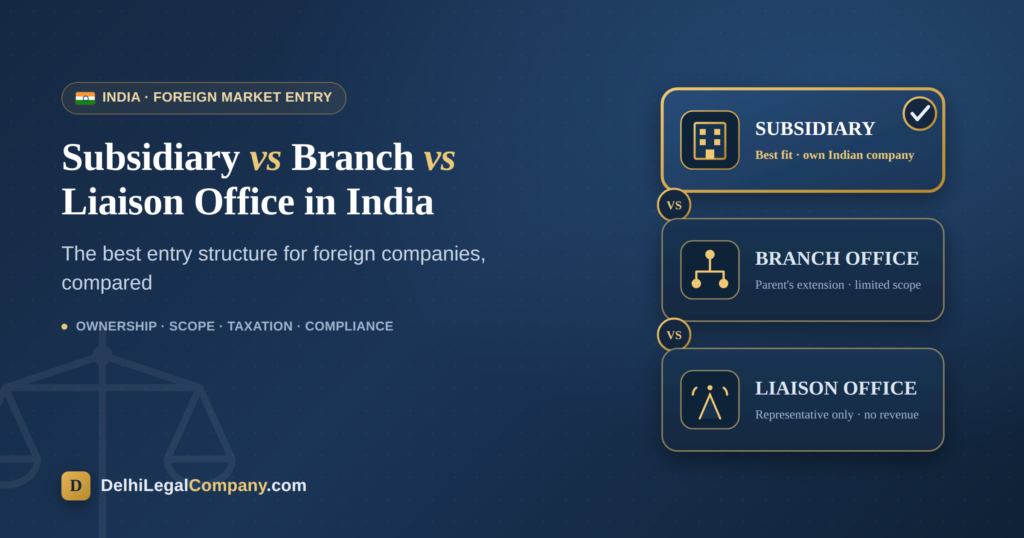
Indian law offers foreign investors three primary entry vehicles, each regulated by a different combination of the Reserve Bank of India (RBI), the Ministry of Corporate Affairs (MCA), FEMA 1999 and the Companies Act, 2013: the Wholly Owned Subsidiary (WOS) — your own Indian company; the Branch Office (BO) — an extension of the foreign parent itself; and the Liaison Office (LO) — a non-commercial representative post. They are not three flavours of the same thing. They differ in legal personality, liability, permitted activities, tax rate, approval route, compliance burden and exit — and the right choice depends entirely on what you intend to do in India and for how long. This guide examines each structure in technical detail, compares them side by side, quantifies the tax difference in real rupees, and closes with a decision framework, the mistakes we see foreign companies actually make, and answers to the questions general counsel ask us most.
The three structures in one glance
What this guide covers
- Why the entry-structure decision matters more than founders expect
- Wholly Owned Subsidiary (WOS): your own Indian company
- Branch Office (BO): the parent, operating in India
- Liaison Office (LO): the non-commercial listening post
- A note on the fourth option: the Project Office
- The comprehensive comparison matrix
- Taxation & repatriation: what CFOs must know
- Setup process, timelines & ongoing compliance
- The decision framework: which structure fits your goals
- The mistakes foreign companies actually make
- Frequently asked questions
1. Why the Entry-Structure Decision Matters More Than Founders Expect
Three consequences flow directly — and permanently — from the structure you choose on day one.
First, tax classification. The Income-tax law treats an Indian subsidiary as a domestic company, eligible for the concessional corporate regime at an effective ~25.17%. A Branch Office is taxed as a foreign company at an effective ~36.4% to 38.2%. That is not a rounding difference; on meaningful profits it is crores of rupees, every year, for as long as the structure survives.
Second, liability architecture. A subsidiary is a separate legal person — the parent’s exposure ends at its equity contribution. A Branch or Liaison Office has no separate legal personality: every contract, tax demand, employment claim and lawsuit in India attaches directly to the foreign parent company and its global balance sheet.
Third, what you are allowed to do at all. A subsidiary can carry on any lawful activity permitted under India’s FDI Policy. A Branch is confined to a closed list of eight RBI-permitted activities — with manufacturing and retail trading expressly excluded. A Liaison Office can conduct no commercial activity whatsoever. Companies that discover these boundaries after signing customer contracts discover them expensively.
Because reversing the choice later means winding up one structure and building another — with RBI closure approvals, tax clearances and business disruption in between — the structure should be matched to your three-to-five-year plan, not to this quarter’s convenience.
2. Wholly Owned Subsidiary (WOS): Your Own Indian Company
A Wholly Owned Subsidiary in India is an Indian company — almost always a Private Limited Company incorporated under the Companies Act, 2013 — in which the foreign parent holds 100% of the equity (technically, all shares but one, with a single share held by a nominee for the parent’s benefit to satisfy the two-shareholder minimum). Once incorporated, it is in every legal sense an Indian company: it contracts, invoices, hires, borrows, owns property, obtains licences and sues in its own name.
Legal status and liability
The subsidiary is a separate legal person, distinct from its parent. The parent’s liability is limited to its subscribed equity capital — Indian claims stop at the Indian entity. For any business that will sign contracts, employ people and carry commercial risk, this insulation alone often decides the question.
Permitted activities
Everything India’s Consolidated FDI Policy permits — manufacturing, software development, IT/ITeS, e-commerce (marketplace model), wholesale trading, consultancy, R&D, services of every description. In most sectors, 100% foreign ownership is allowed under the Automatic Route: no prior approval from the RBI or the government, only post-facto reporting (Form FC-GPR within 30 days of share allotment). Only sectorally capped or sensitive activities — and all investment from land-border countries under Press Note 3 of 2020 — require prior government approval.
Governance requirements
- Minimum two directors, of whom at least one must be resident in India — present in India for 182 days or more in the financial year (Section 149(3), Companies Act, 2013). The resident director need not be a citizen or a shareholder; foreign groups without local personnel routinely engage professional resident-director services.
- Minimum two shareholders — solved with the parent plus one nominee shareholder holding a single share beneficially for the parent, declared under Section 89.
- No minimum capital requirement — capitalise to the business plan, not to a statutory floor.
The tax headline: as a domestic company opting for the concessional regime under Section 115BAA, the subsidiary pays 22% base tax plus 10% surcharge plus 4% cess — an effective ~25.17%. This single classification gives the Wholly Owned Subsidiary a structural, permanent tax advantage of more than ten percentage points over a Branch Office.
3. Branch Office (BO): The Parent, Operating in India
A Branch Office is not a new company at all — it is the foreign parent itself, extended into India, operating under the parent’s name and on the parent’s balance sheet, governed by the FEMA framework (the FEM (Establishment in India of a Branch Office or a Liaison Office or a Project Office or any Other Place of Business) Regulations, 2016) and requiring prior approval routed through an Authorised Dealer Category-I bank, with the RBI’s oversight and a Unique Identification Number (UIN) issued on approval. Sensitive cases — applicants from certain jurisdictions, or activities in sectors like defence, telecom, or news media — go to the RBI/government for specific approval.
Legal status and liability
No separate legal personality. Every obligation the Branch incurs — commercial, tax, employment, tort — is an obligation of the foreign parent company directly. Indian litigation can reach the parent’s global assets. This is the structural price of the Branch, and it is paid whether or not anything ever goes wrong.
Permitted activities — the closed list of eight
A Branch may undertake only the activities the framework permits, which cover: export/import of goods; professional or consultancy services; research work in which the parent is engaged; promoting technical or financial collaborations between Indian companies and the parent group; representing the parent and acting as its buying/selling agent in India; IT and software development services; technical support for products supplied by the parent group; and operations as a foreign airline or shipping company. Two exclusions matter enormously: a Branch cannot carry out manufacturing activities (other than in an SEZ, under separate rules) and cannot engage in retail trading of any nature.
Eligibility gate
The parent must demonstrate a profit-making track record of the immediately preceding five financial years in its home country and a net worth of not less than USD 100,000 per its latest audited accounts. Younger or thinner parents can sometimes proceed with a comfort letter/guarantee from a qualifying group parent — a structuring point worth professional advice.
Taxation
The Branch is taxed in India as a foreign company: base rate 35%, plus surcharge (2% or 5% by income slab) and 4% cess — an effective 36.4% to 38.2%. Its one fiscal consolation: post-tax Branch profits can be remitted to the head office without dividend withholding tax (India levies no separate branch-remittance tax), which narrows — but nowhere near closes — the gap with the subsidiary route.
4. Liaison Office (LO): The Non-Commercial Listening Post
A Liaison Office (or representative office) exists for exactly one purpose: to be the foreign parent’s eyes, ears and voice in India — without doing business. It operates under the same FEMA 2016 framework and the same AD Category-I bank / RBI approval route as the Branch, with approval typically granted for three years at a time and renewable.
The defining restriction: zero revenue
An LO cannot earn any income in India. It cannot render billable services, issue commercial invoices, sign revenue contracts, or trade. Its entire cost base — rent, salaries, travel, everything — must be funded exclusively through inward foreign-currency remittances from the parent. Its permitted activities are correspondingly narrow: representing the parent, promoting export/import from/to India, promoting technical and financial collaborations, and acting as a communication channel between the parent and Indian parties. Market research, relationship-building, vendor coordination — yes. Commerce — never.
Eligibility and compliance
The eligibility gate is lighter than the Branch’s: a three-year profit track record and a net worth of not less than USD 50,000. Compliance centres on proving the negative every year: an Annual Activity Certificate (AAC) from a chartered accountant, filed with the AD bank/RBI (and to the tax authorities), certifying that the LO undertook only permitted activities and earned no income — alongside the ROC filings for foreign companies (Forms FC-3/FC-4) and basic registrations (PAN, TAN where applicable).
The Permanent Establishment trap: an LO that quietly drifts into commercial work — negotiating and concluding contracts, providing services, collecting payments through “workarounds” — risks being treated by the tax department as a Permanent Establishment (PE) of the foreign parent, dragging the parent’s attributable profits into Indian taxation at foreign-company rates, with interest and penalties, alongside FEMA contravention proceedings. The LO’s cheapness is real only while its discipline is real.
5. A Note on the Fourth Option: the Project Office
For completeness: where a foreign company has secured a specific contract from an Indian company — typically infrastructure, EPC or turnkey projects — it may open a Project Office (PO) to execute that project, funded by the project itself, and wound up when the project ends. The PO sits under the same FEMA 2016 framework, is generally permitted where the project is funded by inward remittance or approved financing, and is taxed as a foreign company on the project’s profits. It is a purpose-built vehicle, not a market-entry strategy — but if your India presence begins with one large contract, it is the fit-for-purpose answer, and it can later be succeeded by a subsidiary as the business broadens.
6. The Comprehensive Comparison Matrix
| Parameter | Wholly Owned Subsidiary | Branch Office (BO) | Liaison Office (LO) |
|---|---|---|---|
| Legal identity | Separate Indian legal entity (Private Limited Company) | Extension of foreign parent — no separate personality | Representative office of parent — no separate personality |
| Parent liability | Limited to equity contribution | Unlimited — attaches to the parent directly | Unlimited in law (low in practice — no commercial operations) |
| Permitted activities | Full commercial scope per FDI Policy — manufacturing, trading, services, everything lawful | Closed list of 8 RBI-permitted activities; no manufacturing, no retail trading | Liaison, representation, market research, collaboration promotion — no commercial activity at all |
| Invoicing & revenue | Yes — full local invoicing and revenue rights | Yes, within permitted activities | Strictly prohibited — 100% inward-remittance funded |
| Effective corporate tax (2026) | ~25.17% (domestic company, Sec 115BAA route) | ~36.4%–38.2% (foreign company rate) | N/A — no taxable income permitted (PE risk if breached) |
| Approval route | MCA incorporation (SPICe+); FDI under Automatic Route in most sectors — no prior approval | Prior approval via AD Category-I bank under RBI framework; UIN issued | Prior approval via AD Category-I bank; typically 3-year validity, renewable |
| Parent eligibility gate | None (any investor, subject to FDI Policy & Press Note 3) | 5-year profit track record + net worth ≥ USD 100,000 | 3-year profit track record + net worth ≥ USD 50,000 |
| Property | Can acquire real estate for business freely | Can acquire property necessary for permitted operations | Lease only (generally up to 5 years) |
| Repatriation | Dividends after withholding tax (DTAA rates typically 5–15%); buy-backs; royalties/fees | Post-tax profits remittable to head office — no dividend WHT | Nothing to repatriate; surplus returned on closure with RBI/AD approval |
| Local hiring & scale | Unlimited — full employer of record | Yes, within activity limits | Small liaison teams only |
| Exit | Share sale, strike-off or winding up | Closure via AD bank/RBI with tax clearances | Closure via AD bank/RBI with AAC trail and tax no-objection |
7. Taxation & Repatriation: What CFOs Must Know
Taxation is where the Subsidiary-vs-Branch question is usually decided, so it deserves precision.
The corporate-rate differential
An Indian subsidiary electing the concessional regime pays 22% base + 10% surcharge + 4% cess = ~25.17% effective, with no minimum alternate tax. A Branch Office, taxed as a foreign company, pays a 35% base rate, escalating with surcharge (2% above ₹1 crore of income; 5% above ₹10 crore) and 4% cess to an effective 36.4%–38.2%. On an annual profit of ₹10 crore, the Branch structure costs approximately ₹1.1–1.3 crore more in corporate tax every year than the identical business run through a subsidiary. Over a five-year plan, the structure choice alone is a ₹5–6 crore decision — before considering liability or scope.
Repatriation — the honest comparison
The Branch has one genuine fiscal advantage: its post-tax profits are remitted to the head office without any dividend withholding, since there is no dividend — just an internal transfer, cleared through the AD bank with tax documentation (Forms 15CA/CB). A subsidiary’s profits reach the parent as dividends, which suffer withholding at 20%-plus under domestic law, typically reduced to 5–15% under the applicable DTAA (with a Tax Residency Certificate and Form 10F, and subject to beneficial-ownership and principal-purpose tests). Run the combined arithmetic — corporate tax plus repatriation cost — and the subsidiary still wins for almost every operating business at almost every DTAA rate; the Branch’s withholding advantage rarely survives its ten-point corporate-rate handicap. Subsidiaries also enjoy repatriation flexibility a Branch lacks: dividends can be timed, profits reinvested at the lower rate, and value extracted through arm’s-length royalties, service fees, or buy-backs — each with its own treaty and transfer-pricing treatment.
Transfer pricing applies to everyone
Whichever structure you choose, every transaction with the parent and group affiliates — royalties, management fees, cost recharges, purchases, loans — must be at arm’s length, documented, and reported (Form 3CEB). For a Branch, the profit attribution to Indian operations is itself a transfer-pricing exercise. Budget for this compliance from day one; it is where Indian tax controversy actually lives.
8. Setup Process, Timelines & Ongoing Compliance
Wholly Owned Subsidiary
Incorporation runs through the MCA’s integrated SPICe+ filing: name reservation, incorporation with e-MOA/e-AOA, director DINs, PAN, TAN, EPFO/ESIC and bank-account initiation in one process — typically 10–15 business days once documents are ready. The real timeline driver is the notarisation and apostille of the foreign parent’s charter documents, board resolution, and directors’ KYC. Post-incorporation, the FDI clock governs: capital remitted, shares allotted within 60 days of receipt, FC-GPR filed within 30 days of allotment, commencement declaration (INC-20A) within 180 days. Ongoing: annual ROC filings (AOC-4, MGT-7), statutory audit, the RBI’s FLA return by 15 July, GST/TDS cycles, transfer-pricing documentation, four board meetings a year, and the resident-director requirement maintained continuously. End-to-end, a foreign parent should plan 4–8 weeks from engagement to a capitalised, operating subsidiary.
Branch Office and Liaison Office
Both begin with an application (Form FNC) through an AD Category-I bank, with the parent’s audited financials, incorporation documents (notarised/apostilled), banker’s report and activity description; the AD bank approves under the RBI’s delegated framework (sensitive cases go to the RBI), and a UIN is allotted. Realistic timeline: 4–8 weeks, jurisdiction and paperwork depending. Both then register with the ROC as a foreign company place of business (Form FC-1 within 30 days), obtain PAN/TAN, and file annually: the Annual Activity Certificate with the AD bank, foreign-company accounts and annual return with the ROC (Forms FC-3 and FC-4), and — for the Branch — the Indian income-tax return with audit. Closure at end of life runs back through the AD bank with tax clearances; surplus funds are repatriable on exit.
9. The Decision Framework: Which Structure Fits Your Goals?
Choose a Liaison Office if…
- You are testing the market: researching demand, meeting potential customers and partners, evaluating India before committing capital;
- Your need is coordination — supporting export/import flows with Indian vendors or buyers, without local revenue;
- You want the lowest-cost, lowest-commitment presence — and can live, with genuine discipline, inside the zero-revenue boundary.
Choose a Branch Office if…
- Your India activity falls cleanly within the eight permitted categories — typically consultancy, professional services, IT services, or technical support for the parent’s products;
- The engagement is defined and finite — specific service contracts rather than open-ended commercial expansion;
- Group policy requires operations to sit on the parent’s own balance sheet, and you accept both the unlimited-liability exposure and the foreign-company tax rate as the price of that consolidation.
Choose a Wholly Owned Subsidiary if…
- You are building a long-term commercial business: local customers, local invoicing, local hiring, vendor contracts, potentially manufacturing or retail — activities a Branch cannot touch at all;
- You want the parent’s liability ring-fenced and India risk contained in an Indian entity;
- You want the ~25.17% domestic tax rate, DTAA-optimised dividend flows, and the flexibility to raise capital, grant ESOPs, add partners or investors, and eventually exit by selling shares.
The honest pattern across hundreds of India entries: the LO is a fine first chapter, the BO is a fine special case, and the WOS is the structure roughly nine out of ten foreign companies with genuine commercial intent end up needing — either on day one, or eighteen expensive months later.
10. The Mistakes Foreign Companies Actually Make
- Running revenue through a Liaison Office. The most serious error on this page. Invoicing local clients from the parent while the LO “coordinates”, collecting fees through affiliates, or letting LO staff negotiate and conclude contracts invites FEMA contravention proceedings and Permanent Establishment taxation of the parent — the penalties routinely dwarf whatever the structure saved.
- Choosing a Branch for a business that will grow. The Branch’s activity list does not expand with your ambitions. Companies that start with consultancy and drift toward products, trading or manufacturing hit the wall — and then perform a mid-flight conversion to a subsidiary that proper planning would have avoided.
- Ignoring the tax delta because “we’ll restructure later”. Every year of Branch operation donates ~11 extra points of profit to the exchequer, and the eventual conversion (new incorporation, business transfer, closure approvals, tax clearances) has its own cost and tax friction. Later is expensive.
- Forgetting the resident director and the two-shareholder rule. A subsidiary needs at least one India-resident director at all times and a second (nominee) shareholder — plan both before incorporation, not during it.
- Missing the FEMA reporting clocks. FC-GPR within 30 days of allotment, FLA by 15 July, AAC annually for BO/LO, FC-3/FC-4 at the ROC. These small filings are the documentation trail every future remittance, audit and exit will be checked against.
- Structuring around Press Note 3 instead of through it. Investment from — or beneficially owned in — countries sharing a land border with India requires prior government approval regardless of structure or sector. Screen the ownership chain first; discovering it after the wire transfer means unwinding, not amending.
Frequently Asked Questions (FAQ)
Q1. Can a foreign company own 100% of an Indian subsidiary?
Yes. Under the Automatic Route of India’s Consolidated FDI Policy, 100% foreign equity is permitted in most sectors — IT, SaaS, manufacturing, consulting, wholesale trading, e-commerce marketplaces and more — without prior government approval, subject only to post-facto RBI reporting (Form FC-GPR). Sectorally capped activities and all investment from land-border countries (Press Note 3 of 2020) require prior approval. The two-shareholder minimum is met by the parent plus one nominee shareholder holding a single share for the parent’s benefit.
Q2. Does an Indian subsidiary need a local resident director?
Yes. Under Section 149(3) of the Companies Act, 2013, every Indian company must have at least one director who has stayed in India for 182 days or more during the financial year. The resident director need not be an Indian citizen or a shareholder, and foreign groups without local personnel commonly engage professional resident-director services — a solution Delhi Legal Company provides alongside nominee shareholder and registered office support.
Q3. How long does it take to set up each structure?
A Wholly Owned Subsidiary is typically incorporated through the MCA’s SPICe+ portal in 10–15 business days once documents are apostilled, with 4–8 weeks realistic end-to-end including capitalisation and FDI reporting. A Branch Office or Liaison Office requires prior approval through an AD Category-I bank under the RBI framework, typically taking 4–8 weeks, followed by ROC registration as a foreign company (Form FC-1) and tax registrations.
Q4. What are the eligibility conditions for a Branch Office and a Liaison Office?
A Branch Office requires the foreign parent to show a profit-making track record for the immediately preceding five financial years and a net worth of at least USD 100,000. A Liaison Office requires a three-year profit track record and net worth of at least USD 50,000. Parents that fall short can sometimes proceed with a guarantee or letter of comfort from a qualifying group company, subject to the AD bank’s and RBI’s acceptance.
Q5. Can a Liaison Office be converted into a Wholly Owned Subsidiary?
There is no direct statutory conversion. The standard path is to incorporate a new subsidiary under the Companies Act, transition people, premises and relationships to it, and then close the Liaison Office through the AD bank/RBI with the accumulated Annual Activity Certificates and tax no-objection in order. Many companies deliberately run this sequence — LO for research, WOS for commerce — as a planned two-stage entry.
Q6. Why is a Branch Office taxed so much more heavily than a subsidiary?
Because the Income-tax law classifies the Branch as a foreign company (base rate 35%, effective ~36.4%–38.2% with surcharge and cess), while a subsidiary is a domestic company eligible for the concessional regime (~25.17% effective). The Branch’s partial offset is that post-tax profits remit to the head office without dividend withholding, but on combined arithmetic — corporate tax plus repatriation cost — the subsidiary is cheaper for almost every operating business, especially where a favourable DTAA reduces dividend withholding to 5–15%.
Q7. Can a Branch Office do manufacturing or retail trading in India?
No. Manufacturing (outside SEZ-specific rules) and retail trading of any nature are expressly outside a Branch Office’s permitted activities, which are confined to a closed list of eight categories including export/import, consultancy and professional services, IT services, research, and technical support for the parent’s products. A business with manufacturing or retail ambitions needs a Wholly Owned Subsidiary from the outset.
Q8. What compliance filings do a Branch and Liaison Office have each year?
Both must file an Annual Activity Certificate (certified by a chartered accountant) through the AD bank, foreign-company accounts and annual return with the ROC in Forms FC-3 and FC-4, and maintain PAN/TAN registrations; a Branch additionally files an Indian income-tax return with audit and complies with transfer-pricing documentation for its dealings with the head office. Notably, pending FC-3/FC-4 defaults were among the forms covered by the MCA’s CCFS-2026 amnesty — a reminder that these filings are actively enforced.
Q9. What is the Permanent Establishment (PE) risk with a Liaison Office?
If an LO crosses its non-commercial boundary — negotiating or concluding contracts, delivering services, or functioning as the parent’s sales arm — the Indian tax authorities can treat it as a Permanent Establishment of the foreign parent, taxing the parent’s attributable Indian profits at foreign-company rates with interest and penalties, alongside FEMA contravention action. The protection is operational discipline: documented activity limits, trained staff, and an accurate Annual Activity Certificate every year.
Q10. Which structure should a foreign startup or SaaS company choose for India?
Almost always a Wholly Owned Subsidiary. SaaS and technology sectors permit 100% FDI under the Automatic Route; the subsidiary can invoice Indian customers, hire engineering and sales teams, grant ESOPs, sign local contracts and raise capital — none of which fits a Liaison Office, and only fragments of which fit a Branch. Combined with the ~25.17% domestic tax rate and limited parent liability, the WOS is the default answer, with the LO reserved for genuine pre-commitment market research.
Conclusion
Strip the regulation away and the three structures answer three different intentions. The Liaison Office says: we are looking. The Branch Office says: we are here for this defined work, on our own balance sheet. The Wholly Owned Subsidiary says: we are building an Indian business. The law, the tax code and the RBI’s framework all reward matching the structure to the true intention — and punish, with real money and real liability, every mismatch between what an entity is licensed to be and what it actually does.
For the roughly nine out of ten foreign companies whose intention is sustained commercial presence — revenue, hiring, contracts, scale — the Wholly Owned Subsidiary is the vehicle: fully capable, liability-insulated, and taxed at ~25.17% instead of ~37%. The Liaison Office remains the right low-cost first chapter for genuine market exploration, and the Branch the right special case for defined services within its eight-activity fence. Decide against your three-to-five-year plan, screen the ownership chain for Press Note 3, respect the FEMA clocks — and your India entry starts on a foundation that will not need rebuilding.
Plan Your India Market Entry with Delhi Legal Company
Delhi Legal Company provides end-to-end market-entry support for foreign companies and investors — structure selection and tax modelling (Subsidiary vs Branch vs Liaison), complete Wholly Owned Subsidiary incorporation with nominee shareholder, resident director and registered office, RBI/AD-bank approvals for Branch and Liaison Offices, FEMA and FDI reporting (FC-GPR, FLA, AAC, FC-3/FC-4), and the full ongoing accounting, payroll, GST and ROC compliance calendar — one accountable partner in India, from the first structuring call to every filing after.
☎ +91-9599332456 ✉ info@delhilegalcompany.com 🌐 delhilegalcompany.com