
Step-by-Step Guide to Forming a Foreign Company in India (2026)
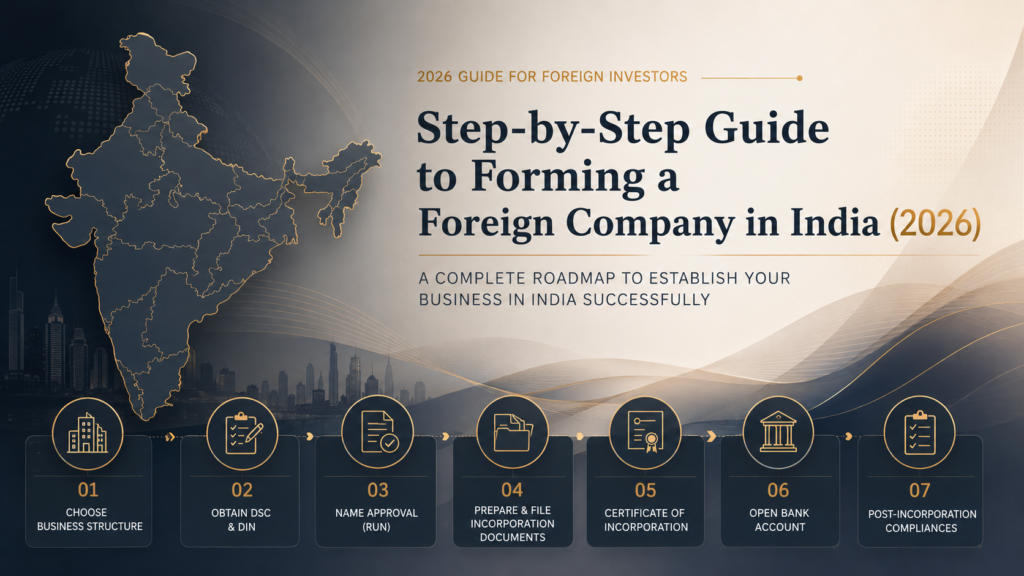
Written by the Delhi Legal Company India Entry & FDI Advisory team · Last updated August 2026 · Reviewed quarterly against MCA, RBI and DPIIT notifications
Introduction
The Ministry of Corporate Affairs will approve a company in a few working days. Most foreign-owned incorporations still take six to ten weeks.
The gap is not the Registrar. It is a notary in Frankfurt, an apostille office in London, a certified translator in Tokyo, a resident director who has not been found yet, and a bank running KYC on a parent company it has never heard of. Every one of those sits on the critical path, and none of them is inside your control once the clock starts.
That is why this guide is written as a project plan rather than a list of forms. It sets out what runs in parallel, what blocks what, where the deadlines are genuinely fixed, and which mistakes cost you a restart rather than a week.
It also separates two things most guides merge. Incorporating an Indian subsidiary and registering a foreign company’s place of business in India are different legal acts, with different forms, different regulators and different obligations. If you are doing the second and reading instructions for the first, you will file the wrong thing.
Before you begin, the structure question must be settled. If it is still open, work through our guide to business structures in India for foreign companies first. Everything below assumes the decision is made.
About this guide
Delhi Legal Company works exclusively with foreign companies establishing and operating in India. The sequencing, timings and failure points below reflect what we see across market-entry mandates, not a reading of the rules alone.
Where a rule is settled, we state it and cite the authority. Where a figure moves — government fees scale with authorised capital, apostille turnaround varies by country, stamp duty differs by state — we say so rather than quote a number that ages badly. Where something is genuinely fact-dependent, we describe the test rather than pretend there is a universal answer.
Primary sources: the Ministry of Corporate Affairs for the Companies Act, 2013, SPICe+ and foreign company filings; the Reserve Bank of India for FEMA, the branch, liaison and project office framework and FDI reporting; and DPIIT for the Consolidated FDI Policy and Press Notes.
Two routes, two entirely different processes
Read this section before anything else. Choosing the wrong lane wastes weeks and produces filings that do not apply to you.
| Route A — Incorporate an Indian company | Route B — Register the foreign company’s place of business | |
|---|---|---|
| What you are creating | A new Indian legal person | An Indian presence of the existing overseas company |
| Structures | Wholly owned subsidiary, joint venture, LLP | Branch office, liaison office, project office |
| Primary regulator | Registrar of Companies, MCA | Authorised dealer bank, with RBI in specified cases |
| Main filing | SPICe+ on the MCA portal | Application through the AD bank, then Form FC-1 with the Registrar |
| Capital | Equity subscribed by the foreign parent, reported on FC-GPR | Funded by inward remittance from head office |
| Tax status | Domestic company | Foreign company |
| Indicative timeline | 6–10 weeks realistically | 8–14 weeks |
| Ongoing MCA filings | AOC-4, MGT-7, board and statutory records | FC-3 and FC-4 as applicable |
| Suits | Long-term operating business | Representation, permitted branch activity, or one defined project |
Sections 1 to 8 cover Route A, because it is what most foreign investors need. Route B is set out in full in section 9.
1. Phase 0 — Before the clock starts
Six things must be settled before a single form is opened. Skipping any of them is what turns a four-week plan into a three-month one.
1.1 Confirm the FDI position for your sector
Three questions, in order.
Is the activity permitted? Foreign direct investment is prohibited in lottery business, gambling and betting, chit funds, Nidhi companies, trading in transferable development rights, real estate business or construction of farmhouses, tobacco manufacturing, and sectors closed to private investment.
The real estate prohibition is narrower than it reads. It targets dealing in land and immovable property with a view to earning profit. It does not extend to development of townships, construction of residential or commercial premises, roads or bridges, educational institutions, recreational facilities, city and regional infrastructure, real estate broking, SEBI-registered REITs, or earning rent or lease income not amounting to a transfer.
What is the cap, and which route applies? Most sectors permit 100% under the automatic route with no prior approval. Some carry caps requiring an Indian partner. Some require government approval through the administrative ministry. Caps also move — the FDI limit in insurance was raised from 74% to 100%, subject to the entire premium being invested domestically. Check the current Consolidated FDI Policy rather than a secondary summary.
Are there performance conditions? Some sectors attach minimum capitalisation, local sourcing or lock-in conditions. These affect your capital planning and sometimes your choice of vehicle — an LLP, for example, is only available under the automatic route where the sector permits 100% FDI with no FDI-linked performance conditions.
1.2 Map beneficial ownership against Press Note 3
Where an investor, or the beneficial owner of the investment, is connected with a country sharing a land border with India, Press Note 3 requires the government approval route — in any sector, regardless of the sectoral position.
Three things groups get wrong here:
- It is not limited to the name on the immediate shareholder register. Beneficial ownership anywhere up the chain can trigger it.
- It captures transfers of existing holdings that result in such ownership, not only fresh investment.
- The approval timeline is materially longer than the automatic route, and it is not a formality.
For any structure with more than one layer above the Indian entity, or with fund investors, draw the ownership chart to ultimate beneficial owners before committing to a go-live date. Discovering this at funding stage is a closing problem no amount of drafting fixes.
1.3 Find your resident director now
Under Section 149(3) of the Companies Act, 2013, at least one director must stay in India for a total of not less than 182 days during the financial year. For a newly incorporated company, the requirement applies proportionately at the end of the financial year in which the company is incorporated.
Note the tense. The test looks at the current financial year. A number of published guides — including some that rank well — still say “the previous financial year.” That is a pre-2018 position and cannot logically apply to a company that did not exist last year. If a checklist tells you the test looks backwards, it has not been updated since 2018 and you should treat the rest of it with the same caution.
Finding a qualified Indian resident willing to serve as director takes time, and the search should begin four to six weeks before the planned incorporation date.
Two practical points. First, the person needs a DIN, which itself depends on attested documents. Second, the role carries statutory liability under the Companies Act for the company’s filings and conduct — this is not a name added to satisfy a form. Where the group has nobody in India, this is met through resident director services, with the arrangement properly documented and indemnified.
1.4 Check director and shareholder nationality
Where a proposed director is a national of a country sharing a land border with India, security clearance from the Ministry of Home Affairs is required before a Director Identification Number can be issued, and that clearance must accompany the consent to act.
This is separate from, and additional to, the Press Note 3 analysis on the investment itself. One concerns who can direct the company; the other concerns whose money can come in. A structure can clear one and fail the other. Both need to be in the timeline from day one, because both are approval processes rather than filings.
1.5 Secure the registered office address
You need a genuine Indian address capable of receiving and acknowledging communications, supported by consistent documents. Options include leased premises, a serviced office, or a registered office address service.
The address also determines which Registrar of Companies handles your file and which state’s stamp duty applies to the incorporation documents. Both vary. If you have a genuine choice of state, this is worth a conversation before you sign a lease.
1.6 Plan the capital structure
Two numbers matter and they are frequently confused.
Authorised capital is the ceiling on what the company may issue. MCA government fees scale with it, so an unnecessarily high figure costs money at incorporation for no benefit.
Paid-up capital is what shareholders actually subscribe. There is no universal statutory minimum, which is not the same as saying a token amount is sensible. Paid-up capital is what your bank sees, what a landlord sees, and what funds the first six months before revenue.
Some sectors impose minimum capitalisation as an FDI condition. Check that in step 1.1 rather than after filing.
1.7 Choose and clear your name
Company names must not be identical or too closely resembling an existing company or LLP name, must not be undesirable in the opinion of the Central Government, and must not infringe a registered trademark.
That last point catches groups who assume MCA approval gives them brand rights. It does not. Company name approval and trademark registration are separate systems with separate registers. If the name is also your brand, run a clearance search before reserving it — see trademark search and advisory and, once cleared, trademark registration.
Prepare at least two names you would genuinely accept, not one preference and one filler.
2. Phase 1 — Documents: the actual critical path
Document preparation is frequently the most time-consuming part of the registration process, particularly for foreign entities unfamiliar with Indian attestation and apostille requirements.
Start here. Everything else waits on this.
2.1 The attestation chain
Every document originating outside India must be notarised by a public notary in the country of origin, then apostilled if the country is a party to the Hague Convention or consularised if it is not, and translated into English by a certified translator where it is not already in English.
Three separate steps, three separate providers, and each with its own queue.
| Step | What happens | Typical constraint |
|---|---|---|
| 1. Notarisation | A public notary in the country of origin certifies the document or the signature on it | Usually quick, but the notary must be one whose seal the apostille authority recognises |
| 2. Apostille (Hague countries) | A designated authority attaches a single apostille certificate | Turnaround varies from same-day to several weeks by country |
| 2. Consularisation (non-Hague countries) | Attestation by the local foreign ministry, then by the Indian embassy or consulate | Two sequential government queues; substantially slower |
| 3. Translation | Certified translation into English where the original is not in English | Must be done after attestation, on the attested document |
Build this chain backwards from your target incorporation date, not forwards from today. If your parent is incorporated in a non-Hague jurisdiction, add several weeks and confirm the embassy’s current turnaround before you promise anyone a date.
2.2 Documents from the foreign parent company
| Document | Purpose | Watch for |
|---|---|---|
| Certificate of incorporation | Proves the parent exists and is the entity subscribing | Name must match exactly across every document and the SPICe+ entry |
| Memorandum and articles of association, or equivalent charter documents | Establishes the parent’s capacity to hold shares abroad | Some jurisdictions issue these in a form that needs explanation; prepare a covering note |
| Board resolution authorising the Indian incorporation | Authorises the investment and names the authorised representative | Must name the representative, state the shareholding to be subscribed, and be dated before the filing |
| Power of attorney | Empowers the person handling the incorporation in India | Scope should cover signing, filing, responding to queries and receiving communications |
All of these must be notarised and apostilled, or consularised for non-Hague countries.
2.3 Documents from each foreign director and shareholder
| Document | Notes |
|---|---|
| Passport, attested | Mandatory for foreign nationals; must be current |
| Proof of address, attested | Utility bill or bank statement; must be recent and must match the address entered on the forms |
| Form DIR-2, consent to act as director | Signed by the individual, dated on or before appointment |
| Affidavit confirming the person is not disqualified | Covers the statutory disqualifications under the Companies Act |
| Specimen signature | Used for banking and MCA verification |
| Passport-size photograph | Standard requirement |
The single most common defect here is an address mismatch: the utility bill says one thing, the passport says another, and the form says a third. Reconcile all three before attestation, because correcting it afterwards means starting the attestation chain again.
2.4 Documents for the registered office
- No-objection certificate from the property owner
- Rent or lease agreement
- Recent utility bill for the premises
These three must be consistent in their address details and current, generally within two months. An address written slightly differently across the three — “Plot 42” on one, “42” on another, a missing sector number on the third — is a routine cause of resubmission.
2.5 Run the workstreams in parallel
Two document tracks are independent of each other and are prepared by different people in different places:
- Track 1: the parent company’s corporate documents, prepared by the company secretary or corporate counsel at head office
- Track 2: each individual director’s personal documents, prepared by that individual
Running them sequentially is the single most common reason a six-week plan becomes ten. Start both on the same day, and appoint one person to chase both.
3. Phase 2 — Digital identity
India’s incorporation process is entirely paperless. Nothing can be filed until the signatories can sign electronically.
3.1 Digital Signature Certificate
Because the process is paperless, every director needs a DSC to sign the incorporation forms. A Class III DSC is issued by a licensed certifying authority against verified identity documents.
For a non-resident director, verification relies on the attested and apostilled documents produced in Phase 1. In practice, DSC issuance is often the point at which a document defect first surfaces — which is useful, because it surfaces before the filing rather than after a Registrar query.
Two planning points. DSCs have a validity period, usually one or two years, and expire quietly; track the expiry from day one, because an expired DSC will stop an annual filing years later. And each DSC is tied to one individual, not to the company — when a director resigns, the company does not inherit anything.
3.2 Director Identification Number
Each director needs a DIN. For first-time directors at incorporation, the DIN application is integrated into the SPICe+ form itself for up to three directors. Where a DIN is needed for additional directors, a separate DIR-3 form must be filed.
This is a useful design constraint. If your board will have four or more directors at incorporation, plan the additional DIR-3 filings into the schedule rather than discovering the limit mid-process. A common workaround is to incorporate with three directors and appoint the rest immediately afterwards through DIR-12, which is often faster overall.
A DIN is permanent and personal. It follows the individual across companies and continues to exist after they resign, which is why the annual KYC obligation attaches to the DIN rather than to any directorship.
3.3 MCA portal registration
Registration on the MCA portal is a pre-filing step for foreign promoters, directors and authorised representatives, and is required to access and submit incorporation forms. The DSC is linked to the portal account at this stage.
Do this before the name reservation, not alongside it. A portal or DSC linkage problem discovered during a live 20-day name window costs days you do not have.
4. Phase 3 — Name reservation
File Part A of SPICe+ with your proposed names in order of preference, together with the proposed objects in brief.
4.1 The 20-day trap
This is where the most expensive timing mistake happens. The name reservation is valid for only 20 days. If the apostilled documents are not ready within that window, the name lapses and you must re-apply.
Reserving early feels like progress. It is usually a false start, because the reservation clock runs whether or not your documents are moving. The practical rule: do not reserve the name until the attested documents are physically in hand, or verifiably within days of arrival.
If a name does lapse, you can re-apply for the same name, but you are back in the queue and there is no guarantee it is still available.
4.2 Why names get rejected
| Reason | How to avoid it |
|---|---|
| Too similar to an existing company or LLP | Search the MCA name availability database and the LLP register before filing; minor differences in spacing, plurals or word order do not make a name distinct |
| Conflicts with a registered trademark | Run a trademark search across relevant classes; MCA checks this and objects |
| Contains restricted words | Words implying government patronage, or connection with a regulator or international body, require specific approval |
| Name does not reflect the objects | Where the name suggests a specific activity, the objects clause must support it and sectoral approval may be needed |
| Generic or purely descriptive | A name consisting only of a description of the activity is likely to be treated as undesirable |
Submit two genuine options. A filler second choice wastes the application when the first is rejected.
5. Phase 4 — The incorporation filing
SPICe+ Part B carries the substance. It is a single-window filing: alongside incorporation itself it covers name reservation, DIN allotment, PAN, TAN and the associated registrations — in practice including GSTIN, EPFO and ESIC registration, bank account opening and professional tax registration in certain states.
5.1 What is filed with it
| Form | What it is | Where it goes wrong |
|---|---|---|
| SPICe+ Part B | Core incorporation: directors, subscribers, capital, registered office | Name and address mismatches against the attested documents |
| eMoA (INC-33) | Memorandum of association, setting out the objects | Objects drafted too narrowly for planned activity |
| eAoA (INC-34) | Articles of association, the internal governance rules | Standard articles adopted where the group needs bespoke rights |
| AGILE-PRO-S (INC-35) | Linked registrations: GSTIN, EPFO, ESIC, bank account, professional tax | Registrations selected that are not yet needed, creating early compliance obligations |
| INC-9 | Declaration by subscribers and first directors | Auto-generated, but fails if any linked detail is inconsistent |
5.2 Drafting the objects clause
The objects clause deserves more attention than it usually gets, because amending it later requires a shareholder special resolution and a filing.
Draft it to cover what the business will do in years one to three, not just at launch. A software company that expects to add professional services, then hardware distribution, then training, should say so. Objects that are too narrow create a problem at exactly the moment the business is growing.
The opposite failure also exists. Objects so broad that they touch regulated activity — financial services, insurance, education — can attract queries or trigger sectoral requirements you did not intend. Aim for a clause that covers the real business plan and stops there.
5.3 Articles of association: do not default
Standard articles work for a straightforward wholly owned subsidiary. They do not work where the group needs specific arrangements: reserved matters requiring parent consent, restrictions on share transfers, board composition rights, or provisions for a future investor.
For a joint venture, the articles must align with the shareholders’ agreement. Where the two conflict, the articles generally prevail as against the company, which is why a well-drafted shareholders’ agreement is routinely reflected in the articles rather than left standing alone. See joint venture company services.
5.4 Certificate of incorporation
On approval, the Registrar issues the certificate of incorporation with the Corporate Identity Number, and PAN and TAN are allotted.
The company now legally exists. It cannot yet trade. That distinction is the subject of section 7.
6. Phase 5 — Bank account and capital infusion
This is the longest dependency chain after attestation, and the one most schedules underestimate.
6.1 Why the account takes longer than expected
Although account opening is initiated through AGILE-PRO-S, activating a corporate account for a foreign-owned company involves separate KYC on the foreign parent and its beneficial owners — a process the bank runs on its own timetable, not the Registrar’s.
Banks vary considerably. Some have dedicated foreign-investment desks and move in days; others treat it as an exception and take weeks. Where the parent sits in a jurisdiction the bank considers higher risk, enhanced due diligence adds further time.
Engage the bank in Phase 1, not after incorporation. Ask what they need from the parent and start assembling it alongside the attestation chain.
6.2 The chain that follows
Each of these depends on the one before it:
- Bank account activated
- Capital remitted by the foreign parent into that account
- Foreign Inward Remittance Certificate and KYC obtained from the AD bank
- Shares allotted by the board
- FC-GPR filed within 30 days of allotment
- Share certificates issued
A delay at step 1 pushes everything, including a statutory deadline at step 5. This is why the bank belongs in the earliest planning conversation.
6.3 Pricing and valuation
Issue of shares to a non-resident is subject to pricing guidelines under FEMA. Where a valuation certificate is required, obtain it before allotment rather than while the FC-GPR clock is running. Getting the sequence wrong here is a common source of last-minute pressure on the 30-day window.
7. Phase 6 — What must happen after incorporation
Most guides stop at the certificate. This is where foreign-owned companies actually get into trouble, because several statutory clocks start on the date of incorporation and nobody is watching them.
| Deadline | Obligation | Form | Consequence of missing it |
|---|---|---|---|
| 30 days from incorporation | First board meeting | Minutes and statutory records | Non-compliance under the Companies Act; blocks other actions requiring a board resolution |
| 30 days from incorporation | Appointment of first statutory auditor by the board | Board resolution; ADT-1 as applicable | If the board fails, members must appoint within 90 days at an extraordinary general meeting |
| 30 days from incorporation | Registered office in place and verified with the Registrar | INC-22 | The Registrar may act to strike the company off the register |
| 30 days from share allotment | Report the issue of shares to a non-resident | FC-GPR | Contravention of FEMA reporting requirements |
| 2 months from incorporation | Issue share certificates to subscribers | Share certificates, stamped as applicable | Penalty exposure; practical difficulty evidencing shareholding |
| 180 days from incorporation | Declaration of commencement of business, confirming subscribers have paid for their shares | INC-20A | The company cannot commence business or exercise borrowing powers |
7.1 The FC-GPR trap
The 30 days run from allotment of shares — not from the investment decision, not from the date funds arrived.
The window passes quickly, especially when coordinating across time zones. Meanwhile the supporting file has to be assembled: the foreign inward remittance certificate and KYC from the AD bank, a valuation certificate where required, a company secretary’s certificate, and the board resolution.
Open the file on the day of allotment. See FC-GPR, FC-TRS and RBI documentation and FEMA compliance and FDI reporting.
7.2 The statutory records nobody sets up
From incorporation, the company must maintain statutory registers — members, directors and key managerial personnel, charges, and contracts in which directors are interested — along with minute books for board and general meetings.
These are not optional and they are examined in any diligence exercise. A company that reconstructs three years of minutes on the eve of a transaction is a company with a diligence problem. Set them up in month one. See maintaining statutory registers and board resolutions and minutes.
7.3 Dematerialisation
Private companies other than small companies must facilitate dematerialisation of their securities and issue and transfer them only in demat form.
For a foreign-owned subsidiary this matters at the moment of a corporate action — a share transfer, bonus issue, rights issue or buy-back. It must be in place before that action, not arranged in response to it. Establish the position early rather than discovering it during a transaction.
8. Phase 7 — Operational registrations
Not all of these apply to every business. Work through the list against your actual activity rather than registering for everything, because each registration creates its own ongoing filing obligation.
| Registration | When it applies | Note |
|---|---|---|
| GST registration | On crossing turnover thresholds; immediately for inter-state supply, e-commerce and certain categories | Initiated through AGILE-PRO-S but activated separately |
| Import Export Code | Any import or export of goods; service exporters claiming FTP benefits | Requires an annual update between April and June or the code is deactivated |
| EPFO and ESIC | On crossing employee thresholds | Registered through incorporation, activated when hiring begins |
| Professional tax | State-specific | Both employer registration and employee deduction |
| Shops and establishment registration | State-specific, for the premises | Usually required before hiring |
| FSSAI licence | Food business operators | Basic, State or Central depending on scale |
| Pollution and fire approvals | Manufacturing and certain premises | Consent to establish before consent to operate |
| Sectoral licences | Regulated sectors | Check before incorporation, not after |
9. Route B — Registering a foreign company’s place of business
If you are establishing a branch, liaison or project office rather than incorporating an Indian company, the process differs from the first step.
9.1 Application through an authorised dealer bank
Applications are generally made through a bank designated as an authorised dealer by the RBI, under the FEMA framework for establishment of a place of business in India.
Prior RBI approval is required in specified cases, including where:
- the applicant’s principal business is in defence, telecom, private security or information and broadcasting, and the requisite approval from the relevant Ministry or sectoral regulator has not already been obtained;
- the applicant is a citizen of, or registered or incorporated in, Bangladesh, Sri Lanka, Afghanistan, Iran, China, Hong Kong or Macau, or the application relates to Jammu and Kashmir, the north-east region, or the Andaman and Nicobar Islands;
- the applicant is a non-government organisation or not-for-profit not registered under the Foreign Contribution (Regulation) Act, 2010.
Applications by foreign banks go directly to the RBI; by foreign insurance companies, to IRDAI.
9.2 Documents
The key documents include the parent company’s certificate of incorporation, memorandum and articles of association, board resolution, power of attorney, a bank reference letter, and audited financial statements, typically for the last three years. All must be notarised and apostilled. For a project office, a copy of the underlying project contract is also required.
Two items surprise applicants working from a subsidiary checklist: the audited financial statements and the bank reference letter. Neither is required for Route A, and both take time to obtain from a parent that has never needed them for this purpose.
The audited accounts also serve a substantive purpose. The AD bank assesses the applicant’s track record and net worth, so a newly formed overseas holding company with no trading history is a materially harder application than an established operating parent.
9.3 Form FC-1 with the Registrar
Once approval is obtained and the place of business is established, the foreign company files Form FC-1 with the Registrar of Companies, accompanied by the approval letter and the parent’s charter documents.
This is the step most published guides omit entirely, because they treat “foreign company registration” as a synonym for subsidiary incorporation. It is not. A foreign company with a place of business in India has its own MCA identity and its own continuing filing obligations, running through Form FC-3 for accounts and Form FC-4 for the annual return, as applicable.
9.4 Tax registration and the Annual Activity Certificate
The office obtains a PAN and files an Indian income tax return — a liaison office does so even though it earns nothing. An Annual Activity Certificate from a chartered accountant is filed with the AD bank and the tax authority.
The position for project offices differs from branch and liaison offices; confirm the specific requirement with your AD bank rather than assuming it is identical.
9.5 What each office can and cannot do
| Liaison office | Branch office | Project office | |
|---|---|---|---|
| Can earn Indian income | No | Yes, within permitted activities | Project revenue only |
| Can manufacture | No | Only in an SEZ, subject to conditions | Project-specific |
| Funded by | Inward remittance only | Inward remittance and permitted revenue | Project funding per the approved route |
| Duration | Defined period, renewable | Ongoing, subject to approval | Tied to the project |
| Tax status | No revenue to tax, but files returns | Foreign company rates | Foreign company rates |
Detail on each is in our service pages for branch office, liaison office and project office setup.
Planning an India entry?
The difference between a six-week and a twelve-week entry is almost always sequencing, not law. Tell us your target go-live date and we will work backwards to a document schedule, tell you what to start this week, and flag anything in your ownership chart or director list that needs approval before you commit.
10. Three worked timelines
The same process produces very different durations depending on three variables: the parent’s jurisdiction, whether an approval is needed, and how early the resident director and bank were engaged.
Scenario A — UK parent, IT services, automatic route
| Week | Activity |
|---|---|
| 1–2 | FDI position confirmed. Resident director search begins. Bank engaged, parent KYC pack requested. Parent and director documents sent for notarisation. |
| 2–3 | Apostille obtained (UK is a Hague country, turnaround short). Registered office documents assembled. |
| 3–4 | DSCs issued. MCA portal accounts created. Resident director confirmed. |
| 4 | Name reserved — documents already in hand. |
| 5–6 | SPICe+ Part B filed. Certificate of incorporation issued. PAN and TAN allotted. |
| 6–8 | Bank account activated. Capital remitted. Shares allotted. FC-GPR filed. |
| Total | About 8 weeks |
Scenario B — Japanese parent, manufacturing, automatic route
Same sequence, but translation of Japanese-language corporate documents adds a step after attestation, and the parent’s internal board approval cycle runs monthly rather than on demand.
Total: about 10 to 12 weeks, with the constraint sitting entirely in Phase 1.
Scenario C — Investor with beneficial ownership in a land-border country
Press Note 3 applies, so the government approval route is required before the investment can proceed. Phases 0 and 1 run in parallel with the approval application, but no capital can come in until approval is granted.
Total: indeterminate, and materially longer. The incorporation itself may complete on the normal timeline, but the company cannot be funded. This is why beneficial ownership belongs in week one, not at closing.
11. Costs
| Item | Basis |
|---|---|
| MCA government fees | Scale with authorised capital |
| Stamp duty on MoA and AoA | State-specific; varies significantly |
| DSC per director | Higher for non-residents |
| Notarisation | Country of origin rates |
| Apostille or consularisation | Country-specific; consularisation costs more and takes longer |
| Certified translation | Per page, where documents are not in English |
| Professional fees | Incorporation, drafting, FEMA reporting |
| Resident director service | Annual, where provided |
| Registered office service | Annual, where provided |
An all-in figure in the region of ₹60,000 to ₹1,25,000 for a foreign-owned private limited company is a reasonable planning range, with government fees scaling by authorised capital. Country-specific attestation and translation costs sit outside that and can exceed the Indian fees where the parent is in a non-Hague jurisdiction.
The more consequential number is what comes after. The recurring compliance calendar starts immediately — corporate income tax, GST where thresholds are crossed, payroll obligations and recurring MCA filings — so budget for a company secretary or accountant from day one. Many groups use virtual CFO services rather than building an India finance function in year one.
12. The compliance calendar that starts on day one
Incorporation is the beginning of an obligation, not the end of a project. A foreign-owned Indian company carries four overlapping calendars.
| Calendar | Principal items |
|---|---|
| MCA and Companies Act | Four board meetings a year with no more than 120 days between consecutive meetings; annual general meeting; AOC-4 and MGT-7; DPT-3 where there is a parent loan; statutory registers; director KYC |
| Income tax | Advance tax quarterly; tax audit where applicable; income tax return; TDS deposits and quarterly returns; Form 3CEB where there are transactions with the parent |
| GST | Monthly or quarterly returns; annual return and reconciliation where thresholds are crossed; reverse charge on services imported from the parent |
| FEMA and RBI | FC-GPR on allotment; FC-TRS on transfers; the annual FLA return by 15 July; ECB reporting where there is a parent loan |
Two of these are routinely missed by foreign-owned companies specifically. Reverse charge GST on management fees and software recharged by the parent, because no invoice bearing Indian GST ever arrives. And the FLA return, which sits with the RBI rather than the tax authority or the MCA, and therefore falls between advisors. Give both a named owner in month one.
13. Twelve mistakes that cost a restart
- Reserving the name before documents are apostilled. The reservation lasts 20 days; if the documents are not ready, the name lapses and you re-apply.
- Starting the resident director search after incorporation is planned. Begin four to six weeks earlier.
- Relying on a checklist that says “previous financial year” for the 182-day residence test. The test looks at the current year, applied proportionately for a new company.
- Inconsistent registered office documents. The NOC, rent agreement and utility bill must match on address and be current.
- Running document workstreams sequentially. Parent corporate documents and individual director documents are independent. Run them together.
- Discovering Press Note 3 at funding stage. Beneficial ownership runs up the chain and the approval route is materially slower.
- Engaging the bank after incorporation. KYC on the foreign parent is a serial dependency for capital infusion, allotment and FC-GPR.
- Missing FC-GPR’s 30 days, which run from allotment, not from receipt of funds.
- Drafting a narrow objects clause that does not cover year two and three activity.
- Adopting standard articles where the group needs reserved matters, transfer restrictions or board rights.
- Setting authorised capital far above what is needed, increasing government fees for no benefit.
- Treating the resident director as a formality. The role carries statutory liability under the Companies Act.
14. Pre-incorporation checklist
- Structure decided and FDI route confirmed for the sector
- Sectoral cap, entry route and performance conditions checked against the current policy
- Beneficial ownership chart drawn to ultimate owners and reviewed against Press Note 3
- Resident director identified, consent obtained, DIN route planned
- Director nationalities checked for MHA clearance requirement
- Registered office secured, with NOC, agreement and utility bill consistent and current
- Authorised and paid-up capital planned; sectoral minimum capitalisation checked
- Two genuine name options checked against the MCA register and against trademarks
- Parent documents notarised, apostilled or consularised, and translated
- Director documents attested: passport, address proof, DIR-2, affidavit, specimen signature, photograph
- Bank engaged and parent KYC underway
- DSCs issued for all signatories and linked to MCA portal accounts
- Objects clause drafted for planned activity, not just launch activity
- Articles reviewed against any shareholders’ arrangement
- Post-incorporation deadlines diarised: first board meeting, first auditor, INC-22, share certificates, FC-GPR, INC-20A
- Named owner assigned for the FLA return and for reverse charge GST
15. Frequently asked questions
Q1. How long does it take to register a foreign-owned company in India?
Plan for six to ten weeks to a trading company. The incorporation filing itself takes two to four weeks, but notarisation, apostille and translation of foreign documents add one to four weeks before it, and bank account activation with KYC on the foreign parent adds two to four weeks after. Document preparation, not the Registrar, controls the timeline.
Q2. Do I need to visit India to incorporate a company?
No. The incorporation process is entirely online through the MCA portal. Foreign directors sign electronically using a Digital Signature Certificate, and documents are executed abroad, notarised, apostilled or consularised, and submitted digitally. You will need an Indian resident director and a registered office address, but the foreign promoters do not need to travel.
Q3. Can a foreign company own 100% of an Indian company?
Yes, in most sectors, under the automatic route with no prior government approval. Some sectors carry caps requiring an Indian partner, some require government approval, and a short list is prohibited. Separately, where an investor or beneficial owner is connected with a country sharing a land border with India, Press Note 3 requires the government route in any sector.
Q4. What documents does the foreign parent company need to provide?
The certificate of incorporation, memorandum and articles of association or equivalent charter documents, a board resolution authorising the Indian incorporation and naming the authorised representative, and a power of attorney. All must be notarised in the country of origin and apostilled for Hague Convention countries, or consularised for non-Hague countries, and translated into English if not already in English.
Q5. What is the difference between apostille and consularisation?
Both authenticate a document for use abroad. An apostille is a single certificate issued by a designated authority in countries party to the Hague Convention. Consularisation, or legalisation, applies to non-Hague countries and requires attestation by the local foreign ministry and then by the Indian embassy or consulate. Consularisation involves two sequential government queues and takes considerably longer.
Q6. Do I need an Indian resident director?
Yes. Under Section 149(3) of the Companies Act, 2013, at least one director must stay in India for a total of not less than 182 days during the financial year. For a newly incorporated company, the requirement applies proportionately at the end of the financial year of incorporation. The test looks at the current financial year, not the previous one.
Q7. How long is the SPICe+ name reservation valid?
Twenty days. This is the most common timing failure in foreign incorporations: applicants reserve a name early to feel like progress is being made, then find the apostilled documents are not ready in time and the reservation lapses. Reserve the name only when the attested documents are in hand or verifiably days away.
Q8. How many directors can get a DIN through SPICe+?
Up to three. For first-time directors at incorporation, the DIN application is integrated into the SPICe+ form for a maximum of three directors. Where additional directors need a DIN, a separate DIR-3 must be filed. A common alternative is to incorporate with three directors and appoint the rest immediately afterwards through DIR-12.
Q9. What is Form FC-1 and when do I file it?
Form FC-1 is filed with the Registrar of Companies by a foreign company that has established a place of business in India, such as a branch, liaison or project office. It follows the AD bank or RBI approval and is accompanied by the approval letter and the parent’s charter documents. It does not apply where you are incorporating an Indian subsidiary.
Q10. When must I file FC-GPR after receiving foreign investment?
Within 30 days of allotment of shares to the non-resident. The clock runs from allotment, not from the date funds were received or the investment decision was taken. The supporting file includes the foreign inward remittance certificate and KYC from the AD bank, a valuation certificate where required, a company secretary’s certificate and the board resolution.
Q11. What happens if I miss the 180-day commencement declaration?
A company with share capital cannot commence business or exercise borrowing powers until the declaration is filed with the Registrar confirming that every subscriber has paid for the shares taken. Missing it does not dissolve the company, but it leaves the company legally unable to trade and attracts penalty exposure for the company and its officers.
Q12. What must happen within 30 days of incorporation?
Three things. The first board meeting must be held. The board must appoint the first statutory auditor, failing which members must do so within 90 days at an extraordinary general meeting. And the registered office must be in place and verified with the Registrar through INC-22, failing which the Registrar may act to strike the company off.
Q13. Our proposed director is a Chinese national. Does that block incorporation?
No, but it adds a step. Where a proposed director is a national of a country sharing a land border with India, security clearance from the Ministry of Home Affairs is required before a Director Identification Number can be issued, and that clearance must accompany the consent to act. Press Note 3 may separately apply to the investment itself. Build both into the timeline.
Q14. How much authorised capital should we register?
Only what you need, because MCA government fees scale with authorised capital. Authorised capital is the ceiling on what the company may issue; paid-up capital is what shareholders actually subscribe. There is no universal statutory minimum for paid-up capital, though some sectors impose minimum capitalisation as an FDI condition, and a token amount will not satisfy banks or landlords.
Q15. What does it cost to register a foreign-owned company in India?
A planning range of roughly ₹60,000 to ₹1,25,000 covers government fees, stamp duty, digital signature certificates and professional fees for a foreign-owned private limited company, with MCA fees scaling by authorised capital. Notarisation, apostille or consularisation and translation costs sit outside that and vary substantially by country, sometimes exceeding the Indian fees.
Q16. Can I hire employees in India before the company is incorporated?
Not through the company, which does not yet exist. An employer of record can place staff within one to two weeks with no incorporation, which suits a market test. Two limits apply: you cannot invoice Indian customers through that arrangement, and it does not by itself eliminate permanent establishment risk for the foreign parent. What the staff actually do decides the tax analysis.
Q17. Does company name approval give us trademark rights?
No. Company name approval at the MCA and trademark registration are separate systems with separate registers. A name can be approved by the Registrar and still infringe an existing trademark, and an approved company name gives no exclusive right to use it as a brand. Run a trademark clearance search before reserving the name if the two are the same.
Q18. Should I register a subsidiary or a branch office?
That is a structure decision to take before starting either process, because the two follow entirely different routes and regulators. A subsidiary is a new Indian company taxed as a domestic company; a branch is the foreign company operating directly, taxed at higher foreign-company rates with the parent exposed. A branch application also requires audited parent accounts and a bank reference letter, which a subsidiary does not.
- Growth through innovation/creativity:
Rather than be constrained by ideas for new products, services and new markets coming from just a few people, a Thinking Corporation can tap into the employees. - Increased profits:
The corporation will experience an increase in profits due to savings in operating costs as well as sales from new products, services and ventures.
- Higher business values:
The link between profits and business value means that the moment a corporation creates a new sustainable level of profit, the business value is adjusted accordingly. - Lower staff turnover:
This, combined with the culture that must exist for innovation and creativity to flourish, means that new employees will be attracted to the organization.