
Written by the Delhi Legal Company India Entry & FDI Advisory team · Last updated August 2026 · Reviewed quarterly against Finance Act amendments, CBDT notifications and RBI circulars
Introduction
Getting money into India is a one-week problem. Getting it out is a five-year design decision.
Most foreign parents think about repatriation for the first time when the Indian subsidiary becomes profitable. By then the intercompany agreements are signed, the capital structure is fixed, the accumulated profits sit in reserves, and the routes that were cheap to build three years ago now require restructuring to open.
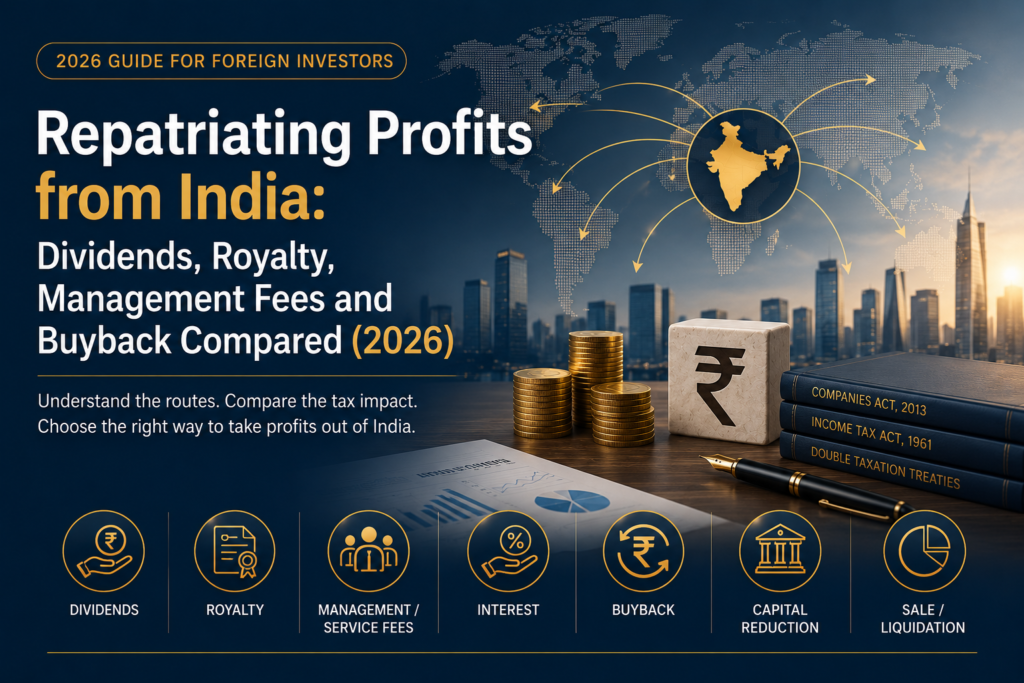
The routes themselves are not complicated. A subsidiary can pay a dividend, a royalty, a service fee or interest; it can buy back its shares, reduce capital, or be sold or wound up. What makes this difficult is that each route carries a different tax rate, a different treaty article, a different set of corporate-law preconditions and a different FEMA position — and the cheapest route on tax is frequently the one your company law position does not permit.
Buyback illustrates the point uncomfortably well. The tax treatment of an identical transaction has changed twice in under two years. A company that planned a buyback in 2024, executed it in 2025 and is considering another in 2026 has faced three different regimes for the same transaction.
This guide compares every route, sets out what each one actually costs, explains the corporate-law and FEMA preconditions, and works through how to choose. It is written for the finance lead of a foreign-owned Indian company deciding how to get cash to the parent.
About this guide
Delhi Legal Company works exclusively with foreign companies establishing and operating in India. Repatriation sits at the intersection of three of our workstreams — corporate tax, withholding and FEMA — and it is the area where advice given in isolation most often produces a plan that cannot actually be executed.
Where a rule is settled we state it and cite the source. Where a position has changed recently — and buyback has changed twice — we set out each regime and the date it applied from, because the treatment of your transaction depends entirely on when it happens.
Where an outcome depends on your specific treaty, we say so rather than quoting a rate that may not be yours.
Primary sources: the Income Tax Department for rates, sections and forms; the Reserve Bank of India for FEMA, pricing guidelines and remittance requirements; and the Ministry of Corporate Affairs for the Companies Act preconditions that decide whether a route is available at all.
1. The seven routes at a glance
| Route | Tax character | Indian tax cost | Main precondition |
|---|---|---|---|
| Dividend | Dividend income of the shareholder | Domestic rate, or treaty rate where lower | Distributable profits available under the Companies Act |
| Royalty | Royalty income of the parent | 20% domestic, effective 20.8% or 21.84%; treaty commonly 10–15% | Genuine IP licensed, arm’s length rate, FEMA conditions |
| Management or service fee | Fees for technical services, or business profits | 20% domestic, effective 20.8% or 21.84%; treaty may reduce or eliminate | Services genuinely rendered, benefit evidenced, arm’s length pricing |
| Interest | Interest income of the lender | Concessional rates available on certain foreign-currency borrowing; treaty commonly 10–15% | ECB framework compliance |
| Buyback | Capital gains from Tax Year 2026-27; deemed dividend for buybacks between 1 Oct 2024 and 31 Mar 2026 | Depends entirely on the regime applicable to the date | Companies Act limits and conditions; FEMA pricing |
| Capital reduction | Deemed dividend to the extent of accumulated profits, with capital gains on the balance | Split treatment | Tribunal-approved scheme |
| Share sale or liquidation | Capital gains | Treaty may allocate taxing rights to the residence state | Buyer, or a formal winding-up process |
Two observations before the detail.
The recurring routes and the exit routes are different problems. Dividend, royalty, fees and interest move cash annually while the business continues. Buyback, capital reduction, sale and liquidation move capital, usually once. Most groups need both, designed together.
Deductibility changes the real cost. A dividend is paid out of taxed profits. A royalty or service fee is generally deductible in computing the Indian company’s income, so the group compares the withholding cost against the Indian corporate tax saved. That comparison, not the headline withholding rate, is the actual arithmetic.
2. Dividend
The most straightforward route, and usually the default.
2.1 How it is taxed
Dividend distribution tax was abolished from April 2020. Dividends are now taxable in the shareholder’s hands, with the Indian company withholding at the applicable rate.
For a non-resident corporate shareholder, the domestic withholding rate applies unless the applicable treaty provides a lower rate. Treaty rates commonly sit between 5% and 15%, and several treaties apply a reduced rate where the recipient holds a specified minimum percentage of the capital.
Under a number of treaties, the lower rate applies where at least 25% of the capital is owned by the beneficial owner of the company paying the dividend, and in some cases where that holding has been maintained for at least six months before the date of payment.
That holding-period condition is worth checking before declaring. A shareholding restructured shortly before a dividend can fall outside the reduced rate for reasons that are entirely avoidable with three months’ notice.
2.2 The corporate-law precondition
This is where dividends fail more often than on tax.
A dividend may generally be paid only out of profits for the year, or out of undistributed profits of previous years after providing for depreciation, or out of accumulated profits transferred to free reserves subject to conditions.
Three constraints follow:
- A company cannot pay dividends out of reserves other than free reserves
- Carried-over losses and unprovided depreciation must be set off first
- Securities premium and capital reserves are not available for distribution
A subsidiary that raised significant share capital and has been loss-making for three years may have substantial cash and no distributable profits at all. The cash is in the bank; the route is closed. That is the single most common repatriation disappointment for foreign-owned companies.
2.3 The FEMA position
Under FEMA, dividends are freely repatriable outside India without restriction, net of applicable tax deducted at source. There is no approval requirement and no cap.
This makes dividend the cleanest route from an exchange-control perspective. The friction is entirely in company law and tax, not in FEMA.
2.4 Where dividend wins and loses
| Wins where | Loses where |
|---|---|
| The company has accumulated distributable profits | The company has cash but no distributable profits |
| The treaty gives a low rate with a satisfied holding condition | The treaty rate is at the higher end and no relief applies |
| Simplicity and FEMA certainty matter | The group needs a deduction in India against Indian taxable income |
| There is no defensible commercial basis for a fee or royalty | Genuine services or IP exist that could be charged for instead |
3. Royalty
Where the parent owns intellectual property the Indian company genuinely uses, a royalty is a legitimate and deductible payment.
3.1 The rate
The tax rate for royalties and fees for technical services under domestic law is 20%, increased by surcharge at 2% or 5% on the income tax depending on taxable income, and health and education cess of 4% on the income tax including surcharge, giving an effective rate of 20.8% or 21.84%.
Treaty rates for royalty commonly sit between 10% and 15%. A tax resident can use either the treaty rate or the domestic rate, whichever is more beneficial.
Note that this domestic rate is below the rate applicable to business profits of a foreign company. Royalty is not a punitive category; it is a lower-rate, gross-basis category. What makes it expensive is the absence of deductions against it, not the rate.
3.2 What has to be true
A royalty is a payment for the use of something. Three tests have to hold.
The IP must exist and be owned by the payee. Registered trade marks, patents, or clearly documented know-how. A royalty for “the brand” where no trade mark has ever been registered or licensed is a weak position — see trademark registration and brand licensing agreements.
The Indian company must actually use it. Under licence, in its business, in a way that can be demonstrated.
The rate must be arm’s length. Benchmarked, documented, and consistent with what an unrelated licensee would pay. This is a transfer pricing exercise — see our guide to transfer pricing for Indian subsidiaries of foreign companies.
The agreement itself needs to be drafted for both regimes at once, since the tax characterisation and the FEMA position both turn on its terms — see royalty agreements and technology licensing agreements.
3.3 The deduction that changes the arithmetic
A royalty is generally deductible in computing the Indian company’s taxable income. That is what makes the comparison against dividend non-obvious.
Our corporate tax team models this alongside the withholding position. A dividend of a given amount comes out of profits already taxed in India at the corporate rate. A royalty of the same amount reduces Indian taxable income by that amount, saving Indian corporate tax, while attracting withholding at the treaty or domestic royalty rate.
Whether that nets out in the group’s favour depends on the Indian corporate rate, the applicable royalty withholding rate, and how the parent’s home jurisdiction taxes the receipt and credits Indian tax. It is an arithmetic question with a specific answer for each group, and it is worth actually computing rather than assuming.
4. Management and service fees
The most commonly used route and the most commonly challenged.
4.1 The rate, and the treaty question that precedes it
The domestic rate for fees for technical services is the same as for royalty — 20%, with an effective rate of 20.8% or 21.84% after surcharge and cess.
But for service fees the rate is often the second question. The first is whether India can tax the payment at all.
Several Indian treaties tax fees for technical or included services only where the service makes available technical knowledge, experience, skill, know-how or processes to the recipient, such that the recipient can apply them independently in future. Routine finance, HR or IT support from a parent to its subsidiary frequently does not make anything available.
Where that condition is not satisfied and the parent has no permanent establishment in India, the payment may fall to be treated as business profits taxable only in the residence state. Our guide to TDS on payments to your foreign parent works through the analysis.
This is the single largest available relief in intra-group service arrangements, and the one most often lost because the service agreement was never drafted with it in mind.
4.2 What the assessment tests
Service fees attract more scrutiny than any other route, and the questions are consistent:
| Question | What answers it |
|---|---|
| Were services actually rendered? | Deliverables, correspondence, meeting records, reports — kept as they were produced |
| Did the Indian company benefit? | Evidence that the service met a need the Indian company had |
| Is the allocation key defensible? | The workings, and a stated reason for choosing headcount over revenue or whatever basis was used |
| Does it duplicate what India already does? | Organisation charts showing the functions do not overlap |
| Is it shareholder activity? | Group reporting, consolidation and investor relations are for the parent’s benefit and are not chargeable |
| Is the mark-up arm’s length? | Benchmarking documentation |
The shareholder activity point catches groups regularly. Time spent by head office consolidating the Indian numbers, preparing group management reporting or satisfying the parent’s own investors is not a service to the subsidiary. Including it in the recharge weakens the whole claim.
4.3 Reimbursements are a different transaction
A genuine reimbursement of a third-party cost, at cost, with no mark-up and no service element, is often not chargeable to tax at all. The file must contain the third-party invoice, the allocation basis, and evidence that nothing was added.
A recharge with a 5% administration uplift is not a reimbursement. It is a service fee, and reporting it as a reimbursement is one of the more visible mismatches in a remittance file.
5. Interest on shareholder funding
Where the parent lends rather than subscribes, interest is a deductible payment out of India.
5.1 The tax position
Concessional rates are available on interest paid on certain foreign-currency borrowings, subject to conditions and to the agreement date. Treaty rates for interest commonly sit between 10% and 15%, and several treaties provide relief where the loan is granted by a bank or financial institution.
5.2 The regulatory layer that decides availability
A shareholder loan from a foreign parent is almost always an external commercial borrowing, and the ECB framework governs whether it can be made at all.
Conditions apply to the eligible lender, the eligible borrower, the minimum average maturity, the all-in-cost ceiling and the permitted end-use. A loan that is attractive on tax but non-compliant on ECB is not a saving; it is a contravention.
The reporting is also continuous rather than one-off. An ECB carries a Loan Registration Number and monthly returns filed through the authorised dealer bank. Groups that structured a shareholder loan two years ago and forgot the ongoing reporting are a recurring pattern — see FEMA compliance and FDI reporting.
5.3 Where interest fits
Interest suits a group that is funding an Indian build-out and wants the funding to be repayable, deductible and finite. It suits a mature profitable subsidiary less well, because the ECB conditions constrain the structure and the deduction is limited to a commercially defensible rate on a commercially defensible principal.
6. Buyback: three regimes in under two years
This is the route where published guidance is most likely to be wrong, because the position has flipped twice. The treatment of your buyback depends entirely on when the payment is received.
6.1 Regime 1 — up to 30 September 2024
Before 1 October 2024, Section 115QA made the company liable for buyback distribution tax at an effective rate of 23.296% — 20% plus 12% surcharge plus 4% cess — while shareholders received proceeds tax-free under Section 10(34A).
The tax sat with the company. The shareholder received the money clean, with no capital gains consequence.
6.2 Regime 2 — 1 October 2024 to 31 March 2026
The Finance (No. 2) Act, 2024 made a fundamental change effective 1 October 2024. The buyback tax at company level was abolished, and the tax burden was shifted entirely to the shareholder, using the deemed dividend route.
The mechanics were harsh:
- The entire proceeds received on buyback were taxable as dividend under the head income from other sources — the amount was no longer restricted to accumulated profits available with the company.
- No deduction could be claimed by shareholders against buyback proceeds taxed as deemed dividend, so the dividend income was taxable on a gross basis without any deduction.
- The cost of acquisition survived as a capital loss, which could be carried forward for eight years and set off against future capital gains.
- The company was required to deduct tax at source — for non-resident shareholders, at the rates in force, subject to the applicable treaty.
The practical effect for a foreign parent was that a buyback became, in substance, a dividend — taxed on the full amount received with no credit for what was originally invested, and with the invested cost recoverable only as a capital loss against future capital gains that might never arise.
6.3 Regime 3 — from Tax Year 2026-27
Budget 2026, enacted via Finance Act 2026, reversed the 2024 deemed dividend characterisation and restored capital gains treatment for buybacks.
Pursuant to the Finance Act 2026, consideration received by shareholders on buyback of shares will not be treated as dividend income from tax year 2026-27 onwards.
Capital gains treatment restores the position that most groups assumed applied all along: tax on the gain, not on the gross proceeds, with the cost of acquisition deductible.
For unlisted company buybacks from April 2026, the long-term capital gains holding threshold is 24 months, not 12.
6.4 What this means practically
| Buyback payment received | Treatment | Effect on a foreign parent |
|---|---|---|
| Up to 30 Sept 2024 | Company paid distribution tax; shareholder exempt | Clean receipt, tax borne in India by the company |
| 1 Oct 2024 – 31 Mar 2026 | Gross proceeds deemed dividend in shareholder’s hands, no cost deduction | Expensive; capital invested recoverable only as a carried-forward capital loss |
| From 1 Apr 2026 | Capital gains, cost deductible | Restored to the position most groups expect; treaty capital gains article becomes relevant again |
Three consequences for anyone planning now.
Check the date on any advice you are reading. Guidance written between late 2024 and early 2026 describes the deemed dividend regime accurately for its period and incorrectly for yours.
If you executed a buyback in the middle window, the treatment is fixed. The restoration is prospective. A 2025 buyback remains a deemed dividend transaction with a carried-forward capital loss, and that loss should be tracked.
The treaty capital gains article matters again. Under capital gains treatment, whether India can tax the gain at all depends on the applicable treaty’s capital gains article. Under the deemed dividend regime that question did not arise, because the payment was a dividend. It now does.
6.5 The corporate-law and FEMA conditions
Tax is only one gate. A buyback must also satisfy the Companies Act conditions, approved and minuted through proper board resolutions, which include limits on the proportion of paid-up capital and free reserves that may be used, a debt-to-capital condition after the buyback, restrictions on frequency, and a requirement that the shares bought back be extinguished.
On the FEMA side, the price at which shares are bought back from a non-resident is subject to pricing guidelines, and the transaction is reportable. A buyback priced above what the guidelines permit is not a tax problem; it is an exchange-control one.
7. Capital reduction
A reduction of share capital returns capital to shareholders, and it is the route groups look at when a buyback is unavailable because the Companies Act conditions cannot be met.
The tax treatment is split. To the extent the company has accumulated profits, the distribution is treated as a deemed dividend. The balance is treated as consideration for the extinguishment of shares, giving rise to capital gains.
Prior to the Finance Act, 2024, a capital reduction was deemed to be dividend income of the shareholders while a buyback was taxed at company level, so the two routes had different implications; the 2024 amendment aligned them by treating buyback proceeds at par with capital reduction. The 2026 restoration of capital gains treatment for buyback has separated them again.
The practical constraint on capital reduction is procedural rather than fiscal. It requires a Tribunal-approved scheme, with creditor protection, notice periods and a hearing. That is months, not weeks, and it is visible.
Where it fits: a subsidiary that is over-capitalised relative to its business, with limited accumulated profits, where the group wants to return capital rather than distribute earnings.
8. Share sale and liquidation
8.1 Sale of shares
The cleanest exit. The foreign parent sells its shares to a third party and receives the consideration outside India, subject to capital gains.
Three things determine the cost. The holding period, which fixes whether the gain is long-term or short-term. The applicable treaty’s capital gains article, which under several treaties allocates taxing rights to the residence state, though anti-abuse provisions and limitation on benefits articles need checking. And FEMA pricing guidelines, which set a floor or ceiling on the price at which shares may transfer between a resident and a non-resident.
The transfer is reportable on FC-TRS within the prescribed period — see FC-GPR, FC-TRS and RBI documentation.
8.2 Liquidation
On winding up, distributions to shareholders are treated as deemed dividend to the extent of accumulated profits, with the balance treated as consideration for capital gains purposes.
Liquidation is slow, involves the Tribunal or the voluntary liquidation process, requires all liabilities to be settled and tax clearances obtained, and typically takes considerably longer than groups expect. It is an exit route, not a repatriation strategy.
9. The mechanics common to every route
Whichever route you use, the same operational sequence applies before money leaves India.
9.1 The treaty file
To access a treaty rate, the payee needs:
- A Tax Residency Certificate from its home tax authority, covering the relevant period
- Form 10F, filed electronically on the Indian income tax portal
- A no-permanent-establishment declaration, where relevant
- A beneficial ownership declaration, particularly for dividend, royalty and interest articles
The TRC must cover the payment date. An expired TRC is no TRC, and the consequence of applying a treaty rate without one falls on the Indian payer, not the foreign recipient.
9.2 PAN, or the alternative
Where the PAN of the deductee is not quoted, the rate of withholding will be the rate specified in the relevant provisions, the rates in force, or 20%, whichever is higher.
Relief from that higher rate is available where the payee furnishes the prescribed alternative details, including name, address in the country of residence, tax identification number and the TRC. Collect these at onboarding, not at the point of remittance.
9.3 The remittance forms
The remitter’s declaration and, above the prescribed threshold, a chartered accountant’s certificate must be filed before the bank will release funds. These forms have been renumbered under the Income-tax Act, 2025 framework; confirm the current form numbers before filing.
The bank will not process an outward remittance without the acknowledgement. That is why the tax workflow has to start when the payment is approved, not when treasury schedules the transfer.
9.4 The FEMA layer
| Route | FEMA position |
|---|---|
| Dividend | Freely repatriable, net of tax deducted at source |
| Royalty | Permitted subject to the applicable conditions on the licence and the payment |
| Service fee | Permitted against a genuine service arrangement documented through properly drafted agreements, with the purpose code applied correctly |
| Interest | Governed by the ECB framework, with continuing reporting |
| Buyback | Pricing guidelines apply; reportable |
| Capital reduction | Follows the approved scheme; reportable |
| Share sale | Pricing guidelines apply; FC-TRS reporting within the prescribed period |
10. Choosing between the routes
Work through these in order. The first three are gates, not preferences.
Gate 1: What does company law permit?
Are there distributable profits? Do the buyback conditions hold? Is a Tribunal scheme realistic in the time available? These questions are answered from the statutory accounts and the annual ROC filings, not from the bank balance.
A group with no distributable profits cannot pay a dividend however attractive the treaty rate. This is the constraint that eliminates the preferred option most often, and it is knowable a year in advance.
Gate 2: Is there a genuine commercial basis?
A royalty requires IP that exists, is owned by the payee and is used by the Indian company. A service fee requires services genuinely rendered with demonstrable benefit. Interest requires a loan that complies with ECB.
Manufacturing a commercial basis to justify a payment route is the most expensive mistake in this area, because it fails on both transfer pricing and withholding simultaneously, in every year it was used.
Gate 3: What does FEMA allow?
Pricing guidelines, ECB conditions, reporting obligations. A structure that is tax-efficient and FEMA non-compliant is not a structure.
Then: what is the group’s net cost?
Only now does the arithmetic matter, and it has four components:
- Indian withholding at the treaty or domestic rate
- Indian corporate tax saved, where the payment is deductible
- Home-country tax on the receipt
- Foreign tax credit available for the Indian tax
A route that is cheapest on Indian withholding can be the most expensive on a group basis if the home jurisdiction taxes the receipt without allowing credit. Model it at group level, with your home tax advisor, before designing the arrangement.
11. A practical repatriation architecture
Most established foreign-owned Indian subsidiaries end up with a combination rather than a single route, and the combination is more defensible than any one route used to excess.
| Layer | Route | Rationale |
|---|---|---|
| Recurring, tied to genuine IP | Royalty at an arm’s length rate | Deductible, benchmarked, supportable year on year |
| Recurring, tied to genuine services | Service fee with documented benefit | Deductible; treaty may reduce or eliminate Indian tax |
| Periodic, from accumulated earnings | Dividend | Clean FEMA position; uses profits that have already borne Indian tax |
| Funding phase | Interest on compliant ECB | Deductible and repayable while the business is building |
| Capital return, when needed | Buyback or capital reduction | Where cash exceeds what the business needs and distributable profits are limited |
| Exit | Share sale | Treaty capital gains article may allocate taxing rights to the residence state |
The design principle is that each payment has an independent commercial justification. A group taking a royalty, a service fee and a dividend, each supportable on its own terms, is in a stronger position than a group extracting the same total through one inflated charge.
12. Three groups, three answers
The same question — how do we get cash to the parent — produces different answers depending on what the Indian entity actually is.
Scenario A — The profitable captive services subsidiary
A UK group’s Indian entity provides software development to overseas group customers. Seven years old, consistently profitable, substantial accumulated reserves, no meaningful IP of its own, no Indian customers.
What is open. Dividend is clean — the reserves exist and FEMA is straightforward. A management fee for genuine group services is available if there is anything real to charge for, though the direction of service here is largely the other way. Royalty is weak: the parent’s IP is not what the Indian entity is monetising.
What we would look at. The transfer pricing margin first. A captive services entity earning a cost-plus margin is already remitting most of its value through its billing, and the residual is a genuine profit that a dividend distributes cleanly. Check whether the treaty gives a reduced dividend rate on a minimum holding, and whether that holding condition has been continuously satisfied.
What would be a mistake. Introducing a large royalty to the parent to reduce Indian tax, where the Indian entity’s revenue comes from its own delivery rather than from the parent’s IP. That fails on transfer pricing and invites an adjustment across several years.
Scenario B — The distribution subsidiary with brand and no reserves
A German manufacturer’s Indian entity distributes its products domestically. Four years old, growing, marginally profitable after years of investment, significant accumulated losses carried forward. Sells under the parent’s global brand.
What is closed. Dividend. Losses must be set off before profits become distributable, and on current trajectory that is two or three years away.
What is open. Royalty for the brand, provided the trade mark is registered in India and properly licensed, at a benchmarked rate. A service fee for genuine parent support. Interest, if the funding was structured as compliant ECB rather than equity.
What we would look at. Whether the brand licence exists at all. Many groups have been using the parent’s brand in India for years without a written licence, which means the royalty has no foundation and cannot simply be started retrospectively. Registering and licensing the mark now opens the route prospectively.
What would be a mistake. Waiting until the losses are absorbed and then relying entirely on dividend. The royalty route, if built now, is deductible and reduces the Indian tax on the profits that will emerge.
Scenario C — The over-capitalised subsidiary after a strategy change
A Japanese group capitalised its Indian subsidiary heavily for a manufacturing plan that was subsequently shelved. The entity now runs a modest services business, holds significant surplus cash from the original subscription, and has limited accumulated profits.
What is closed. Dividend, largely — the cash is subscribed capital, not earnings, and distributable profits are small.
What is open. Buyback, subject to the Companies Act limits on the proportion of paid-up capital and free reserves that may be used, the post-buyback debt-to-capital condition, and FEMA pricing guidelines. Capital reduction, if the buyback conditions cannot be met, though that requires a Tribunal scheme and months of process.
What we would look at. The timing. From tax year 2026-27 a buyback is taxed as capital gains with cost deductible, which for a parent that subscribed at par and is buying back at a valuation reflecting little accumulated profit may produce a modest gain. That is a materially different outcome from the deemed dividend regime that applied until March 2026, under which the full proceeds would have been taxable with no credit for the subscription price.
What would be a mistake. Executing on advice written during the deemed dividend window, or assuming the pre-2024 company-level tax still applies.
13. Why your treaty decides more than the domestic rate
Almost every rate in this guide has a treaty alternative, and the treaty usually wins. Which treaty you are under is therefore a structuring input, not a fact you discover at payment time.
| Article | What varies between treaties | Why it matters |
|---|---|---|
| Dividends | The rate, and whether a reduced rate applies on a minimum shareholding, sometimes with a holding-period condition | Can halve the withholding cost on every distribution |
| Royalties | The rate, and the definition of royalty, which affects whether software payments are caught | Determines the cost of the most common deductible route |
| Fees for technical services | Whether the article exists at all, and whether a make-available condition applies | Can move a service fee from taxable to not taxable in India |
| Interest | The rate, and whether relief applies where the lender is a bank or financial institution | Affects the viability of debt funding |
| Capital gains | Whether taxing rights on share gains are allocated to the residence state | Decides the cost of buyback under the restored capital gains regime, and of exit |
| Limitation on benefits | Whether treaty access is conditional on substance or purpose tests | Can remove every relief above at the moment it is relied on |
The limitation on benefits point deserves particular attention for holding structures. A treaty rate is available only if the recipient actually qualifies for treaty benefits, which requires a valid tax residency certificate and, under several treaties, satisfaction of substance or principal purpose tests. An intermediate holding company with no genuine activity in its jurisdiction may find the treaty it was built to access is unavailable when tested.
Note also that the capital gains article has become materially more relevant since April 2026. Under the deemed dividend buyback regime the question did not arise, because the payment was a dividend. With capital gains treatment restored, whether India can tax a buyback gain at all now depends on that article.
14. Twelve mistakes that cost money
- Discovering there are no distributable profits at the point the board wants to declare a dividend.
- Applying a treaty rate without a TRC covering the payment date. The exposure sits with the Indian payer.
- Missing a treaty holding-period condition for the reduced dividend rate, having restructured the shareholding shortly before.
- Charging a royalty for a brand that was never registered or licensed.
- Including shareholder activity in a management fee — group consolidation and investor reporting are not services to the subsidiary.
- Treating a marked-up recharge as a reimbursement.
- Structuring a shareholder loan without ECB compliance, then discovering the monthly reporting obligation two years later.
- Reading buyback guidance from the wrong period. Three regimes have applied since 2024.
- Assuming the 2026 restoration is retrospective. A 2025 buyback remains a deemed dividend transaction.
- Losing track of the capital loss generated by a Regime 2 buyback, which can be carried forward for eight years.
- Ignoring FEMA pricing guidelines on a buyback or share transfer.
- Optimising Indian withholding in isolation, without modelling home-country tax and foreign tax credit.
15. Annual repatriation checklist
- Distributable profits computed and confirmed against the Companies Act tests
- Free reserves distinguished from securities premium and capital reserves
- Carried-forward losses and unprovided depreciation set off
- Treaty identified, and any holding-period or beneficial ownership condition tested
- TRC obtained covering the payment period, and Form 10F filed electronically
- No-PE and beneficial ownership declarations on file and dated
- PAN of the payee obtained, or prescribed alternative details collected
- Royalty and service agreements current, executed before the payments, and matched against actual conduct
- Benefit evidence for service fees collected during the year, not at year end
- Cost allocation key documented with its rationale
- Transfer pricing benchmarking completed for royalty and service fee rates, and reflected in the income tax filing position
- ECB compliance confirmed and monthly returns filed, where there is a parent loan
- FEMA pricing guidelines applied to any buyback or share transfer
- Remittance forms filed and acknowledgements retained before funds are released — see TDS return filing
- Group-level net cost modelled, including home-country tax and foreign tax credit
Cash in India you cannot get out?
The usual cause is not tax. It is that the route the group wants requires a company-law position it does not have. Tell us your reserves position and what agreements are in place and we will tell you which routes are open now, which need building, and what the group-level cost of each looks like.
16. Frequently asked questions
Q1. How can a foreign parent take profits out of an Indian subsidiary?
Seven routes: dividend, royalty, management or service fees, interest on shareholder funding, share buyback, capital reduction, and sale of shares or liquidation. Each has a different tax rate, a different treaty article, different corporate-law preconditions and a different FEMA position. Most established groups use a combination rather than a single route.
Q2. Are dividends freely repatriable from India?
Yes. Under FEMA, dividends are freely repatriable outside India without restriction, net of applicable tax deducted at source. There is no approval requirement and no cap. The constraint on dividends is not exchange control but company law: the company must have distributable profits available under the Companies Act tests.
Q3. Why can’t our profitable subsidiary pay a dividend?
Most likely because it has cash but no distributable profits. Dividends may be paid only out of profits for the year, undistributed profits of previous years after providing for depreciation, or accumulated profits transferred to free reserves. Securities premium and capital reserves are not available, and carried-forward losses and unprovided depreciation must be set off first.
Q4. What is the withholding tax rate on royalty paid to a foreign parent?
The domestic rate for royalties and fees for technical services is 20%, with surcharge of 2% or 5% and 4% cess giving an effective rate of 20.8% or 21.84%. Treaty rates commonly sit between 10% and 15%. A tax resident may use whichever of the treaty rate or the domestic rate is more beneficial, provided the treaty documentation is in place.
Q5. Can a management fee to the parent be free of Indian tax?
Potentially. Several Indian treaties tax fees for technical services only where the service makes available technical knowledge, skill or know-how so the recipient can apply it independently in future. Routine finance, HR or IT support often does not make anything available, which can remove the payment from India’s taxing net. It depends on the treaty and on how the service agreement is drafted.
Q6. Is a royalty or dividend cheaper for the group?
It depends on arithmetic specific to your group. A royalty is generally deductible in India, so it saves Indian corporate tax while attracting royalty withholding. A dividend comes out of profits already taxed at the corporate rate. Which is cheaper turns on the Indian corporate rate, the treaty withholding rate, home-country taxation of the receipt, and available foreign tax credit.
Q7. How is a share buyback taxed in India in 2026?
As capital gains. The Finance Act 2026 reversed the 2024 deemed dividend characterisation, and consideration received on buyback is not treated as dividend income from tax year 2026-27 onwards. For unlisted company buybacks from April 2026, the long-term capital gains holding threshold is 24 months rather than 12.
Q8. How was a buyback taxed between October 2024 and March 2026?
As deemed dividend in the shareholder’s hands. The entire proceeds were taxable as income from other sources on a gross basis, with no deduction for the cost of acquisition, and the amount was not restricted to the company’s accumulated profits. The cost survived as a capital loss, carried forward for eight years against future capital gains, and the company withheld tax on the payment.
Q9. Does the 2026 buyback change apply retrospectively?
No. The restoration of capital gains treatment is prospective, applying from tax year 2026-27. A buyback executed between 1 October 2024 and 31 March 2026 remains subject to the deemed dividend regime, and the capital loss it generated should be tracked and carried forward for use against future capital gains.
Q10. What was the position before October 2024?
The company paid buyback distribution tax under Section 115QA at an effective rate of 23.296%, being 20% plus 12% surcharge plus 4% cess, and shareholders received the proceeds exempt under Section 10(34A). The tax sat with the company and the shareholder had no capital gains consequence.
Q11. What is the difference between a buyback and a capital reduction?
A buyback from tax year 2026-27 is taxed as capital gains. A capital reduction is treated as deemed dividend to the extent of accumulated profits, with the balance treated as capital gains. Procedurally, a buyback must satisfy Companies Act conditions on limits and frequency, while a capital reduction requires a Tribunal-approved scheme, which takes months.
Q12. Can we repatriate through interest on a loan from the parent?
Yes, but the external commercial borrowing framework governs whether the loan can be made at all. Conditions apply to the eligible lender, minimum average maturity, all-in-cost ceiling and permitted end-use, and the loan carries a Loan Registration Number with monthly reporting through the authorised dealer bank. A tax-efficient loan that breaches ECB conditions is a contravention, not a saving.
Q13. What documents do we need before the bank will release a remittance?
A Tax Residency Certificate covering the payment period, Form 10F filed electronically by the payee, a no-permanent-establishment declaration and a beneficial ownership declaration where relevant, and the prescribed remittance declaration with a chartered accountant’s certificate above the threshold. The bank will not process the transfer without the acknowledgement number.
Q14. What happens if the foreign payee has no PAN?
A higher withholding rate can apply — the rate specified in the relevant provisions, the rates in force, or 20%, whichever is higher. Relief is available where the payee furnishes prescribed alternative details including name, address in the country of residence, tax identification number and the Tax Residency Certificate. Collect these at vendor or shareholder onboarding rather than at remittance.
Q15. Is a cost reimbursement to the parent taxable in India?
A genuine reimbursement of a third-party cost, at cost with no mark-up and no service element, is often not chargeable. The file must contain the third-party invoice, the allocation basis and evidence that nothing was added. A recharge carrying an administration uplift is a service fee, not a reimbursement, and reporting it as one is a visible mismatch.
Q16. Do FEMA pricing guidelines apply to a buyback from a foreign parent?
Yes. The price at which shares are bought back from a non-resident is subject to pricing guidelines, and the transaction is reportable. A buyback priced outside what the guidelines permit is an exchange-control contravention independent of its tax treatment, so the pricing must be confirmed before the offer is made.
Q17. Which route should we use to get cash out?
Work through three gates first: what company law permits, whether there is a genuine commercial basis for the payment, and what FEMA allows. Only then compare cost, and compare it at group level including home-country tax and foreign tax credit. Most established groups use a combination — royalty, service fee and periodic dividend — each independently justifiable.
Q18. How far in advance should repatriation be planned?
Before incorporation, ideally. The routes available in year five depend on decisions taken in year one: whether IP was licensed under a proper agreement, whether services were documented, whether funding came as equity or compliant debt, and how the capital structure was set. Retrofitting a repatriation route to an existing structure is possible but slower and more expensive than designing it in.