

Most foreign companies entering India incorporate a Private Limited Company — and for most of them, that is the right call. But there is a category of foreign investor for whom “private” is precisely the wrong word: the institutional investor structuring a venture that will one day list on Indian stock exchanges; the multinational building a joint venture with multiple corporate partners; the group entering banking, insurance or infrastructure, where regulators expect — sometimes require — the public-company form; the business that will need more than two hundred shareholders, or intends to raise money from the public itself. For them, Indian law offers a more powerful, more demanding vehicle: the Public Limited Company.
Public Limited Company registration in India is open to foreign investors on essentially the same FDI terms as a private company — 100% foreign ownership under the Automatic Route in most sectors — but the entity itself plays by bigger-league rules: seven subscribers instead of two, three directors instead of two, freely transferable shares, the legal capacity to invite the public to subscribe, and a governance framework that scales with size — statutory auditors, company secretaries, secretarial audits, independent directors and board committees, each switching on at defined thresholds. This guide walks through all of it for 2026: who qualifies, how the seven-shareholder rule is lawfully satisfied by a 100% foreign parent, the FEMA and FDI compliance that wraps every share, the step-by-step SPICe+ incorporation process with realistic timelines, the post-registration governance ladder, and the questions foreign boards ask most — followed by a professional’s answer to each.
Public Limited Company for foreign investors — at a glance
What this guide covers
- Why foreign investors choose the Public Limited form
- Statutory eligibility: shareholders, directors & thresholds
- FDI & FEMA compliance: routes, Press Note 3 and FC-GPR
- Public Limited vs Private Limited: the comparison table
- Step-by-step incorporation via SPICe+ (with timeline)
- Post-registration compliance & the governance ladder
- Frequently asked questions
1. Why Foreign Investors Choose the Public Limited Form
A Public Limited Company under the Companies Act, 2013 is a company that is not a private company — which sounds circular until you see what the private company’s defining restrictions are. A private company must restrict the transferability of its shares, cap its membership at 200, and refrain from inviting the public to subscribe. A public company is defined by the absence of those three restrictions: freely transferable shares, no ceiling on the number of members, and the legal capacity to raise funds from the public. Its name ends in “Limited” rather than “Private Limited” — a suffix that carries measurable weight with Indian banks, regulators, government counterparties and large customers.
Foreign investors reach for this form in five recurring situations:
- The IPO trajectory. Only a public company can list on Indian stock exchanges. A venture whose agreed exit or capital plan includes an Indian listing either incorporates as a public company or converts to one later — and sophisticated structures increasingly start in the final form.
- Large, multi-partner joint ventures. Where several corporate partners, financial investors and employee shareholders will co-exist — and stakes will change hands over time — free transferability and the unlimited member count fit the reality better than a private company’s restrictions.
- Regulated and capital-intensive sectors. Banking, insurance, NBFCs and major infrastructure concessions operate in ecosystems where the public-company form is the expected — sometimes prescribed — vehicle.
- Public and institutional fundraising. Only a public company can issue a prospectus, make a public offer, or accept deposits from the public (subject to stringent conditions) — capabilities a scaling business may want available even before it uses them.
- Credibility at scale. The heavier governance regime — more directors, committees, audits and disclosure — is not only a burden; it is a signal. For groups whose Indian entity will bid for government contracts or bank very large facilities, the “Limited” badge and its governance substance are commercial assets.
The honest counterpoint: for a straightforward operating subsidiary with a single foreign parent and no listing plan, a Private Limited Company remains simpler and cheaper to run. The public form earns its extra compliance only where its extra capabilities — listing, unlimited members, public fundraising, sectoral expectation — are actually part of the plan. Choose by trajectory, not by prestige.
2. Statutory Eligibility & Regulatory Thresholds
Minimum seven shareholders — and how a 100% foreign parent satisfies it
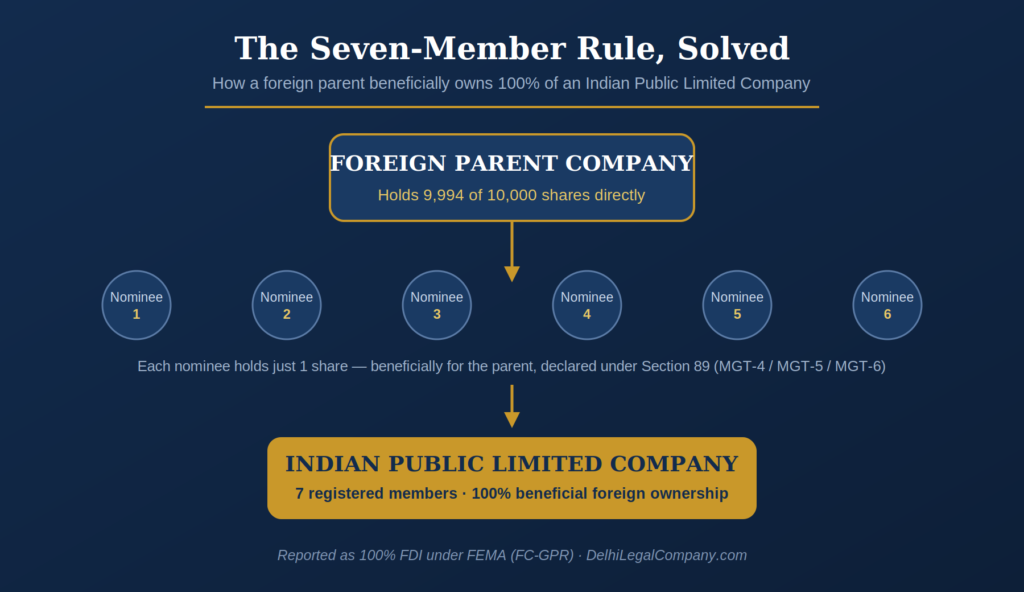
A public company must have at least seven members at all times. Foreign investors’ first question follows immediately: can we still own it entirely? Yes — through the same nominee mechanism used (with two members) in private companies, scaled up. The foreign parent subscribes to virtually the entire capital, and six nominee shareholders each hold a single share beneficially for the parent, with the split between registered and beneficial ownership formally declared under Section 89 of the Companies Act (Forms MGT-4 and MGT-5 by the holders, MGT-6 filed by the company with the ROC). The company is thereby 100% beneficially foreign-owned — exactly as reported under FEMA — while the register lawfully shows seven names. Members can be individuals or body corporates, Indian or foreign; a mix of group entities and professional nominees is common. Falling below seven members for more than six months exposes the continuing members to personal liability for debts contracted in that period — one of several reasons the nominee arrangement should be professionally documented, not improvised.
Minimum three directors — including one resident in India
A public company needs at least three directors (maximum fifteen, extendable by special resolution), each holding a Director Identification Number (DIN). At least one director must be resident in India — physically present for 182 days or more during the financial year (Section 149(3)). The resident director need not be a citizen or shareholder; foreign groups without Indian personnel routinely engage a professional resident director. Additional board composition requirements — independent directors, a woman director — switch on at size thresholds covered in Section 6, not at incorporation.
Capital, signatures and the registered office
- No minimum paid-up capital. The former ₹5,00,000 floor for public companies was abolished by the Companies (Amendment) Act, 2015. Capital is a commercial decision — sized to the business plan and any sector-specific regulatory floors (an NBFC or insurer has its own).
- Class 3 Digital Signature Certificates (DSC) for every subscriber and director signing the e-forms — obtainable for foreign nationals against notarised/apostilled passport and address proof.
- A registered office in India, evidenced by a utility bill and the owner’s no-objection — required within 30 days of incorporation and declarable at filing; professional registered-office services fill the gap for foreign groups without premises on day one.
- Name ending in “Limited”, cleared through the MCA’s name-reservation process and, prudently, a trademark search first.
3. FDI & FEMA Compliance: Routes, Press Note 3 and FC-GPR
FDI in a Public Limited Company follows the same architecture as for any Indian company — the FEM (Non-Debt Instruments) Rules, 2019 and the Consolidated FDI Policy — with the public form adding no separate approval layer of its own.
Automatic Route vs Government Route
In most sectors — manufacturing, IT and software, most services, infrastructure, wholesale trading — 100% foreign investment enters under the Automatic Route: no prior approval from the government or the RBI, only post-facto reporting. The Government Route (prior approval of the concerned ministry, processed through the National Single Window System) applies to sectorally capped or sensitive activities — multi-brand retail, print news media, defence beyond 74%, and the like — and a public company in such a sector needs the approval before capital flows, exactly as a private company would.
Press Note 3 (2020): the land-border rule
Regardless of sector or structure, all investment from countries sharing a land border with India — or whose beneficial owner is situated in such a country — requires prior government approval. For public companies with layered or institutional cap tables, this is the first screening question, not the last: a fund with limited partners, or a chain of holding entities, must be examined for land-border beneficial ownership before the subscription is signed, because discovering it after remittance means unwinding, not amending.
The capital-and-reporting clock
- Eligible instruments: equity shares, Compulsorily Convertible Preference Shares (CCPS), Compulsorily Convertible Debentures (CCDs) and share warrants. Optionally convertible or redeemable paper is debt under the ECB regime — not FDI.
- Pricing guidelines: shares issued to non-residents at or above fair market value (CA/merchant-banker certified); exits to residents at or below fair market value. Assured-return promises to foreign shareholders are unenforceable.
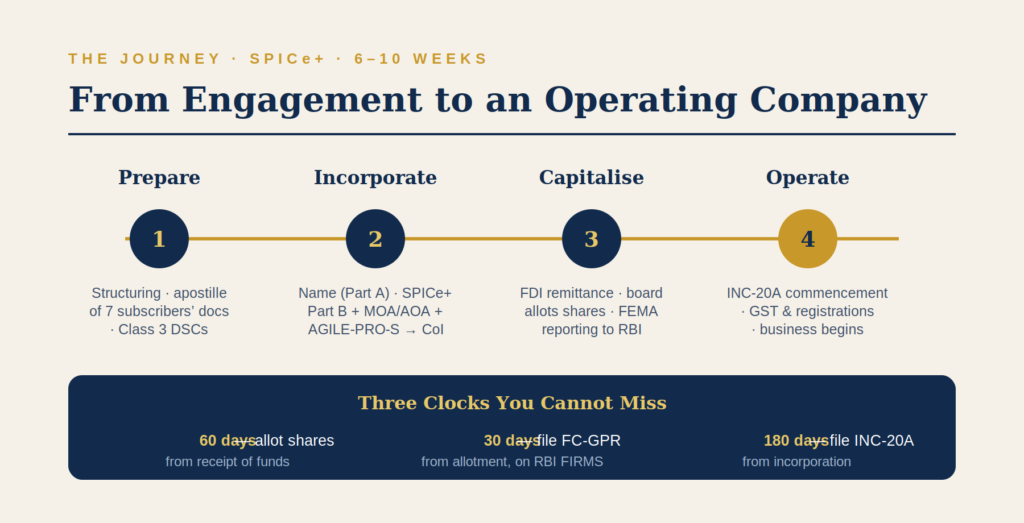
- Allotment within 60 days of receiving the subscription money — else the funds must be refunded.
- Form FC-GPR within 30 days of allotment, filed on the RBI’s FIRMS portal through the Single Master Form, with the valuation certificate and declarations. This is the filing every future remittance and exit will be checked against — file it precisely, on time, every time.
- Annual FLA return by 15 July to the RBI, and FC-TRS within 60 days of any subsequent resident–non-resident share transfer — a filing public companies encounter more often than private ones, precisely because their shares are freely transferable.
4. Public Limited vs Private Limited: The Comparison
| Parameter | Public Limited Company | Private Limited Company |
|---|---|---|
| Minimum / maximum shareholders | 7 minimum / no maximum | 2 minimum / 200 maximum |
| Minimum directors | 3 (max 15; one resident in India) | 2 (max 15; one resident in India) |
| Share transferability | Freely transferable | Restricted by the Articles (ROFR & board consent typical) |
| Raising funds from the public | Permitted — prospectus, public offers, listing on stock exchanges; public deposits subject to conditions | Prohibited — private placements and rights issues only |
| Name suffix | “Limited” | “Private Limited” |
| Statutory compliance load | Higher — CS and secretarial audit at thresholds, independent directors and committees at thresholds, fuller disclosure | Moderate — several exemptions available to private companies |
| Governance signalling / brand credibility | Highest — the expected form for listings, regulated sectors and very large counterparties | High for its class — the standard form for subsidiaries and startups |
| FDI treatment | Identical — same routes, caps, instruments, pricing rules and FC-GPR/FLA reporting | |
| Effective corporate tax (2026) | Identical — ~25.17% as a domestic company under the concessional regime | |
| Best suited for | IPO-track ventures, multi-partner JVs, regulated/capital-intensive sectors, 200+ shareholder structures | Wholly-owned subsidiaries, startups, closely held ventures |
5. Step-by-Step Incorporation via SPICe+ (With Timeline)
Public company incorporation runs through the same integrated SPICe+ system on the MCA’s V3 portal as a private company — one application delivering incorporation, DINs, PAN, TAN, EPFO/ESIC, professional tax (where applicable) and bank-account initiation. What changes is the headcount of paperwork: seven subscribers and three directors mean more KYC, more signatures, and — for foreign signatories — more apostilles. The sequence:
| Stage | Step | What happens | Indicative time |
|---|---|---|---|
| A. Preparation | 1. Structuring | Cap table (parent + six nominees, with Section 89 documentation planned), board slate, FDI route and Press Note 3 screening confirmed | 3–7 days |
| 2. Document legalisation | Foreign parent’s charter documents, board resolution and POA; every foreign subscriber’s and director’s passport and address proof — notarised and apostilled (Hague countries) or consularised (others), translated into English where needed | 1–3 weeks (the true timeline driver — start day one) | |
| 3. Class 3 DSCs | Digital signatures issued for all subscribers and proposed directors | 2–5 days | |
| B. Incorporation | 4. Name reservation — SPICe+ Part A (or RUN) | Two proposed names ending in “Limited”; trademark clash check strongly advised | 2–4 days |
| 5. SPICe+ Part B + e-MOA/e-AOA + AGILE-PRO-S | Integrated filing: incorporation, DIN allotment for new directors, PAN, TAN, EPFO/ESIC, bank account. Where foreign subscribers execute documents outside India, physically signed and apostilled MOA/AOA are attached in place of e-signing — a standard accommodation for cross-border subscribers | 7–12 days (incl. any resubmission) | |
| 6. Certificate of Incorporation | ROC issues the CoI with CIN, PAN and TAN — the company exists | — | |
| C. Capital & commencement | 7. Remittance & allotment | Foreign subscribers remit through banking channels (AD bank issues FIRC/KYC); board allots shares within 60 days of receipt | 1–2 weeks |
| 8. FC-GPR filing | Reported on the RBI FIRMS portal within 30 days of allotment, with valuation certificate; Section 89 declarations (MGT-4/5/6) completed for the nominee shares | Within 30 days | |
| 9. Commencement of business — INC-20A | Declaration that subscribers have paid in, filed within 180 days of incorporation; business cannot commence without it | — | |
| D. Operational | 10. Registrations | GST, IEC, Shops & Establishment, sector licences as the business requires | 1–3 weeks (parallel) |
Realistic end-to-end: six to ten weeks from engagement to a capitalised, FDI-compliant public company — with the apostille chain across seven subscribers and three-plus directors, not the Indian filings, deciding which end of that range you reach. Foreign directors do not need to travel to India for incorporation: every document can be executed abroad, notarised, apostilled and couriered.
6. Post-Registration Compliance & the Governance Ladder
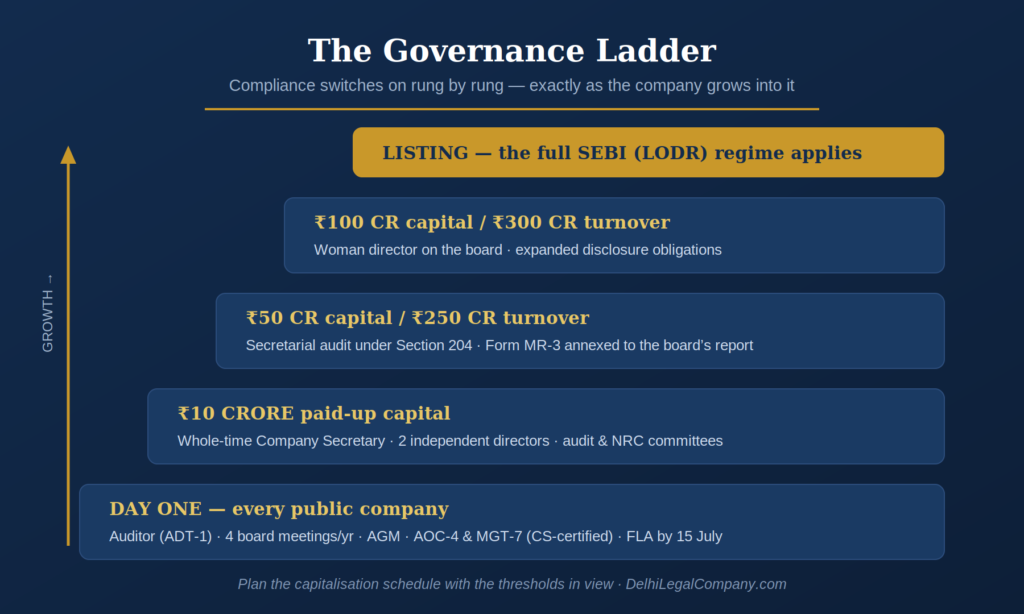
A public company’s compliance is best understood as a ladder: a base rung every company stands on, plus additional rungs that switch on as paid-up capital, turnover or borrowings cross defined thresholds.
The base rung — every public company, from day one
- Statutory auditor: first auditor appointed by the board within 30 days of incorporation (failing which by the members in general meeting within 90 days), with the appointment intimated in Form ADT-1; thereafter appointed for five-year terms at the AGM.
- Board rhythm: first board meeting within 30 days of incorporation; at least four board meetings a year with no more than 120 days between two; the Annual General Meeting each year within statutory timelines.
- Annual filings: financial statements in Form AOC-4 within 30 days of the AGM; annual return in Form MGT-7 within 60 days of the AGM — and MGT-7 of a public company requires certification by a practising Company Secretary. Director KYC (DIR-3 KYC), DPT-3, and maintenance of statutory registers and minutes complete the set.
- FEMA annuals: the FLA return to the RBI by 15 July, and event-based FC-GPR/FC-TRS filings as capital moves.
- Taxation: ~25.17% effective as a domestic company under the concessional regime, GST and TDS cycles, and transfer-pricing documentation (Form 3CEB) for every transaction with the foreign parent and affiliates.
The threshold rungs — switching on with scale
- Whole-time Company Secretary: mandatory once paid-up capital reaches ₹10 crore — and a KMP suite (MD/CEO, CFO, CS) for public companies at the prescribed scale.
- Secretarial audit (Section 204): required for listed companies and for public companies with paid-up capital of ₹50 crore or more or turnover of ₹250 crore or more (and companies with large outstanding borrowings under the extended rule) — an annual audit of the company’s compliance with corporate law, reported in Form MR-3 and annexed to the board’s report.
- Independent directors, audit committee & nomination-and-remuneration committee: public companies crossing paid-up capital of ₹10 crore, turnover of ₹100 crore, or aggregate borrowings of ₹50 crore must appoint at least two independent directors and constitute the committees.
- Woman director: required for listed companies and public companies with paid-up capital of ₹100 crore or more or turnover of ₹300 crore or more.
- Internal auditor, CSR, XBRL filing and related obligations follow their own thresholds as the company grows — and on listing, the entire SEBI (LODR) regime layers on top.
Planning insight for foreign boards: the ladder is a feature, not a bug. A newly incorporated public subsidiary with modest paid-up capital carries only marginally more compliance than a private one — the heavier rungs (CS, secretarial audit, independent directors) engage only as the balance sheet grows into them. Structure the capitalisation schedule with the thresholds in view, and the governance cost arrives exactly when the scale that justifies it does.
Frequently Asked Questions (FAQ)
Q1. Can a foreign company own 100% of an Indian Public Limited Company?
Yes — beneficially. FDI up to 100% is permitted in most sectors under the Automatic Route, for public and private companies alike. The seven-member minimum is satisfied by the foreign parent holding virtually all shares while six nominee shareholders each hold a single share beneficially for the parent, formally declared under Section 89 (Forms MGT-4, MGT-5 and MGT-6). The company is 100% foreign-owned in substance and reported as such under FEMA.
Q2. Do foreign directors or shareholders need to travel to India for incorporation?
No. The entire process is digital via the MCA’s SPICe+ system. Foreign subscribers and directors execute their documents abroad — notarised and apostilled (or consularised for non-Hague countries) — obtain Class 3 digital signatures against that KYC, and where subscription documents are signed outside India, physically executed and apostilled MOA/AOA are filed in place of e-signing. Physical presence becomes relevant only for the one director who must be resident in India for 182+ days a year — a requirement professional resident-director services can satisfy.
Q3. What is the minimum capital for a Public Limited Company in 2026?
There is none. The earlier ₹5,00,000 minimum was abolished by the Companies (Amendment) Act, 2015. Capital should be sized to the business plan, any sector-specific regulatory floors, and — usefully — the governance thresholds: paid-up capital of ₹10 crore triggers the whole-time Company Secretary and committee requirements, so the capitalisation schedule can be planned with the compliance ladder in view.
Q4. What tax rate does a foreign-owned Public Limited Company pay?
The same as any domestic Indian company: under the concessional corporate regime (the Section 115BAA route), 22% base tax plus 10% surcharge plus 4% cess — an effective ~25.17%, with no minimum alternate tax. Dividends to the foreign parent suffer withholding, typically reduced to 5–15% under the applicable tax treaty with a Tax Residency Certificate and Form 10F, and all related-party transactions require transfer-pricing documentation.
Q5. When must a Public Limited Company appoint a Company Secretary and undergo secretarial audit?
A whole-time Company Secretary becomes mandatory when paid-up capital reaches ₹10 crore. Secretarial audit under Section 204 applies to listed companies and to public companies with paid-up capital of ₹50 crore or more or turnover of ₹250 crore or more (with an extended trigger for companies carrying large borrowings). Separately, from day one, a public company’s annual return (MGT-7) must be certified by a practising Company Secretary regardless of size.
Q6. What are the FC-GPR and FLA filings, and when are they due?
FC-GPR is the RBI filing (on the FIRMS portal, through the Single Master Form) reporting every allotment of shares to non-residents — due within 30 days of allotment, with a valuation certificate confirming FEMA pricing compliance; allotment itself must occur within 60 days of receiving the subscription money. The FLA is the annual return of foreign liabilities and assets, due to the RBI by 15 July each year from every company carrying foreign investment. Late filings attract late-submission fees and blemish the record every future remittance is checked against.
Q7. How long does Public Limited Company registration take for foreign investors?
Realistically six to ten weeks end to end: one to three weeks for notarisation and apostille of the foreign documents (the true timeline driver, multiplied across seven subscribers and three-plus directors), two to three weeks for the SPICe+ incorporation itself, and the balance for capital remittance, allotment within 60 days, FC-GPR within 30 days, and the INC-20A commencement declaration within 180 days of incorporation.
Q8. Should a foreign investor incorporate as a public company now, or convert from private later?
If an Indian IPO, public fundraising, a 200+ member cap table, or a sector that expects the public form is part of the credible three-to-five-year plan, incorporating as a public company avoids a later conversion (special resolution, altered Articles, ROC approval and fresh compliance onboarding) at a moment when the business least wants distraction. If none of those apply, a Private Limited Company is the simpler default — conversion remains available when the trajectory changes.
Q9. Does Press Note 3 apply to Public Limited Companies?
Fully. Any investment from a country sharing a land border with India — or whose beneficial owner is situated in such a country — requires prior government approval regardless of sector, structure or stake size. For public companies with institutional or layered cap tables, beneficial-ownership screening of every investor chain is the first structuring step, since a Press Note 3 issue discovered after remittance means unwinding the investment, not amending a form.
Q10. Who can be the six nominee shareholders — and is that arrangement safe?
Nominees can be individuals or body corporates, Indian or foreign — commonly a mix of group entities and professional nominees. The arrangement is expressly lawful when documented and declared: a declaration-of-trust/nominee agreement, pre-signed transfer instruments held in escrow, and the Section 89 filings (MGT-4/5/6) that record the parent’s beneficial ownership with the ROC. Done professionally, the nominee shares are administratively invisible; done informally, a single stranded share can obstruct a future transfer or exit — which is why Delhi Legal Company provides documented nominee shareholder services as part of every public-company incorporation.
Conclusion
The Public Limited Company is India’s heavyweight corporate form — built for businesses whose ambitions include listing, public capital, many shareholders, or the regulated sectors where scale and governance are the price of admission. For foreign investors, 2026 makes it remarkably accessible: 100% beneficial foreign ownership through the parent-plus-six-nominees structure, no minimum capital, the same Automatic-Route FDI treatment as any private company, the same ~25.17% domestic tax rate, and a fully digital SPICe+ incorporation that no director need fly to India to complete. What the form asks in return is precision — seven sets of apostilled documents instead of two, the 60-day allotment and 30-day FC-GPR clocks respected, Section 89 declarations filed for every nominee share, and a governance ladder climbed rung by rung as the balance sheet grows.
Choose it for the trajectory, not the title: if your India plan genuinely runs toward a listing, a broad register, or a sector that expects the “Limited” suffix, incorporating in the final form from day one is cleaner than converting mid-flight. And whichever way that analysis lands for your group, land it before the first remittance — because in Indian company law, as this guide has shown throughout, the expensive mistakes are the structural ones.
Incorporate Your Indian Public Limited Company with Delhi Legal Company
Delhi Legal Company delivers Public Limited Company registration in India end to end for foreign enterprises and institutional investors — structure and FDI-route confirmation with Press Note 3 screening, the complete SPICe+ incorporation with seven-subscriber documentation and apostille coordination, documented nominee subscriber arrangements with full Section 89 compliance, resident director and registered office solutions, FC-GPR and all RBI/FEMA reporting, and the entire post-incorporation calendar — auditor appointment, board and AGM support, AOC-4/MGT-7 filings with CS certification, and the governance ladder managed as you scale. One accountable partner in India, from name approval to Certificate of Incorporation and every filing after.
☎ +91-9599332456 ✉ info@delhilegalcompany.com delhilegalcompany.com