
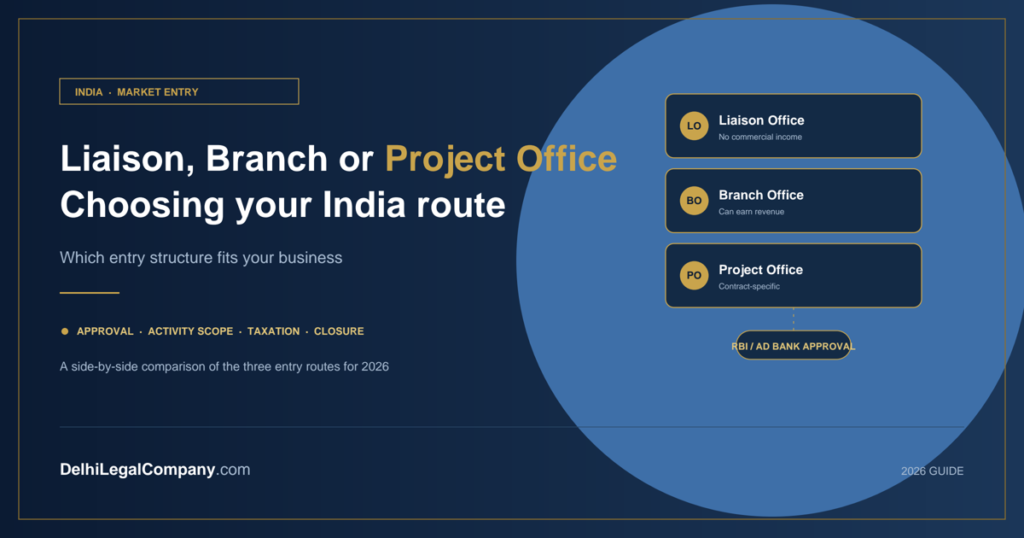
Imagine three doors into the Indian market. Behind the first, you can look around, talk to customers, and learn — but not sell a thing. Behind the second, you can trade, invoice, and earn — but only within strict limits. Behind the third, you can execute one specific project, then you must leave. For a foreign company testing India without setting up a full subsidiary, these three doors are the Liaison Office, Branch Office, and Project Office — and choosing the wrong one can cost you months and a great deal of money.
Unlike a subsidiary (a separate Indian company you own), all three of these are extensions of your foreign parent company, governed not just by the Companies Act but tightly by the Reserve Bank of India (RBI) under FEMA. That means more oversight, narrower permissions, and — crucially — RBI approval before you can even begin. Pick the structure that matches what you actually intend to do in India, and the path is smooth. Pick wrong, and you’ll find yourself legally unable to do the very thing you came to do.
This guide walks you through all three side by side — what each can and cannot do, who qualifies, how the RBI approval works, how they’re taxed, and exactly which one fits your situation. By the end, you’ll know precisely which door to open.
1. Meet the Three Structures
Each office serves a fundamentally different purpose. Understanding the intent behind each is the fastest way to narrow your choice.
Liaison Office (LO) — the listener
Also called a Representative Office, a Liaison Office is purely a communication bridge between your overseas headquarters and the Indian market. It can promote the parent’s business, explore opportunities, build relationships, gather market intelligence, and facilitate imports and exports between the parent and Indian parties — but it cannot earn a single rupee of income in India. It cannot raise an invoice, charge a fee, or sign a revenue contract.
Because it earns nothing, every cost it incurs — office rent, salaries, travel — must be funded entirely by inward remittances from the parent company through normal banking channels. Think of it as your eyes and ears in India: it watches the market, builds the relationships, and lays the groundwork, but the moment any actual selling needs to happen, that business must be booked by the parent abroad or by a different Indian entity. The LO is the lowest-commitment way to have a real, branded presence in India without yet committing to operate there.
Branch Office (BO) — the operator
A Branch Office is a genuine commercial extension of the parent — the same legal entity, simply operating in India. Unlike the Liaison Office, it can generate revenue in India by carrying out the activities the RBI specifically permits: import and export of goods, professional or consultancy services, technical support for the parent’s products, research in the parent’s field, promoting technical or financial collaborations, and acting as a buying or selling agent for the parent.
The big restrictions define its edges: a Branch Office cannot undertake manufacturing or processing directly (it may only subcontract to Indian manufacturers, with manufacturing in its own right allowed solely inside Special Economic Zones), and it cannot engage in retail trading. Profits it earns in India can be repatriated to the parent after paying Indian taxes. The Branch is the route for a foreign company that wants to do defined business in India — and book the revenue here — without yet forming a separate Indian company.
Project Office (PO) — the contractor
A Project Office exists for one reason and one reason only: to execute a specific project that a foreign company has been awarded in India — typically in construction, engineering, infrastructure, or installation. It can carry out commercial activities, but strictly those related to and incidental to that one project. It cannot diversify into other business, and it is fundamentally temporary: when the project is completed, the office is wound up and any surplus is repatriated to the parent.
The Project Office is often the quickest of the three to establish, because the RBI grants it general permission rather than requiring case-by-case approval — provided the foreign company has secured a contract from an Indian entity, the project has its necessary regulatory clearances, and the funding comes from inward remittance or a term loan from an Indian or recognised bank. It is the natural vehicle for a foreign contractor who has won a single, time-bound Indian assignment.
2. The Head-to-Head Comparison
Here is the table that settles most of the decision — the three routes across every factor that matters:
| Factor | Liaison Office | Branch Office | Project Office |
|---|---|---|---|
| Core purpose | Representation & communication | Commercial operations | Execute one project |
| Can earn income? | No | Yes | Yes (project-related only) |
| Duration | 3 years (renewable) | Ongoing | Till project completion |
| Manufacturing | No | No (except SEZ) | Only if part of project |
| Funding | Parent remittances only | Indian revenue + parent | Project funds |
| RBI approval | Required (Form FNC) | Required (Form FNC) | General permission if conditions met |
| Profit repatriation | Not applicable | Yes, after tax | Surplus on completion |
3. What Each Office Can — and Cannot — Do
The single biggest cause of trouble is a foreign company doing something its structure doesn’t permit. So here is the precise scope of each, in black and white.
Liaison Office — permitted activities
- Representing the parent company in India.
- Promoting import from / export to India.
- Promoting technical and financial collaborations between the parent and Indian companies.
- Acting as a communication channel between the parent and Indian parties.
Strictly prohibited: earning any income in India, raising invoices, charging commission, importing goods on its own account, or undertaking any commercial/trading/industrial activity. All sale proceeds generated by its efforts must be paid directly to the parent through proper banking channels.
Branch Office — permitted activities
- Import and export of goods.
- Professional or consultancy services.
- Research work in areas the parent is engaged in.
- Promoting technical/financial collaborations.
- Acting as a buying/selling agent for the parent.
- Rendering IT services and technical support for the parent’s products.
Prohibited: direct manufacturing or processing (allowed only in SEZs, or it must be subcontracted to Indian manufacturers) and retail trading of any kind.
Project Office — permitted activities
Only activities relating and incidental to the execution of the specific project for which it was approved. Nothing beyond the project’s scope is allowed, and the office must close once the project concludes.
The line a liaison office must not cross
The restriction on a liaison office is easy to state and surprisingly easy to breach in practice, because the breach is usually accidental rather than deliberate.
A liaison office may represent the parent, promote its business, gather market intelligence, and act as a communication channel. It may not earn income, sign contracts, negotiate prices, accept orders, hold stock, or invoice anyone. Its entire funding must come from the parent through normal banking channels.
The problem arises because commercial teams behave commercially. An office established to “explore the market” begins attending customer meetings, then discussing terms, then agreeing scope, then coordinating delivery. No single step feels like a breach. Cumulatively they look exactly like a business being conducted.
The consequence has a name: permanent establishment. If the tax authorities conclude that the liaison office constituted a permanent establishment of the parent, the parent’s India-attributable profits become taxable in India — at the foreign company rate, with interest, and retrospectively for the years concerned. What was set up as a non-taxable representative presence becomes a taxable one, and the assessment covers the period already elapsed.
Common activities that create exposure:
- Negotiating or concluding contracts in India, even where the paper is signed abroad
- Habitually securing orders for the parent
- Providing after-sales or technical support that goes beyond liaison
- Maintaining stock for delivery to Indian customers
- Employees whose role is substantively commercial rather than representative, regardless of their job title
The practical control is documentary as much as behavioural: keep board minutes, employment descriptions, correspondence and the Annual Activity Certificate consistent with a liaison role, and escalate to a branch or subsidiary as soon as the actual activity outgrows the permitted scope. A structure that no longer matches the business is a liability, not a saving.
4. Eligibility: Who Qualifies?
The RBI doesn’t hand these out freely — it wants to see a financially sound parent with a track record. The bar differs by structure:
| Requirement | Liaison Office | Branch Office |
|---|---|---|
| Profit track record | Profitable in last 3 financial years | Profitable in last 5 financial years |
| Net worth | ≥ USD 50,000 | ≥ USD 100,000 |
| If criteria not met | Letter of Comfort from parent | Letter of Comfort from parent |
A Project Office follows a different logic: there’s no fixed net-worth test, but the foreign company must have secured a contract from an Indian company, the project must have the necessary clearances, and it must be funded by inward remittance or a term loan from an Indian/recognised bank.
5. How RBI Approval Works
For Liaison and Branch Offices, the gateway is Form FNC, filed through an Authorised Dealer (AD) Category-I Bank, which scrutinises and forwards it to the RBI. Applications travel one of two routes:
- RBI / Automatic route: if the parent’s principal business falls in a sector where 100% FDI is permitted automatically, the AD bank can typically process it.
- Government / Approval route: if the business is in a restricted sector — or the applicant is an NGO/NPO/government body — the RBI decides in consultation with the Ministry of Finance.
Extra scrutiny applies to applicants from Pakistan, Bangladesh, China, Sri Lanka, Afghanistan, Iran, Hong Kong, or Macau, and to the four sensitive sectors — Defence, Telecom, Private Security, and Information & Broadcasting. These always go through prior government consultation.
For Project Offices, the RBI grants general permission (no case-by-case approval) as long as the contract and funding conditions are met — making the PO often the fastest of the three to establish.
The approval route, and who lands in it
Applications are made through an authorised dealer bank on Form FNC, and follow one of two paths.
The automatic route applies where the applicant meets the eligibility conditions, the activity falls within permitted scope, and the sector permits foreign investment under the automatic route. The AD bank processes the application.
The approval route requires the RBI’s prior approval, in consultation with the Government where relevant. It applies in several situations that catch applicants unprepared:
- Applicants from countries sharing a land border with India — and this extends to applicants whose beneficial owner is situated in such a country, however many holding layers intervene. Under Press Note 3 of 2020, this screening applies regardless of sector and regardless of how small the stake is.
- Applicants from Pakistan, Bangladesh, Sri Lanka, Afghanistan, Iran, China, Hong Kong or Macau, for whom prior approval is generally required.
- Sensitive sectors including defence, telecom, private security and information and broadcasting.
- Applicants that are NGOs or non-profit organisations, which are separately regulated.
- Applicants who do not meet the financial track-record and net-worth conditions, where the RBI may still consider the application with a letter of comfort from the parent.
Beneficial-ownership screening should be the first question, not the last. A fund structure with an intermediate holding company in Hong Kong, or a limited partner in a land-border country, changes the route entirely. Discovering this after the application has been prepared costs weeks; discovering it after the office has commenced operations is materially worse.
6. Documents You’ll Need
The core document set is similar across all three, with foreign documents requiring notarisation/attestation:
- Certificate of Incorporation, plus MOA & AOA, attested by a Notary Public or the Indian Embassy in the home country (translated to English if needed).
- Audited balance sheet of the parent for the last 3–5 years.
- Details of the parent’s directors/shareholders and the proposed activities in India.
- Board resolution authorising the office and naming an authorised representative.
- For a Project Office: a copy of the awarded contract.
- KYC documents, forwarded by the parent’s bank to the AD bank.
After RBI sanction, Liaison and Branch Offices must also register with the Registrar of Companies (ROC) and obtain PAN, a bank account, and other registrations.
7. Taxation
This is where many foreign companies are caught off guard — because these structures are taxed as foreign companies, not domestic ones.
- Liaison Office: since it earns no income, it generally pays no income tax — but it must still file returns and an Annual Activity Certificate.
- Branch Office: taxed as a foreign company at the higher rate of around ~40% (plus surcharge and cess) on its India income — significantly more than a subsidiary’s ~25%.
- Project Office: also taxed at the foreign-company rate on project income.
The tax trap: if you expect meaningful, ongoing profits in India, the Branch Office’s ~40% rate often makes a Private Limited subsidiary (taxed far lower) the smarter long-term vehicle. The office routes shine for representation, defined services, or one-off projects — not for scaling a profitable business.
The gap is worth seeing in numbers. A Branch or Project Office, taxed as a foreign company, faces an effective rate in the region of 40% plus surcharge and cess on its India-sourced income. A domestic Private Limited subsidiary, by contrast, can elect the concessional regime and pay an effective rate of roughly 25% — and a new manufacturing company can go lower still. On ₹1 crore of Indian profit, that difference is on the order of ₹15 lakh in tax every year. Over a multi-year presence, the cumulative tax penalty of running a Branch instead of a subsidiary can dwarf the one-time cost of incorporating the subsidiary in the first place.
There are two further tax wrinkles foreign companies should plan for. First, a Branch or Project Office can create a “permanent establishment” under the relevant tax treaty, which is precisely what attracts the higher foreign-company rate on attributable profits — so the structure you pick directly shapes your tax exposure. Second, repatriating a Branch’s post-tax profit is generally cleaner than extracting a subsidiary’s profit as dividends, so the comparison isn’t purely about the headline rate — it’s about the whole journey of the money. For anything beyond a short, defined engagement, this is a conversation to have with a tax advisor before you choose.
Transfer pricing applies to offices too
A point that surprises many foreign companies: a branch or project office transacting with its own head office is subject to transfer pricing scrutiny, because head office and branch are treated as associated enterprises for these purposes.
That means the charges flowing between them — head-office expense allocations, management recharges, technical service fees, interest on funding — must be at arm’s length, documented, and reported in Form 3CEB where the thresholds are met. Head-office expenditure allocated to the Indian branch is also subject to statutory limits on deductibility, which is a frequent source of assessment disputes.
The practical consequence: an office structure does not avoid the compliance burden of a subsidiary so much as substitute a different one. A branch office pays tax at the higher foreign-company rate and carries transfer-pricing documentation obligations, without the subsidiary’s ability to build a clean standalone financial record.
The Annual Activity Certificate is a substantive filing
The AAC is not a formality. Certified by a Chartered Accountant and filed with the AD bank and the tax authorities, it confirms that the office has operated within the activities permitted by its approval.
This makes it the document that either supports or undermines your position if scope is later questioned. An AAC that describes activity going beyond the approved scope is, in effect, a self-reported breach. An office whose actual work has drifted should address the structure before the next certificate is due, rather than asking an auditor to certify something that is no longer accurate.
8. Compliance & the Annual Activity Certificate
All three structures carry ongoing compliance, with one signature requirement unique to them:
- Annual Activity Certificate (AAC): Liaison and Branch Offices must submit an AAC — certified by a Chartered Accountant — to the RBI (via the AD bank) each year, confirming the office stayed within its permitted activities.
- Income tax returns and (where applicable) GST and TDS filings.
- ROC filings applicable to a foreign company’s place of business in India.
- Annual audit of the office’s accounts.
Stay in your lane: the fastest way to lose your approval is to do something outside your permitted activities — a Liaison Office raising an invoice, for example. Adverse findings in the AAC are reported straight to the RBI.
9. Setup Timeline & What to Expect
How long does each take? The honest answer: it depends on the route and how clean your documents are. As a realistic guide:
| Stage | What happens | Typical time |
|---|---|---|
| Document preparation | Notarisation/attestation of parent documents abroad | 2–4 weeks |
| Form FNC filing (LO/BO) | AD bank review and submission to RBI | 1–2 weeks |
| RBI approval (LO/BO) | Automatic route faster; approval route longer | 4–8 weeks |
| ROC registration | Registering the place of business + PAN, bank account | 2–3 weeks |
| Project Office | General permission — no case-by-case RBI approval | Often fastest |
Add it up and a Liaison or Branch Office usually takes 6–12 weeks end to end, with the approval route at the longer end. A Project Office can move faster because it sidesteps case-by-case RBI approval. As always, the real bottleneck is getting foreign documents apostilled — start that on day one.
10. Closing or Converting an Office
These structures aren’t always forever — and how you wind them down matters as much as how you set them up.
- Closure: to close an office, you file a closure application with the AD bank/RBI, settle taxes, obtain a clearance from the tax authorities, and remit any remaining balance abroad. A Project Office naturally closes on project completion.
- No direct “conversion”: you cannot simply convert a Liaison or Branch Office into a subsidiary. In practice, companies that outgrow an office structure close it and incorporate a fresh subsidiary — so it pays to anticipate that path if growth is likely.
Plan the exit at the entrance: if there’s a real chance you’ll scale into a full commercial operation, it can be cheaper and faster to start with a Wholly-Owned Subsidiary than to set up an office now and replace it later.
When to convert — and what conversion actually involves
There is no mechanism to convert a liaison office into a branch office, or a branch office into a subsidiary, in the way a company converts from private to public. Each is a separate legal form with a separate approval. In practice, “conversion” means establishing the new structure and closing the old one, in that order where possible.
The signals that a structure has been outgrown are usually commercial rather than legal:
- The liaison office team is being asked to discuss commercial terms
- Customers want to contract with an Indian entity and pay in rupees
- You are hiring beyond a representative headcount
- The activity has become continuous rather than project-bound
- You need to hold assets, stock, or intellectual property in India
- Tax advisors have raised permanent establishment risk
The closure side has its own sequence, and it is slower than most expect. Closure requires an application to the AD bank with the auditor’s certificate, confirmation that no liabilities remain outstanding, tax clearances, settlement of employee dues, and closure of bank accounts — before any residual funds can be repatriated to the parent. Where a project office is concerned, closure follows completion of the project and settlement of the contract.
Budget three to six months for a clean closure. The step that most often delays it is tax clearance, particularly where assessments for earlier years remain open. Companies that plan to shut an office at the end of a financial year and repatriate immediately are usually working to a timeline that does not survive contact with the process.
The honest comparison with a subsidiary
For most foreign companies with ongoing commercial intent in India, the office forms exist to serve narrow purposes and the subsidiary does the rest. The three differences that decide it:
| Factor | Branch / Project Office | Private Limited Subsidiary |
|---|---|---|
| Liability | Parent fully exposed — the office is not a separate entity | Limited to capital subscribed |
| Tax rate | Foreign company rate, roughly ten points higher | Domestic company rate |
| Scope | Restricted to approved activities | Any lawful business |
| Approval | RBI or AD bank approval required | None in automatic-route sectors |
| Raising capital | Not possible — no shares | Equity, CCPS, CCDs, ESOPs |
| Exit | Closure process with tax clearance | Share sale or winding up |
The office forms remain the right answer in specific situations — a genuine market-research phase, a single EPC contract, an export-support function. They are the wrong answer for a business that intends to sell in India on an ongoing basis, and the cost of that mistake compounds through the higher tax rate and the unlimited liability for as long as the structure remains in place.
11. So Which One Should You Choose?
Strip it down to your actual intent in India, and the answer becomes obvious:
Choose a Liaison Office if you…
- Want to explore the Indian market, do research, or build relationships first.
- Have no intention of earning income in India yet.
- Want the lowest-commitment, lowest-overhead entry point.
Choose a Branch Office if you…
- Want to do defined commercial work — consultancy, import/export, technical support — under the parent’s control.
- Need to earn and repatriate revenue, but don’t want a separate subsidiary yet.
- Don’t need to manufacture or do retail.
Choose a Project Office if you…
- Have won a specific contract/project in India.
- Need a structure only for the life of that project.
- Want the fastest setup under RBI’s general permission.
And if none fit? If you plan to operate long-term, hire locally, earn substantial profits, or raise investment, none of these three is ideal — a Wholly-Owned Subsidiary (a separate Indian company) usually wins on tax, flexibility, and credibility. The office routes are for testing, serving, or executing — not for scaling.
Conclusion
The Liaison, Branch, and Project Office each answer a different question. The Liaison Office asks “can I look before I leap?” The Branch Office asks “can I do defined business without a full company?” The Project Office asks “can I execute this one contract?” Match the structure to your honest intent — and remember that all three are RBI-supervised extensions of your parent, taxed as foreign companies. For anything resembling a long-term, profit-driven India presence, weigh them against a subsidiary before you commit. Choose deliberately, and your India entry will be smooth from the first day.
Frequently Asked Questions (FAQ)
The questions foreign companies ask us most often when choosing an India entry route:
What is the main difference between a Liaison, Branch, and Project Office?
A Liaison Office can only represent the parent and cannot earn income in India. A Branch Office can carry out permitted commercial activities and earn revenue. A Project Office exists solely to execute one specific contract in India and closes when the project ends. In short: represent, operate, or execute.
Can a Liaison Office earn income in India?
No. A Liaison Office is strictly non-commercial — it cannot invoice, trade, or earn any income in India. All its expenses must be funded by inward remittances from the foreign parent company. Earning income would breach its RBI approval.
Do all three need RBI approval?
Liaison and Branch Offices require RBI approval via Form FNC, filed through an AD Category-I bank. Project Offices generally enjoy RBI’s general permission (no case-by-case approval) provided the contract and funding conditions are met, making them the quickest to set up.
What are the eligibility requirements?
A Liaison Office requires a profit-making track record over the last 3 financial years and net worth of at least USD 50,000. A Branch Office requires profits over the last 5 years and net worth of at least USD 100,000. If these aren’t met, a Letter of Comfort from the parent may be accepted. A Project Office instead needs a secured Indian contract with proper funding.
Can a Branch Office do manufacturing in India?
No, not directly — except within a Special Economic Zone (SEZ) under specific conditions. A Branch Office also cannot do retail trading. Manufacturing generally requires a Wholly-Owned Subsidiary instead.
How are these offices taxed?
They are taxed as foreign companies. A Liaison Office earns no income so generally pays no income tax (but must still file). Branch and Project Offices are taxed on their India income at the foreign-company rate of roughly 40% plus surcharge and cess — notably higher than a domestic subsidiary’s rate.
What is an Annual Activity Certificate (AAC)?
The AAC is a yearly certificate, signed by a Chartered Accountant, that Liaison and Branch Offices must submit to the RBI through their AD bank. It confirms the office operated only within its RBI-permitted activities. Adverse remarks or non-submission are reported to the RBI and can jeopardise the approval.
Can profits be repatriated to the parent company?
A Liaison Office has no profits to repatriate. A Branch Office can remit its profits abroad after paying Indian taxes, subject to RBI guidelines. A Project Office can repatriate the surplus on completion of the project under RBI’s general permission.
How long can each office operate?
A Liaison Office is typically approved for 3 years and can be renewed. A Branch Office can operate on an ongoing basis subject to compliance. A Project Office lasts only until the project it was set up for is completed, after which it must be wound up.
Is a subsidiary better than these office structures?
For long-term, profit-generating operations — especially with local hiring, manufacturing, or fundraising plans — a Wholly-Owned Subsidiary is usually better, thanks to a much lower tax rate, full operational flexibility, and stronger credibility. The office routes are best for representation, defined services, or one-off projects.
Which entry route is fastest to set up?
The Project Office is often fastest because it operates under RBI’s general permission once a valid Indian contract and funding are in place. Liaison and Branch Offices take longer because each requires RBI approval via Form FNC through an AD bank.
What is Form FNC?
Form FNC is the prescribed application form a foreign company files to establish a Liaison or Branch Office in India. It is submitted through an Authorised Dealer (AD) Category-I bank, which reviews it and forwards it to the RBI for approval, along with the parent’s incorporation documents and audited financials.
Can a foreign company from China or Pakistan open these offices?
It can apply, but applications from entities in countries such as Pakistan, Bangladesh, China, Sri Lanka, Afghanistan, Iran, Hong Kong, and Macau receive extra scrutiny and require the RBI’s approval in consultation with the Government of India, particularly for sensitive locations or sectors.
How long does a Liaison Office approval last, and can it be renewed?
A Liaison Office is typically approved for three years. It can be renewed on application to the AD bank/RBI, provided the office has complied with its conditions and submitted its Annual Activity Certificates. Some categories of applicants may receive shorter validity.
What happens if my office operates outside its permitted activities?
Operating beyond your approved scope — for instance, a Liaison Office earning income — is a FEMA contravention. It can be flagged in the Annual Activity Certificate, reported to the RBI, and lead to penalties or cancellation of approval. Always stay strictly within your permitted activities.
Can a liaison office ever earn any income in India?
No. A liaison office cannot earn income, sign contracts, negotiate prices, accept orders, hold stock or invoice anyone. Its entire funding must come from the parent through banking channels. The restriction is absolute, and the risk is that commercial teams drift across it incrementally — attending meetings, then discussing terms, then agreeing scope — without any single step feeling like a breach.
What is permanent establishment risk and why does it matter here?
If the tax authorities conclude that a liaison office has been conducting business rather than merely liaising, it can be treated as a permanent establishment of the foreign parent. The parent’s India-attributable profits then become taxable in India at the foreign company rate, with interest, and retrospectively for the years concerned. A structure set up specifically to avoid Indian taxation becomes the reason for it.
Does Press Note 3 affect office applications?
Yes. Applicants from countries sharing a land border with India require prior approval regardless of sector, and the screening extends to applicants whose beneficial owner is situated in such a country, however many holding layers intervene. A fund with an intermediate holding company in Hong Kong or a limited partner in a land-border country changes the route entirely, which is why beneficial-ownership screening should be the first question rather than a closing formality.
Do transfer pricing rules apply to a branch office?
Yes. A branch and its head office are treated as associated enterprises, so charges flowing between them — expense allocations, management recharges, technical service fees, interest on funding — must be at arm’s length, documented, and reported in Form 3CEB where thresholds are met. Head-office expenditure allocated to the Indian branch is also subject to statutory deductibility limits, which is a frequent source of assessment disputes.
Can we convert a liaison office into a branch or subsidiary?
Not through a conversion mechanism — each is a separate legal form with a separate approval. In practice conversion means establishing the new structure and closing the old one, in that order where possible. The signals that a structure has been outgrown are usually commercial: customers wanting to contract with an Indian entity, hiring beyond representative headcount, or advisors raising permanent establishment risk.
How long does it take to close an office?
Realistically three to six months for a clean closure. It requires an application to the AD bank with an auditor’s certificate, confirmation that no liabilities remain outstanding, tax clearances, settlement of employee dues, and closure of bank accounts before residual funds can be repatriated. Tax clearance is the usual bottleneck, particularly where assessments for earlier years remain open.
Why do most foreign companies end up choosing a subsidiary instead?
Three differences decide it for ongoing commercial activity: the office forms leave the parent with unlimited liability because they are not separate entities; where taxable, they pay at the foreign company rate roughly ten percentage points above the domestic rate; and they cannot issue shares, CCPS, CCDs or ESOPs. The office forms remain right for a genuine market-research phase, a single EPC contract, or an export-support function — and wrong for a business intending to sell in India on an ongoing basis.
Not Sure Which India Entry Route Fits You?
Delhi Legal Company helps foreign companies choose and set up the right structure — Liaison, Branch, or Project Office, or a Wholly-Owned Subsidiary — handling RBI/FNC approvals, ROC registration, taxation, AAC filings, and ongoing compliance end to end.