

Written by the Delhi Legal Company India Entry & FDI Advisory team · Last updated August 2026 · Reviewed against Part II of the Arbitration and Conciliation Act, 1996 and current authority

Introduction
Winning is not the same as being paid.
The effectiveness of international arbitration ultimately depends not on obtaining an arbitral award, but on successfully enforcing it against the losing party. An arbitration award that cannot be enforced is little more than a paper victory.
For a foreign party holding an award against an Indian counterparty, three things determine what happens next, and only one of them is legal.
The first is a threshold question with a concrete answer. Signatories to the New York Convention do not automatically become reciprocating countries in India — the Central Government must notify them. So far it has notified 48 countries as reciprocating territories. An award from a seat outside that list does not enter the Part II machinery at all.
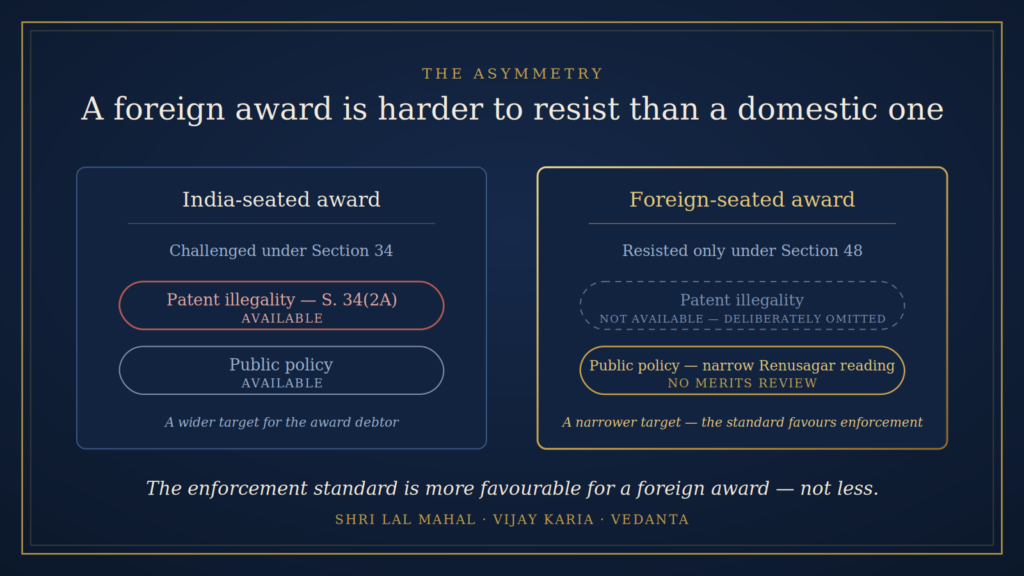
The second is a point that runs in a foreign party’s favour and is rarely made: a foreign award is harder to resist in India than a domestic one. Patent illegality, which is available against an India-seated award, is not available against a foreign one.
The third is not law. Execution can only proceed against assets located within Indian jurisdiction. An award is worth what you can reach.
This guide covers the threshold, the narrow grounds on which enforcement can be resisted, a significant 2026 decision on finality, and the limitation question on which authority genuinely differs.
About this guide
Delhi Legal Company works exclusively with foreign companies establishing and operating in India. Enforcement is where the arbitration clause negotiated years earlier either works or does not, and where the choice of seat is finally tested.
Where a rule is settled we state it. Where authority conflicts — and on the limitation period it does — we set out both lines and give the course that protects you either way.
Primary sources: the Arbitration and Conciliation Act, 1996, Part II; the New York Convention, 1958; and Supreme Court and High Court authority including Renusagar, Shri Lal Mahal, Vijay Karia, Vedanta and Cruz City.
1. Which track
New York Convention awards fall under Sections 44 to 52, covering awards from countries that are signatories to the 1958 Convention and which India has notified as reciprocating territories. Geneva Convention awards fall under Sections 53 to 60, a smaller and older category relevant only for a limited list of countries.
In practice almost every award a foreign party seeks to enforce in India runs on the New York Convention track. The Geneva track survives for a narrow set of jurisdictions and has a parallel refusal provision at Section 57.
2. The threshold: is it a foreign award at all
The award must be made in a territory notified by the Central Government as a reciprocating territory under the New York Convention. Whether an award qualifies as a foreign award is a threshold issue, because only awards falling within the statutory definition can be enforced under Part II.
An award qualifies only if it comes from a country notified as a reciprocating territory and satisfies the definition under Section 44 or Section 53.
2.1 Convention membership is not enough
This is the point most foreign parties assume away.
India requires the Central Government to notify a territory. Membership of the Convention does not produce that notification automatically, and forty-eight countries have been notified.
The major seats used for India-related work are on the list. A less common seat — agreed because it suited a counterparty, or inherited from a template — may not be.
2.2 The check belongs at drafting, not at enforcement
By the time you are enforcing, the seat is fixed. Confirming that the chosen seat is a notified reciprocating territory costs nothing at the point the clause is agreed and cannot be fixed afterwards.
See arbitration clauses in India contracts.
3. Where to file
The relevant High Court having jurisdiction over the assets, or over the party against whom enforcement is sought, has jurisdiction to enforce a foreign award.
So the forum follows the assets. Where an Indian counterparty holds property, receivables or bank accounts in more than one state, that is a choice — and it should be made on where the recoverable assets actually are rather than on where the counterparty is headquartered.
4. One stage, not two
A structural advantage of an arbitral award over a foreign judgment, and one worth understanding.
No separate suit is required. Once the court finds that no grounds for refusal exist, the award itself is treated as a decree without a fresh suit.
Under Section 46, a foreign award enforceable under Part II is treated as binding for all purposes on the parties.
4.1 Recognition and execution collapse into one process
The court examines whether any Section 48 ground is made out. If none is, the award is a decree and execution follows.
There is no separate recognition action, no fresh pleading of the underlying cause, and no re-litigation of the merits.
4.2 The contrast with foreign judgments
| Foreign arbitral award | Foreign judgment | |
|---|---|---|
| From a reciprocating territory | Enforced under Part II; treated as a decree | Execution proceedings directly under Section 44A of the CPC |
| From a non-reciprocating territory | Outside Part II | A fresh civil suit in India on the underlying cause of action, using the judgment as evidence |
| Merits review | None | Limited, but the fresh suit route reopens more |
For a foreign party choosing between arbitration and litigation in an India contract, the enforcement position is a real point in arbitration’s favour.
5. The grounds for refusal
Section 48 lists the limited grounds on which a court can refuse enforcement: incapacity of a party, invalid arbitration agreement, lack of proper notice, the award dealing with matters beyond the arbitration agreement’s scope, improper composition of the tribunal, or the award being contrary to India’s public policy.
Article V of the New York Convention provides an exhaustive and limited set of grounds for refusing enforcement. This pro-enforcement ethos is a cornerstone of international arbitration.
| Ground | In substance |
|---|---|
| Incapacity | A party was under some incapacity |
| Invalid agreement | The arbitration agreement was not valid under its governing law |
| Notice and natural justice | Section 48(1)(b) permits resisting enforcement where a party was unable to present its case |
| Excess of scope | The award deals with matters beyond the agreement |
| Composition or procedure | The tribunal or procedure did not accord with the agreement |
| Not binding, or set aside | The award has been set aside or suspended at the seat |
| Non-arbitrability | The subject matter is not capable of settlement by arbitration under Indian law |
| Public policy | Section 48(2) gives statutory expression to Article V(2) of the New York Convention |
5.1 The list is exhaustive
Enforcement cannot be refused simply because the foreign law differs from Indian law. Refusal is limited strictly to the grounds under Section 48 or Section 57, not general disagreement with the foreign legal system.
5.2 No merits review
Indian courts have repeatedly clarified that Section 48 must be interpreted narrowly because enforcement proceedings are not intended to operate as appellate reviews of arbitral awards.
Enforcement proceedings are not appellate proceedings. Indian courts exercising jurisdiction under Section 48 cannot conduct a merits review of the arbitral award, and the role of the enforcement court remains limited to examining whether the narrow statutory grounds for refusal are established.
Even procedural defects, such as an arbitral tribunal considering inadmissible evidence or ignoring binding evidence, do not necessarily provide a basis to refuse enforcement on the grounds of public policy. The Supreme Court held that even where a Board of Appeal erred in relying on a report inconsistent with the contract, such errors would not bar enforceability.
6. Public policy is narrow — and patent illegality is not available
Public policy is one of the most frequently invoked yet narrowly interpreted grounds for challenge.
Courts in India have supported a narrow view of public policy. The pro-enforcement bias implicit in the New York Convention is indicative of the narrow manner in which the public policy defence is to be construed.
Over the last decade the Supreme Court has consistently adopted a pro-enforcement approach in decisions such as Shri Lal Mahal Ltd. v. Progetto Grano Spa, Vijay Karia v. Prysmian Cavi E Sistemi SRL and Government of India v. Vedanta Ltd.
6.1 The point that favours a foreign seat
This is the asymmetry worth knowing, and it is rarely stated plainly.
The National Highways Authority decision (2019) reiterated the narrow Renusagar meaning of public policy for foreign awards under Section 48(2)(b). Patent illegality, introduced by the 2015 Amendment at Section 34(2A) for domestic awards, was deliberately omitted for foreign awards to ensure India remained an attractive venue.
So an India-seated award can be attacked on patent illegality under Section 34. A foreign-seated award cannot.
A foreign award is harder to resist in India than a domestic one. That is a genuine advantage of a foreign seat, and it sits alongside the countervailing consideration — that an Indian seat gives you directly enforceable interim measures.
The choice remains a trade-off. But it should be made knowing that the enforcement standard is more favourable for a foreign award, not less.
6.2 What public policy actually covers
On the narrow Renusagar reading, enforcement is refused where the award contravenes the fundamental policy of Indian law, the interests of India, or justice or morality.
Disagreement with the tribunal’s reasoning, its assessment of evidence, or its application of foreign law does not meet that standard.
7. The 2026 finality decision
A significant development and a recent one.
In a 2026 decision the Supreme Court held that issues conclusively adjudicated by the supervisory court at the arbitral seat cannot ordinarily be reopened during enforcement proceedings in India. Allowing repeated challenges across jurisdictions would undermine India’s obligations under the New York Convention, and permitting such repetitive challenges would encourage forum shopping and delay enforcement indefinitely. The judgment further reinforced that the public policy of India exception under Section 48 must be construed narrowly.
7.1 What this closes off
The tactic it addresses is familiar: a losing party challenges the award at the seat, loses, and then runs the same arguments again when enforcement is sought in India.
Where the supervisory court at the seat has conclusively decided an issue, that decision is not ordinarily reopened in the Indian enforcement court.
7.2 The practical consequence
It rewards defending the challenge properly at the seat. A foreign party that succeeds before the supervisory court has secured more than a local win — it has narrowed what can be argued in India.
India’s arbitration jurisprudence continues to evolve in favour of minimal judicial intervention and stronger enforcement of foreign arbitral awards.
8. The discretion in “may”
A subtlety with real consequences, and it cuts both ways.
Section 48(2) provides that the court “may” refuse enforcement of a foreign award. This gives the court discretion to allow enforcement of a foreign award in certain circumstances even where grounds of refusal are made out.
In Cruz City 1 Mauritius Holdings v. Unitech Limited, the Delhi High Court proposed a balancing test to determine when a foreign arbitral award may be refused enforcement on the ground of public policy, considering whether refusing to enforce an award contrary to public policy may itself be opposed to public policy.
8.1 Why this matters to an award creditor
Establishing a Section 48 ground does not automatically defeat enforcement. The court retains discretion, and the pro-enforcement direction of Indian jurisprudence informs how it is exercised.
An award debtor that makes out a technical ground has not necessarily won.
9. Limitation: the question authority has not settled
This is the most important practical uncertainty in the area, and it materially affects planning.
Neither the Act nor the Limitation Act 1963 specifically prescribes a limitation period for an enforcement application, so recourse has been made to Articles 136 and 137 of the Limitation Act.

| Line of authority | Period | Reasoning |
|---|---|---|
| Article 137 | Three years | Established in Government of India v. Vedanta Limited (2020) for enforcement petitions |
| Article 136 | Twelve years | On the basis that the Act presupposes a foreign award is a decree whose execution can only be impeded under Section 48, so “enforcement” should be treated as execution |
9.1 How to plan
Proceed on three years. It is the shorter period, it has clear Supreme Court authority behind it, and planning to it costs nothing if the longer period ultimately applies.
Planning to twelve years and being met with the three-year line is unrecoverable.
9.2 When the clock starts is also unsettled
It is not exactly known when accrual takes place, and the jurisprudence on condonation of delay for sufficient cause has not fully emerged — including where awards are delivered remotely, in a foreign language, or subject to confidentiality conditions.
Which is a further argument for moving early rather than calculating finely. Do not spend the margin.
10. What actually decides the outcome: assets
Enforcement becomes practically difficult, since execution can only proceed against assets located within Indian jurisdiction.
Every legal question in this guide is downstream of one practical one: what does the counterparty own in India, and can it be reached?

10.1 Asset tracing belongs before the enforcement petition
Filing without knowing what is available produces a decree and no recovery.
The work is ordinary: identifying immovable property, bank accounts, receivables from Indian customers, plant and equipment, and shareholdings. Where the counterparty is a company, its public filings — charges registered, financial statements, related party disclosures — are a starting point.
10.2 The dissipation risk
The period between an award and its enforcement is when assets move.
Interim protection is the answer, and this is where the arbitration clause matters again: a clause preserving recourse to Indian courts allows an application in support of enforcement, and relief remains available to a foreign award-creditor even after an enforcement petition is filed.
10.3 Choose the forum by the assets
Jurisdiction lies with the High Court having jurisdiction over the assets or the party. Where the counterparty has property in one state and its registered office in another, file where the recoverable value is.
11. Two situations, worked through
Scenario A — The seat that was never notified
A foreign supplier’s contract with an Indian distributor provides for arbitration seated in a jurisdiction agreed late in negotiation because it suited the counterparty. The supplier wins an award.
The problem. The seat is not among the territories notified by the Central Government as reciprocating. The award does not satisfy the Section 44 definition, so it does not enter the Part II machinery.
What remains. Substantially harder and slower routes, none of which resemble enforcing a New York Convention award.
What would have prevented it. One check at drafting: is the proposed seat a notified reciprocating territory? Forty-eight are. It takes minutes and cannot be fixed later.
Scenario B — The challenge run twice
A European claimant obtains an award seated in Singapore against an Indian company. The Indian company challenges it before the Singapore courts and loses. It then resists enforcement in India on materially the same grounds.
The position. Issues conclusively adjudicated by the supervisory court at the seat cannot ordinarily be reopened during Indian enforcement proceedings, since permitting repetitive challenges would encourage forum shopping and delay enforcement indefinitely.
What secured that. Defending the challenge properly at the seat. The claimant’s win in Singapore did more than resolve the Singapore proceedings — it narrowed what could be argued in India.
What still had to be done. Asset tracing, an application filed in the High Court with jurisdiction over those assets, and a limitation calculation run on three years rather than twelve.
12. Twelve mistakes
- Assuming New York Convention membership is enough. India requires notification, and forty-eight countries are notified.
- Checking the reciprocating territory position at enforcement rather than at drafting, when it can no longer be fixed.
- Planning to a twelve-year limitation period, when clear authority applies three.
- Calculating limitation finely, when the date of accrual is itself unsettled.
- Filing before tracing assets, producing a decree with nothing to execute against.
- Filing in the High Court where the counterparty is headquartered rather than where the assets are.
- Doing nothing about dissipation between the award and the enforcement petition.
- Expecting a merits review. Enforcement proceedings are not appellate.
- Expecting to resist on patent illegality. It is available against domestic awards only.
- Treating public policy as a general fairness argument, when the Renusagar reading is narrow.
- Not defending the challenge properly at the seat, which is what narrows the Indian argument.
-
- Assuming a made-out ground defeats enforcement, when Section 48(2) says the court “may” refuse.
13. Checklist
The Checklist · 1 of 3
At drafting — before there is an award
- Seat confirmed as a notified reciprocating territory Only 48 territories qualify — Convention membership alone is not enough
- Interim relief carve-out preserving recourse to Indian courts Keeps asset-protection orders available while enforcement is pending
- Institution and rules named precisely Ambiguity here is what later challenges are built on
- Appointment mechanism that survives challenge It is tested only after the relationship has already broken down
The seat is chosen here — and enforcement is decided with it.
The Checklist · 2 of 3
Before filing
- Award and arbitration agreement in the required form, with certified translations where needed
- Reciprocating territory position confirmed against the notified list
- Limitation calculated on three years — not left to the margin
- Assets traced: immovable property, bank accounts, receivables, plant, shareholdings
- Counterparty’s public filings reviewed — charges, financial statements, related party disclosures
- High Court selected by reference to where the recoverable assets are
- Any challenge at the seat resolved, with the supervisory court’s findings available
Three years, not twelve — and the clock may already be running.
The Checklist · 3 of 3
Anticipating resistance
- Section 48 grounds assessed in advance Notice, scope, composition, arbitrability, public policy — the list is exhaustive
- Record from the arbitration assembled to answer natural justice arguments Notices served, hearing record, every opportunity to present the case
- Position prepared on issues already decided by the supervisory court at the seat The 2026 ruling bars re-running them in the Indian enforcement court
- Interim protection considered where dissipation is a risk The award-to-enforcement window is exactly when assets move
A debtor that makes out a ground has not necessarily won — but arrive prepared.
Holding an award against an Indian counterparty?
Two things decide what you recover, and neither is the merits: whether your seat is a notified reciprocating territory, and what the counterparty actually owns in India. Tell us the seat, the award date and the counterparty and we will tell you whether Part II is available, where to file, and whether the limitation position still works.
14. Frequently asked questions
Q1. Can a foreign arbitral award be enforced in India?
Yes, where it qualifies as a foreign award. New York Convention awards are enforced under Sections 44 to 52 of the Arbitration and Conciliation Act, 1996, and a smaller category of Geneva Convention awards under Sections 53 to 60.
Q2. Is New York Convention membership sufficient?
No. Signatories do not automatically become reciprocating countries in India — the Central Government must notify them, and it has notified 48 countries. An award from a seat outside that list does not enter the Part II machinery.
Q3. When should the reciprocating territory position be checked?
At drafting. By the time you are enforcing, the seat is fixed and cannot be changed. Confirming the proposed seat is notified costs nothing when the clause is agreed and is unfixable afterwards.
Q4. Which court enforces a foreign award in India?
The relevant High Court having jurisdiction over the assets, or over the party against whom enforcement is sought. Where a counterparty holds assets in more than one state, the forum should be chosen by reference to where the recoverable value actually is.
Q5. Is a separate suit required to enforce a foreign award?
No. Once the court finds no grounds for refusal exist, the award itself is treated as a decree without a fresh suit. Recognition and execution collapse into one process, with no re-pleading of the underlying cause.
Q6. How does that compare with enforcing a foreign judgment?
Favourably. A judgment from a reciprocating territory goes to execution under Section 44A of the CPC, but one from a non-reciprocating territory requires a fresh civil suit on the underlying cause of action, using the judgment as evidence. The arbitral route avoids that.
Q7. On what grounds can enforcement be refused?
The limited grounds in Section 48: incapacity of a party, an invalid arbitration agreement, lack of proper notice or inability to present the case, the award dealing with matters beyond the agreement’s scope, improper composition of the tribunal, the award having been set aside at the seat, non-arbitrability, or conflict with India’s public policy.
Q8. Can an Indian court review the merits?
No. Enforcement proceedings are not appellate proceedings, and the enforcement court’s role is limited to examining whether the narrow statutory grounds for refusal are established. Section 48 must be interpreted narrowly for that reason.
Q9. Do procedural errors by the tribunal defeat enforcement?
Not necessarily. Even procedural defects such as a tribunal considering inadmissible evidence or ignoring binding evidence do not necessarily provide a basis for refusal on public policy grounds — the Supreme Court has held that such errors would not bar enforceability.
Q10. Can enforcement be refused because foreign law differs from Indian law?
No. Refusal is limited strictly to the grounds under Section 48 or Section 57, not general disagreement with the foreign legal system.
Q11. How narrowly is public policy construed?
Very. Indian courts have supported a narrow view, reflecting the pro-enforcement bias implicit in the New York Convention, and the Supreme Court has consistently adopted that approach in Shri Lal Mahal, Vijay Karia and Vedanta.
Q12. Is patent illegality available against a foreign award?
No, and this is a significant asymmetry. Patent illegality was introduced by the 2015 Amendment at Section 34(2A) for domestic awards and deliberately omitted for foreign awards, to keep India an attractive venue. A foreign award is therefore harder to resist in India than a domestic one.
Q13. Does that affect the choice of seat?
It should inform it. A foreign seat produces an award subject to a more favourable enforcement standard, while an Indian seat produces directly enforceable interim measures. The choice remains a trade-off, but it should be made knowing the enforcement standard is more favourable for a foreign award.
Q14. What did the 2026 Supreme Court decision hold?
That issues conclusively adjudicated by the supervisory court at the arbitral seat cannot ordinarily be reopened during enforcement proceedings in India, since permitting repetitive challenges would encourage forum shopping and delay enforcement indefinitely, and would undermine India’s Convention obligations.
Q15. What does that mean practically?
It rewards defending a challenge properly at the seat. A party that succeeds before the supervisory court has done more than win locally — it has narrowed what can be argued when enforcement is sought in India.
Q16. If a Section 48 ground is established, is enforcement automatically refused?
No. Section 48(2) provides that the court “may” refuse, which gives discretion to allow enforcement even where grounds are made out. In Cruz City the Delhi High Court proposed a balancing test, considering whether refusing to enforce an award may itself be opposed to public policy.
Q17. What is the limitation period for enforcing a foreign award in India?
Authority differs. Neither the Act nor the Limitation Act prescribes one specifically, so recourse has been made to Articles 136 and 137. Government of India v. Vedanta (2020) established three years under Article 137; another line applies the twelve-year period under Article 136 on the basis that a foreign award is presupposed to be a decree.
Q18. Which period should be planned to?
Three years. It is the shorter period, it has clear Supreme Court authority, and planning to it costs nothing if the longer period ultimately applies. Planning to twelve years and meeting the three-year line is unrecoverable.
Q19. When does the limitation clock start?
That is itself unsettled — it is not exactly known when accrual takes place, and the jurisprudence on condonation of delay has not fully emerged, including for awards delivered remotely, in a foreign language, or under confidentiality conditions. A further reason to move early rather than calculate finely.
Q20. What ultimately determines recovery?
Assets. Execution can only proceed against assets located within Indian jurisdiction, so every legal question is downstream of what the counterparty owns in India and whether it can be reached.
Q21. Should assets be traced before filing?
Yes. Filing without knowing what is available produces a decree and no recovery. Identify immovable property, bank accounts, receivables from Indian customers, plant and equipment and shareholdings, using the counterparty’s public filings as a starting point.
Q22. What about assets being moved before enforcement?
The period between award and enforcement is when assets move, so interim protection should be considered. This is where the arbitration clause matters again — one preserving recourse to Indian courts allows an application in support, and relief remains available to a foreign award-creditor even after an enforcement petition is filed.
Related reading
- Arbitration clauses in India contracts — the drafting decisions that determine everything here
- Shareholders’ agreements for Indian joint ventures — where the dispute clause usually sits
- Commercial lease agreements in India — stamping and the enforceability stack
- Best business structures in India for foreign companies — the counterparty you are contracting with
Talk to us before the limitation runs
Delhi Legal Company works exclusively with foreign companies establishing and operating in India. Enforcement petitions in the appropriate High Court, reciprocating territory and limitation analysis, asset tracing, interim protection against dissipation, and resisting Section 48 objections — alongside the arbitration clause drafting that determines all of it.
How we usually start. Send us the award, the arbitration agreement and what you know about the counterparty. We come back with whether Part II is available, where to file, what the limitation position looks like, what assets appear reachable, and what objections to expect.