
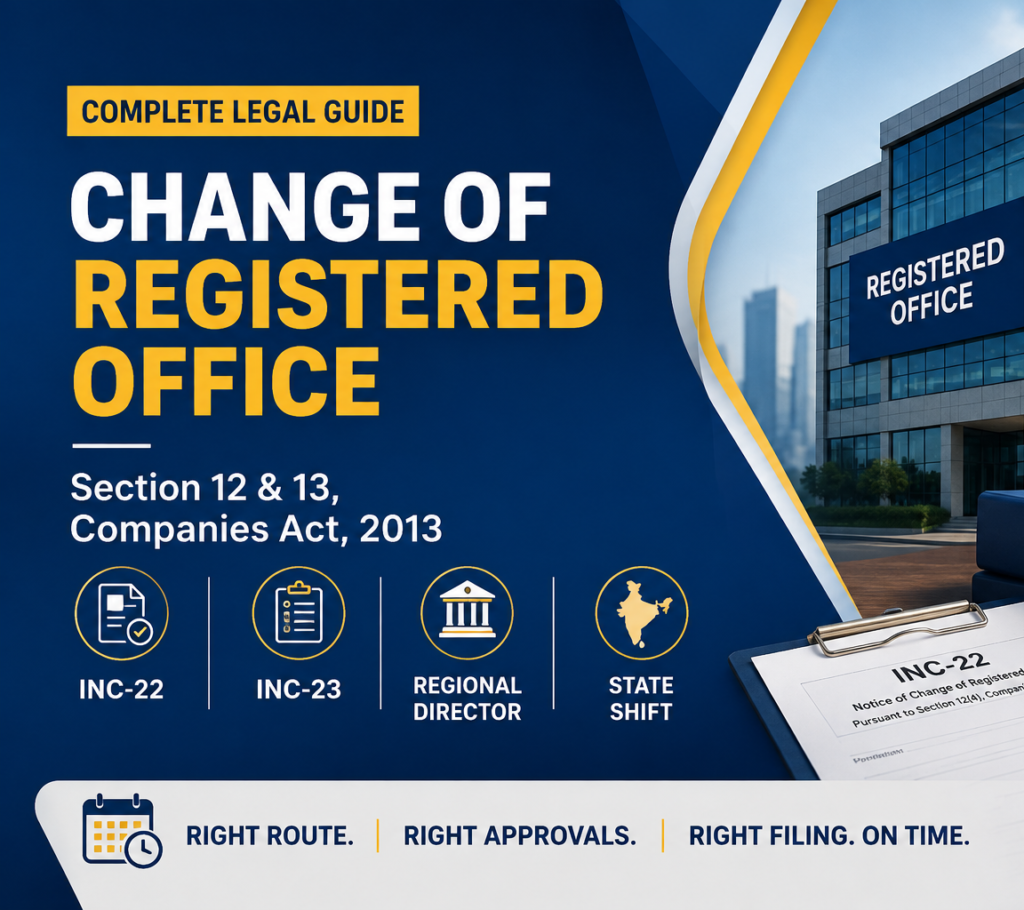
Every route, on one page
| Move | Approval needed | Key forms | Filing clocks | If defaulted |
|---|---|---|---|---|
| Within the same city, town or village | Board resolution only | INC-22 | INC-22 within 30 days of the change | Sec 12(8): ₹1,000/day on the company and each officer, up to ₹1 lakh |
| Outside local limits — same State, same ROC | Special resolution | MGT-14 + INC-22 | MGT-14 within 30 days of the SR; INC-22 within 30 days of the change | Same Sec 12(8) meter, plus a Sec 117 default on the MGT-14 |
| Same State — one ROC's jurisdiction to another's | Special resolution + Regional Director confirmation | MGT-14, INC-23, INC-28, INC-22 | Confirmation filed with the ROC within 60 days (Sec 12(6)); INC-28 within 30 days of the order | The shift is not registered — the old address stays official |
| One State (or UT) to another | Special resolution + Central Government (Regional Director) approval — the MOA itself changes | MGT-14, INC-26 advertisement, INC-23, INC-28, INC-22 | INC-26 ads not more than 30 days before INC-23; INC-28 within 30 days of the certified order, with the ROCs of both States; INC-22 within 30 days | The alteration has no effect until registered — and shifting is barred while any inquiry, inspection, investigation or prosecution is pending |
Introduction
A company's registered office is not just an address on a letterhead. It fixes which ROC governs the company, where statutory notices are validly served, which Regional Director and NCLT bench have jurisdiction, and where the statutory registers live. That is why the Companies Act, 2013 does not treat every move equally: the further the office moves, the heavier the approval — from a board resolution for a shift across the street, to Central Government approval, newspaper advertisements and creditor no-objections for a shift across a State line.
Matching the procedure to the move is the whole game. Companies routinely run the light procedure for a heavy move — a special-resolution shift filed as if it were a same-city change, or a cross-ROC move filed without the Regional Director's confirmation — and discover the defect months later, when a notice goes to the wrong address or a diligence team reconstructs the sequence. The reverse mistake costs too: running the full Central-Government machinery for a move two streets away wastes weeks nobody needed to lose.
The clocks are short and the meter is personal. Notice of every change goes to the ROC on Form INC-22 within thirty days, and default under Section 12(8) runs at ₹1,000 for every day — on the company and on every officer in default — up to ₹1 lakh each. The discipline is the same one that runs through every ROC intimation we write about: the fifteen-day clock in our guide to auditor appointment and Form ADT-1, and the thirty-day SH-7 clock on a capital increase, are this filing's close cousins.
This guide maps all four routes, the forms each one uses, the documents the Registrar actually accepts as proof of the new address, the state-to-state procedure end to end, and the mistakes that surface in due diligence.
1. First, pick your route — the four moves
Everything in this subject follows from one question: how far is the office moving? The Act grades the approval to the distance.
Within the same city, town or village
Outside local limits — same State, same ROC
Same State — one ROC to another
One State (or Union Territory) to another
2. The approval matrix
One table, four routes, every requirement — the fastest way to brief a board on what its move actually involves.
| Requirement | Route 1 Same city | Route 2 Same ROC | Route 3 ROC → ROC | Route 4 State → State |
|---|---|---|---|---|
| Board resolution | ✔ | ✔ | ✔ | ✔ |
| Special resolution of members | — | ✔ | ✔ | ✔ |
| MGT-14 (30 days of the SR) | — | ✔ | ✔ | ✔ |
| MOA alteration | — | — | — | ✔ (situation clause) |
| INC-26 newspaper advertisements | — | — | — | ✔ English + vernacular |
| Notice to creditors / debenture holders / regulators | — | — | ✔ affected parties | ✔ |
| INC-23 to the Regional Director | — | — | ✔ | ✔ |
| INC-28 (file the order) | — | — | ✔ 30 days of the order | ✔ 30 days — with both States' ROCs |
| INC-22 (notice of the new address) | ✔ 30 days | ✔ 30 days | ✔ | ✔ 30 days |
| Fresh certificate of incorporation | — | — | — | ✔ from the new State's ROC |
3. The statutory frame
Five provisions carry the subject.
| Provision | What it does | The point to hold on to |
|---|---|---|
| Sec 12(1)–(2) | Every company must have a registered office capable of receiving communications, within 30 days of incorporation, and verify it | A building under construction or vacant land cannot be the registered office; residential premises can |
| Sec 12(3) | Name and registered office address on every business letter, billhead, notice and official publication | The address change ripples into stationery, invoices, the website and the name-board — on day one |
| Sec 12(4) | Notice of every change to the ROC within 30 days — Form INC-22 | The universal filing: every route ends here |
| Sec 12(5)–(6) | Special resolution for any move outside local limits; Regional Director confirmation for a cross-ROC move, filed within 60 days | The RD must dispose of a Rule 28 application; 21 days' silence from a notified party is deemed consent |
| Sec 13(4), (7) · Rules 30–31 | State-to-state shift as an MOA alteration with Central Government approval, advertisements and creditor protection | No effect until registered — and barred while an inquiry, inspection, investigation or prosecution is pending |
4. Routes 1 and 2 — the moves most companies make
4.1 Route 1 · Within the same city, town or village
The Board passes a resolution approving the new premises and authorising the filing. The proof documents are gathered — see Section 6 — and INC-22 is filed within thirty days of the change on the MCA V3 portal, signed with a director's DSC and certified by a practising professional. That is the whole procedure; no shareholder vote is needed because the company's legal neighbourhood has not changed.
4.2 Route 2 · Outside local limits, same State, same ROC
Once the office crosses the local limits of the city, town or village, Section 12(5) puts the decision to the members: a special resolution at a general meeting (or by postal ballot where applicable). Two filings follow, each on its own clock — MGT-14 within thirty days of the resolution under Section 117, and INC-22 within thirty days of the change. They do not cover each other, and the commonest Route 2 defect is exactly one of the pair filed and the other forgotten.
5. Routes 3 and 4 — when a regulator enters the room
5.1 Route 3 · Same State, different ROC
Some States have more than one Registrar — Maharashtra (Mumbai and Pune) and Tamil Nadu (Chennai and Coimbatore) being the working examples. Crossing that internal line needs the Regional Director's confirmation under the proviso to Section 12(5), sought on Form INC-23 under Rule 28. The company serves notice on affected parties; if no objection reaches the RD within twenty-one days of service or publication, consent is deemed. The confirmation, once issued, is filed with the ROC — the certified order on INC-28 within thirty days, and the confirmation itself within the sixty days Section 12(6) allows — after which the Registrar registers the change. Note the bar: the shift is not allowed while any inquiry, inspection or investigation has been initiated, or a prosecution is pending.
5.2 Route 4 · State to State — the full machinery
Shifting the registered office from one State or Union Territory to another alters the situation clause of the Memorandum, so Section 13(4) applies: a special resolution, and the approval of the Central Government — a power exercised by the Regional Director. Rule 30 scripts the sequence:
Two features make this route unlike the others. First, the creditor protection is real: the application carries a declaration by two directors or KMP that no workman's dues are in default and that creditors' consent has been obtained — and an objecting creditor can hold the order up until the debt is discharged or secured. Second, the alteration has no effect until registered under Section 13(7): a company that starts operating from the new State before the INC-28 and INC-22 land is operating from an address the law does not recognise.
6. What the Registrar accepts as proof — the INC-22 pack
Every route ends at INC-22, and INC-22 lives or dies on its attachments. The Registrar wants to see that the premises exist, that the company is entitled to use them, and that they are capable of receiving communication.
The INC-22 evidence pack
- Owned premises: the registered title document in the company's name
- Leased or rented premises: the lease / rent agreement in the company's name, with a rent receipt not older than one month
- NOC from the owner, where the premises are used with consent
- Utility bill — electricity, telephone, gas or water — not older than two months, showing the address and the owner's name
- The board or special resolution behind the move, per the route
- For Routes 3–4: the RD's confirmation / order and the INC-28 SRN
Two premises rules trip companies regularly: a building under construction or vacant land cannot be declared as the registered office, while residential premises can — the test is capability of receiving and acknowledging communications, not commercial zoning. And remember the separate, annual cousin: the ACTIVE e-form (INC-22A) tagging regime, which expects the office to be photographed and genuinely functional. An address that exists only on paper fails both.
7. The clock and the meter
The meter is the visible cost. The invisible one is service: until the change is on the record, notices validly served at the old address bind the company — a tax notice, a legal demand, an ROC communication delivered to premises nobody checks any more. Companies have lost limitation periods to a letterbox they had stopped opening. File first, move the nameplate after.
And the ripple under Section 12(3) starts immediately: letterheads, invoices, the website, the name-board outside the office, bank records, GST registration, tax records, licences — every registration that carries the address needs the update, and a diligence team will sample-check exactly that consistency.
8. Two matters from practice
A growing company moved from its incorporation address in one city to larger premises in another city of the same State, treating it as a routine change: board resolution, INC-22, done. Eight months later, a funding diligence asked for the special resolution — the move had crossed local limits, and Section 12(5) required the members.
The repair: a ratifying general meeting, a late MGT-14 with its Section 117 consequences, an explanatory note in the diligence disclosures, and a Section 12(8) exposure computed from the date of the move. The correct procedure would have added one EGM and one filing at the time — the incorrect one added a warranty.
A company shifted offices within the same city and filed its INC-22 four months late — "the landlord took time with the NOC." In the gap, a statutory notice was served at the old address, went unanswered, and matured into an ex-parte order the company first learned of from its bank.
The lesson: the thirty days exist because service follows the record, not the furniture. The Section 12(8) meter (₹1,000 × 120 days, on the company and officers) was the smaller half of the bill.
9. Ten mistakes
- Running the light procedure for a heavy move — a board resolution where Section 12(5) required the members, or a plain SR where the Regional Director's confirmation was needed.
- Filing INC-22 but forgetting MGT-14 for the special resolution — or the reverse. The pair run on separate clocks.
- Declaring premises that fail the test — a building under construction, vacant land, or an address incapable of receiving communication.
- A utility bill older than two months, or a rent receipt older than one — the attachments are date-sensitive and the form bounces on them.
- Treating the INC-26 advertisements as a formality — they must run in both an English and the vernacular newspaper, not more than 30 days before the INC-23.
- Ignoring creditor consent on a state shift — an objecting creditor can hold the Regional Director's order until secured.
- Attempting a cross-ROC or cross-state shift while an inquiry, inspection, investigation or prosecution is pending — the bar is absolute.
- Moving in first, filing after — service at the old address binds the company until the record moves.
- Forgetting the ripple: letterhead, invoices, name-board, bank, GST and every licence carry the address under Section 12(3).
- Missing that a state shift changes the CIN's State code and brings a fresh certificate of incorporation — every document quoting the CIN needs a look.
10. Checklist
Before the move
- Route identified — same city / same ROC / cross-ROC / cross-state — before any resolution is drafted
- Premises test cleared: capable of receiving communication; not under construction or vacant land
- Proof pack assembled: title or lease + fresh rent receipt, NOC, utility bill under two months
- For Routes 3–4: creditor list, no-default declaration, and the inquiry/prosecution bar checked
The approvals and filings
- Board resolution — and special resolution with MGT-14 in 30 days, where the route requires
- Route 4: INC-26 ads (English + vernacular) not more than 30 days before INC-23; notices served
- INC-23 to the Regional Director; order obtained; INC-28 filed in 30 days (both States' ROCs on Route 4)
- INC-22 filed within 30 days with the full evidence pack; SRN saved
After registration
- Master data verified; fresh certificate of incorporation collected on a state shift
- Letterheads, invoices, website, name-board updated — Section 12(3) applies from day one
- Bank, GST, tax, labour and licence records amended to the new address
- Statutory registers moved (or Board-resolved to another location where permitted) and the change minuted
11. Frequently asked questions
Q1. What is a registered office and why does it matter?
The company's official address under Section 12 — where statutory notices are validly served, which fixes the jurisdiction of the ROC, the Regional Director and the NCLT bench, and where the statutory registers ordinarily live. Every company must have one within thirty days of incorporation.
Q2. What are the ways a registered office can be changed?
Four routes, graded by distance: within the same city (board resolution only); outside local limits within the same ROC's jurisdiction (special resolution); from one ROC to another within the same State (Regional Director confirmation); and from one State or UT to another (Central Government approval as an MOA alteration).
Q3. Which form notifies the change of address?
Form INC-22, filed with the ROC within thirty days of the change under Section 12(4) — on every route. Routes with approvals add MGT-14, INC-23, INC-26 and INC-28 before it.
Q4. Is a special resolution always needed?
No. A move within the same city, town or village needs only a board resolution. The special resolution enters under Section 12(5) the moment the office crosses local limits — and stays for every heavier route.
Q5. What is Form MGT-14 and when is it filed?
The filing that carries a special resolution to the ROC under Section 117, within thirty days of the resolution. It runs on its own clock, separate from INC-22 — filing one never covers the other.
Q6. What is Form INC-23?
The application to the Regional Director — for confirmation of a cross-ROC shift within the same State (Rule 28), or for approval of a state-to-state shift (Rule 30). It carries the resolutions, the creditor material and, on a state shift, the advertisements.
Q7. What is Form INC-26?
The newspaper advertisement for a state-to-state shift — published in at least two dailies, one in English and one in the principal vernacular of the district, not more than thirty days before the INC-23 application, inviting objections.
Q8. What is Form INC-28 and where is it filed?
The form that places the Regional Director's certified order on the record — within thirty days of receiving it. On a state-to-state shift it is filed with the ROCs of both States, old and new.
Q9. How long does the Regional Director take?
Affected parties get twenty-one days from service or publication to object — silence is deemed consent. A clean, unopposed application is typically disposed of in a few weeks; objections, creditor issues or defective advertisements stretch it to months.
Q10. Can creditors block a state-to-state shift?
They can hold it. The application carries a declaration that workmen's dues are not in default and that creditor consent is obtained; an objecting creditor is heard, and the Regional Director can require the debt to be discharged or secured before ordering.
Q11. When is a shift barred altogether?
While any inquiry, inspection or investigation has been initiated against the company, or any prosecution is pending under the Act. A company under scrutiny cannot change its Registrar — the bar is absolute.
Q12. What documents prove the new address in INC-22?
The title document (owned) or lease/rent agreement with a rent receipt not older than one month (rented), the owner's NOC, and a utility bill — electricity, telephone, gas or water — not older than two months showing the address and the owner's name, plus the resolution behind the move.
Q13. Can the registered office be a residential address?
Yes. The test is capability of receiving and acknowledging communications, not commercial zoning. What cannot be declared is a building under construction or vacant land.
Q14. What is the penalty for a late INC-22?
Section 12(8): ₹1,000 for every day the default continues — on the company and on every officer in default, separately — capped at ₹1 lakh each. Normal filing fees and additional fees apply besides.
Q15. What happens to notices served at the old address?
Until the change is registered, service follows the record: a notice validly served at the old registered office binds the company even if nobody works there any more. That — more than the penalty — is why the thirty days matter.
Q16. Does a state-to-state shift change the CIN?
Yes — the State code within the CIN changes, and the new State's ROC issues a fresh certificate of incorporation. Every document, registration and contract quoting the CIN should be reviewed.
Q17. Does the MOA change on a registered office shift?
Only on a state-to-state shift, where the situation clause of the Memorandum is altered under Section 13 — which is precisely why that route needs Central Government approval while the others do not.
Q18. When does the alteration take effect?
On registration. Section 13(7) makes a state-shift alteration ineffective until registered — a company operating from the new State before the INC-28 and INC-22 land is operating from an address the law does not recognise.
Q19. What else must change with the address?
Under Section 12(3): the name-board, business letters, billheads, notices and official publications. In practice also the bank, GST and tax registrations, labour registrations, licences, the website and every live contract's notice clause.
Q20. Which States have more than one ROC?
Maharashtra (ROC Mumbai and ROC Pune) and Tamil Nadu (ROC Chennai and ROC Coimbatore) are the working examples — which is where Route 3, the Regional Director confirmation under Rule 28, actually arises.
Q21. Can a newly incorporated company change its registered office immediately?
Yes — once the office is established and verified under Section 12, any of the four routes is available. What a new company cannot do is skip the verification: the office must exist and be evidenced within thirty days of incorporation.
Q22. Is Regional Director approval needed to move within the same ROC's jurisdiction?
No. Within the same city a board resolution suffices; outside local limits but within the same Registrar's jurisdiction, a special resolution suffices. The RD enters only when the move crosses a Registrar's boundary or a State line.
Q23. How long does each route take in practice?
Route 1: days — as fast as the proof pack and the filing. Route 2: the notice period for the general meeting plus the filings. Route 3: several weeks to a few months, driven by the RD's list. Route 4: commonly two to four months end to end — ads, notice periods, objections and two ROCs.
Q24. What is the ACTIVE (INC-22A) tagging and how does it relate?
A separate compliance under which the company's registered office is photographed and tagged as genuinely functional. It is not part of the change procedure, but it is the reason a paper-only address fails: the office must actually operate at the declared premises.
Q25. Can the statutory registers be kept somewhere other than the registered office?
Certain registers can, subject to conditions — typically a special resolution and notice — but the default home is the registered office, and any arrangement should be minuted and consistent with what the filings say.
Q26. Who signs and certifies these forms?
A director (or manager, secretary, CEO/CFO) with a valid DSC signs; certification by a practising CA, CS or CMA applies as prescribed. On the heavier routes, professional drafting matters most at INC-23 — a thin application before the Regional Director invites requisitions that cost weeks.
Corporate — related reading
- Registered office address in Indiawhere the address itself comes from — including for foreign-owned companies without premises yet
- Company incorporation in Indiawhere the first registered office is declared and verified
- Auditor appointment and Form ADT-1the fifteen-day cousin of this thirty-day clock
- Annual ROC filingswhere the registered address must reconcile every year
- Board resolutions and minutesthe resolutions every route begins with, drafted properly
- Resident director servicesthe other India-presence requirement foreign groups pair with the address
Talk to us before the thirty days run
Delhi Legal Company handles registered office changes on every route — the board and special resolutions, MGT-14, the INC-26 advertisements and creditor notices, INC-23 applications before the Regional Director, INC-28 and INC-22 with the full evidence pack, and the downstream updates across bank, GST, tax and licences — for Indian companies and foreign-owned subsidiaries alike.
How we usually start. Tell us the current address, the proposed address, and the date you plan to (or already did) move. We come back with the exact route, every approval and form it needs, the documents to gather, and a timetable that keeps notices landing where someone is actually reading them.