
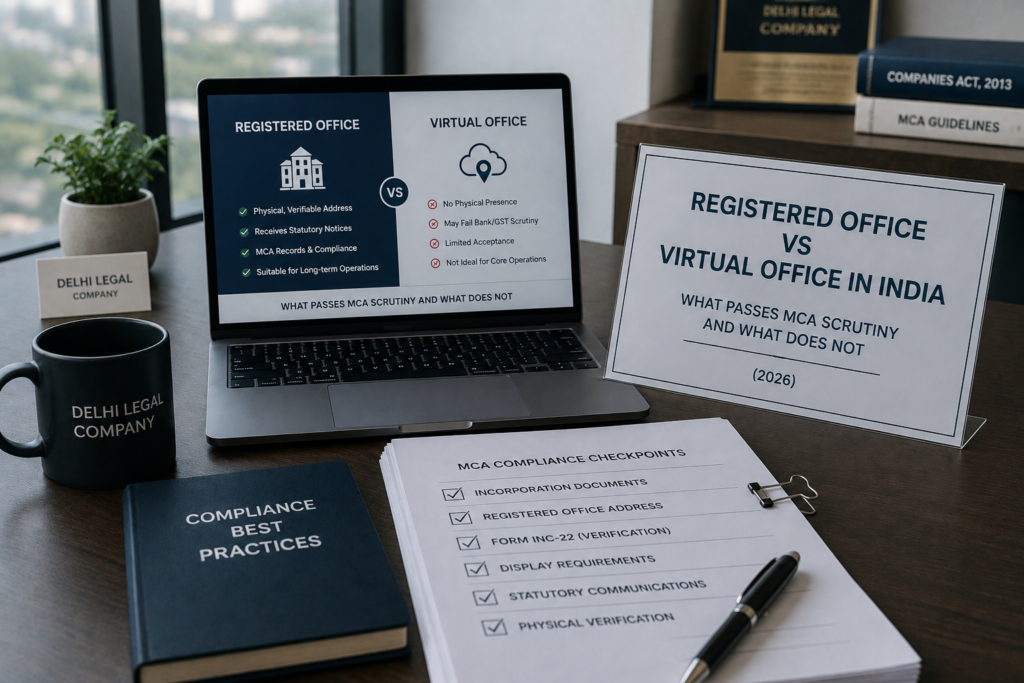
Written by the Delhi Legal Company India Entry & FDI Advisory team · Last updated August 2026 · Verified against Section 12 of the Companies Act, 2013 with amendment history
Introduction
The Registrar accepted your virtual office. Then the GST officer visited it and found a mailbox. Then the bank asked for a lease you do not have.
That sequence is the single most common address problem for foreign-owned Indian companies, and it happens because of a fact almost no guidance states plainly: one address is judged by three different authorities against three different standards, and the MCA’s is the most permissive of the three.
A virtual office that clears incorporation can fail GST verification in Maharashtra or Karnataka, and can be declined outright by a bank that wants to see occupancy. By then the address is on your certificate of incorporation, your PAN and your MCA record, and changing it is a filing with its own timeline.
There is a second problem layered on top. The MCA has been actively tightening enforcement in this area — geo-tagging, physical verification, and strike-off action — specifically to target shell companies. A foreign-owned subsidiary at a shared address with fifty other entities is not a shell company, but it looks like the pattern the enforcement is aimed at.
This guide covers what Section 12 actually requires, what makes a virtual office defensible rather than merely accepted, where each of the three authorities draws its line, and what happens when the line is crossed.
About this guide
Delhi Legal Company works exclusively with foreign companies establishing and operating in India. The registered office is a decision taken in week one of an incorporation, usually quickly, and it constrains the next three years — where your ROC jurisdiction sits, whether your bank will open an account, whether GST registration goes smoothly, and how exposed you are to a physical verification.
Where a rule is settled we state it with the section. Where the position varies by state or by institution — and here it substantially does — we say so rather than presenting a single national answer that will not match your city.
Primary sources: the Ministry of Corporate Affairs for Section 12 and the incorporation forms; the GST framework for principal place of business; and the Reserve Bank of India for the branch, liaison and project office framework.
1. Two things the ranking pages get wrong
| Commonly published | The position |
|---|---|
| “A company must have a registered office within 15 days of incorporation” | Thirty days. Section 12(1) originally read “on and from the fifteenth day of its incorporation”. It was substituted by the Companies (Amendment) Act, 2017 to read “within thirty days of its incorporation and at all times thereafter” |
| “Shifting the registered office to another state requires NCLT approval” | Central Government approval, exercised through the Regional Director, following alteration of the memorandum under Section 13 — not the Tribunal |
The second error matters commercially, because groups reading it assume an inter-state shift is a tribunal process and either over-budget for it or avoid a move that would have made sense.
2. What Section 12 actually requires
Section 12(1) of the Act mandates that every company incorporated under the Act must have a registered office within 30 days of its incorporation and is to thereafter maintain its registered office at all times as the principal address for receiving statutory communication and notices.
Four obligations sit in that section, and they are separate from one another.
| Obligation | What it requires |
|---|---|
| Have a registered office | Within 30 days of incorporation, and at all times thereafter |
| Verify it with the Registrar | Through Form INC-22 within the prescribed period |
| Display the name and address | Painted or affixed outside every office or place of business, in legible letters, and in the local language as well |
| Show details on documents | Name, registered office address, CIN, telephone and email on business letters, billheads, notices and other official publications |
2.1 “Capable of receiving and acknowledging”
This is the phrase the whole analysis turns on.
A registered office must be a physical location capable of receiving documents and notices, not merely a postal address.
Note both verbs. Receiving is passive — a mailbox does that. Acknowledging implies someone there who can accept service and confirm it. A PO box fails on both counts; an unstaffed address fails on the second.
This is also why the test is not “is it a virtual office” but “does someone at this address actually take delivery of a notice and acknowledge it.” A well-run serviced office passes. A mail-forwarding subscription does not.
2.2 The two obligations most companies forget
The name board. Section 12(3)(b) requires the company’s name and registered office address to be painted or affixed outside the registered office and every place of business, in legible letters, and in the local language of the area as well as English.
This is not decorative. It is what a physical verification looks for, and it is a separate default from not having an office.
Company name board display under Section 12(3)(b) is mandatory. Include company name, CIN, and registered office address.
Details on documents. Letterheads, invoices and email footers must carry the name, registered office address, CIN, telephone number and email. A foreign-owned subsidiary using its parent’s global letterhead template is frequently non-compliant on this without anyone noticing.
3. Where MCA has tightened
With increasing regulatory scrutiny, especially to curb shell companies and benami structures, the Ministry of Corporate Affairs has strengthened this provision through geo-tagging, physical verification, and enhanced inspection powers of the Registrars of Companies around India.
Over recent years, the MCA and the ROC have intensified enforcement through physical inspections, adjudication of penalties, and statutory orders highlighting non-compliance risks.
3.1 The physical verification power
The Companies (Amendment) Act, 2019 inserted a power allowing the Registrar, where there is reasonable cause to believe the company is not carrying on business or operations, to cause a physical verification of the registered office — and, if a default is found, to initiate action for removal of the company’s name from the register.
Two features of that make it consequential for foreign-owned companies.
The trigger is the Registrar’s belief, not a complaint. A company that files late, has no visible activity, or sits at an address shared with many entities can attract attention without anyone reporting it.
The remedy is strike-off, not a fine. The verification power is linked to removal from the register, which is a far more serious outcome than a penalty.
3.2 Geo-tagging
The MCA’s forms require photographic evidence of the registered office with the geo-coordinates captured, and with a director visible in the photograph.
The practical implication: the address you file has to be somewhere a director can actually stand, at a location matching the coordinates, in front of a name board. That is a meaningful filter, and it is why a purely notional address does not survive the process even if the paperwork looks complete.
3.3 The consequences
Non-compliance with the provisions of Section 12 may trigger strike-off actions under Section 248 and the imposition of the monetary penalties detailed under Section 12(8).
Section 12(8) provides for a penalty on the company and every officer in default of ₹1,000 for every day the default continues, subject to a maximum of ₹1,00,000.
Note the daily accrual and the fact that it applies to officers separately. For a subsidiary whose Indian board is one resident director and two parent nominees, that is three separate exposures running simultaneously.
And the strike-off risk is the sharper one. A struck-off company loses its bank account, its registrations and its ability to trade, and restoration is a tribunal process. See closing down an Indian subsidiary for what compulsory strike-off involves.
4. Is a virtual office legal?
Yes, with a qualification that does most of the work.
The MCA SPICe+ form accepts virtual office addresses as registered offices provided proper documentation — utility bill, lease agreement, NOC — is uploaded.
There is no legal restriction on using a virtual office for company incorporation. The MCA portal accepts virtual office addresses as registered offices as long as proper documentation is uploaded during the SPICe+ filing.
A virtual office address becomes a valid registered office address when it is backed by the right documentation. Without those documents, it is just a mailing address — it will not pass MCA or GST scrutiny.
4.1 The distinction that matters
“Virtual office” covers two quite different products, and Indian practice treats them differently.
| Mail-handling service | Serviced office with a right to occupy | |
|---|---|---|
| What you get | An address and mail forwarding | A designated desk or cabin, reception, meeting rooms |
| Can someone acknowledge a notice? | Sometimes, sometimes not | Yes — staffed reception |
| Can a director stand there for geo-tagging? | Awkward | Yes |
| Name board possible? | Usually not individually | Usually yes, at the entrance or a directory |
| Will a GST officer accept it on visit? | Often not | Usually yes |
| Will a bank accept it? | Frequently not | More likely, with the agreement |
The word “virtual” attaches to both, which is why the debate about whether virtual offices are permitted goes nowhere. The right question is whether the specific arrangement produces a place where a person can receive and acknowledge a communication.
4.2 The documentation trio
Three documents, and they must be internally consistent:
- No-objection certificate from the property owner, permitting use of the premises as the registered office
- Rent, lease or licence agreement, signed by both parties with witnesses
- Recent utility bill for the premises, generally within two months
MCA rejects a significant proportion of SPICe+ applications due to address proof issues: utility bills older than 2 months, missing NOC, incorrect property owner details, or mismatched address formats.
Every one of those is an internal consistency problem rather than a substantive one. The address must read identically on all three documents and on the form — including plot numbers, floor references, sector numbers and pin codes.
4.3 The registration point on leases
The rental agreement or lease deed should be registered if the lease term exceeds 11 months, as per the Registration Act 1908.
This is why so many Indian commercial arrangements run for exactly eleven months and renew. For a foreign group used to multi-year leases, it looks odd; it is a registration and stamp duty consequence rather than a commercial preference.
5. The three authorities and their three standards
This is the section that matters most, and it is the one almost no guidance sets out.
| MCA | GST | Bank | |
|---|---|---|---|
| What it is testing | Capability to receive and acknowledge communications | Whether this is a genuine principal place of business | Whether the customer is what it says it is |
| Method | Documents at filing; geo-tagged photograph; physical verification where triggered | Documents, and a physical visit in many states | Documents, and the bank’s own risk policy |
| Strictness | Most permissive | Varies sharply by state | Often strictest |
| Typical failure | Document inconsistency | Officer visits and finds no business presence | Occupancy documentation not accepted |
| Consequence of failure | Rejection, penalty, or strike-off action | Registration refused or cancelled | Account declined |
5.1 GST is where virtual offices most often fail
GST registration with a virtual office is possible but requires more attention. Some states, notably Maharashtra and Karnataka, have stringent physical verification processes. During verification, the GST officer visits the address.
The GST framework requires a “principal place of business”, defined as the primary location where the taxpayer’s business is carried out. That is a different concept from a registered office, and it is tested by someone standing in the doorway.
There is a counterweight worth knowing. GST Instruction No. 03/2025 clarifies acceptable documentation for rented premises and prohibits officers from demanding excessive documentation beyond the prescribed list.
So the officer cannot demand an open-ended document trail. But the officer can still visit, and what they see on the visit is what decides it.
5.2 The bank is often the strictest
Banks may be more cautious about virtual office addresses for current account opening.
Banks apply their own onboarding standards on top of the regulatory framework, and for a foreign-owned entity with a foreign parent already attracting enhanced due diligence, an address that looks notional adds to the picture.
The practical consequence is severe out of proportion to the issue: the account is the dependency on which capital infusion, allotment and FC-GPR all sit. See opening a bank account for your Indian subsidiary.
5.3 The sequencing lesson
Because MCA is the most permissive and comes first, and the bank is often the strictest and comes last, groups routinely clear the easiest test and then fail the hardest one — at a point where the address is already on the certificate of incorporation.
Ask the bank about your proposed address before you incorporate. It is one question, and it is asked in week one or paid for in week eight.
6. What makes a virtual office defensible
Not all providers are equivalent, and the difference is not price.
Before signing up, verify: the provider has a proper commercial premises lease, not a sublease that can be terminated; the address is not shared with 50+ companies, which raises red flags; and the provider has experience handling MCA and GST verifications. Cheap virtual offices often lack these capabilities.
| Question to ask the provider | Why |
|---|---|
| Do you hold a head lease on the premises, or a sublease? | A sublease that can be terminated puts your registered office at someone else’s discretion |
| How many companies are registered at this address? | A high count is a pattern the enforcement is looking for |
| Can we display a name board with our CIN? | Section 12(3)(b) is a separate obligation with a daily penalty |
| Will someone acknowledge and sign for a statutory notice? | This is the actual statutory test |
| Have you handled a GST physical verification here? | Ask for the outcome, not just whether it happened |
| Will a director be able to take a geo-tagged photograph at the premises? | Required for the filing |
| Can we get a utility bill in a form the MCA accepts? | Within two months, matching the address exactly |
| What happens to our address if you lose the premises? | You would need to change the registered office, with a filing and a timeline |
6.1 The shared-address problem
This deserves isolating because it is the risk foreign groups least expect.
An address at which many companies are registered is exactly the pattern shell-company enforcement targets. Your subsidiary is a genuine operating business with a real foreign parent, real capital and real employees — but the screening that flags addresses does not know that at the point of flagging.
The cost is not a penalty. It is being included in an enquiry, which consumes time and attention and sits on your record.
7. When a virtual office is the right answer
The analysis above is not an argument against virtual offices. For several situations they are clearly correct.
| Situation | Why a virtual or serviced office fits |
|---|---|
| Market entry before hiring | No team yet; leasing space for an empty office wastes capital |
| Fully remote Indian team | There is no operational office to point to |
| Registered office in a different city from operations | Legitimate and common — the registered office need not be where the team sits |
| Multi-state GST registrations | Virtual offices are particularly useful here — obtaining GST registrations in several states simultaneously using virtual addresses instead of leasing offices in each |
| Bridging to a permanent lease | Incorporation should not wait on landlord negotiations |
7.1 The multi-state GST use case
This is the strongest case for virtual offices and it is genuinely commercial rather than a workaround.
An Indian company supplying goods or services from multiple states needs GST registration in each. Leasing premises in four states to obtain four registrations would be absurd. Virtual addresses in each state, properly documented, achieve the same result at a fraction of the cost.
Note that this is a separate question from your registered office, which is one address in one state.
7.2 When to move to real premises
Move to a dedicated office when you have 10+ employees, need secure infrastructure such as data centres or labs, or your operations require privacy.
Add two more triggers for foreign-owned companies. When a bank or a customer’s procurement team wants to visit. And when the company is preparing for a transaction, because an address that has never been anything but a mailbox is a diligence question.
8. Where the registered office sits determines other things
The address is not only a compliance item. It carries consequences that are hard to change later.
| Consequence | Detail |
|---|---|
| ROC jurisdiction | Which Registrar handles your filings, queries and any adjudication |
| Stamp duty on incorporation documents | State-specific, and the differences are material |
| Shops and establishments registration | State legislation, with its own registration and renewal cycle |
| Professional tax | Levied by some states and not others, at different rates |
| Labour Code rules | States are notifying rules at different speeds — see employment contracts in India |
| Service of legal process | Notices are validly served at the registered office whether or not anyone reads them |
| Court jurisdiction | Relevant to where certain proceedings can be brought |
8.1 The service point is the one that hurts
A notice sent to the registered office is validly served. It does not matter that the mail-forwarding provider took three weeks to scan it, or that it went to a general inbox nobody monitors.
Statutory notices carry deadlines. A tax notice with a thirty-day response window, received on day twenty-six because of a forwarding delay, is a real problem — and the delay is not a defence.
Whatever address you use, the mail handling arrangement needs a named owner and a same-day escalation route for anything from a government authority.
9. Changing the registered office later
Groups often plan to start with a virtual office and move. That is sensible, but the move is a filing with escalating requirements depending on how far it goes.
| Move | What it needs |
|---|---|
| Within the same city, town or village | Board resolution, and Form INC-22 within the prescribed period |
| Outside those local limits, same ROC jurisdiction | Special resolution, and Form INC-22 |
| To another ROC jurisdiction within the same state | Special resolution plus Regional Director confirmation |
| To another state | Alteration of the memorandum under Section 13, special resolution, and Central Government approval exercised through the Regional Director |
The inter-state move is the one commonly mis-described as requiring NCLT approval. It does not; the power sits with the Central Government and is exercised through the Regional Director. It involves notice to creditors and to the state, and it takes months rather than weeks.
9.1 Plan the first address with the second in mind
If the business will operate in Bengaluru, do not incorporate with a registered office in Delhi because a provider offered a cheap address there. The subsequent inter-state shift is a months-long process that the initial choice would have avoided entirely.
Choose the state you will actually operate in, then choose the address within it.
10. Branch, liaison and project offices
Where the foreign company is registering a place of business rather than incorporating a subsidiary, the address question arises in a different form.
Foreign companies applying for liaison or branch office approval must provide a detailed address of the proposed local office.
The AD Category-I bank processing the application applies its own view of whether the proposed office is a genuine place of business. A liaison office in particular is defined by having a physical presence for representation — an address with no one at it is difficult to reconcile with the permitted activities.
Where the foreign company has filed Form FC-1 on establishing a place of business, changes to that address carry their own filing obligations. See liaison office setup in India and branch office setup.
11. Three situations, worked through
Scenario A — The address that cleared MCA and failed everything else
A US software group incorporates an Indian subsidiary using a low-cost virtual address in Bengaluru found online. The SPICe+ filing goes through without a query.
What happened next. The bank asked for occupancy documentation and would not accept a mail-handling agreement. GST registration triggered a physical verification; the officer found a reception desk with a list of company names and no presence for this one. The company could not display a name board with its CIN.
The cost. Six weeks lost. The company took a serviced office with a designated cabin, re-ran the address documentation, and filed INC-22 to change the registered office — a change it had not planned or budgeted for.
What would have prevented it. One question to the bank in week one, and one question to the provider about whether it had ever cleared a GST verification at that address.
Scenario B — The address in the wrong state
A European group incorporates with a registered office in Delhi because that is where its consultant was based. The business, when it starts, operates entirely from Pune.
The consequences. ROC jurisdiction in Delhi for every filing and query. Shops and establishments and professional tax obligations to work out across two states. And an eventual inter-state shift requiring alteration of the memorandum, a special resolution and Central Government approval through the Regional Director — months of process for a decision taken casually in week one.
What would have prevented it. Choosing the state of operations first, and the address within it second.
Scenario C — The virtual office that worked
A UK group incorporates with a serviced office in Gurugram: a designated cabin, staffed reception, and a provider holding a head lease with experience of MCA and GST verifications at that address.
What worked. The NOC, licence agreement and utility bill matched exactly. A director took the geo-tagged photograph at the entrance with the name board visible. The bank accepted the licence agreement as occupancy evidence. GST verification passed on the visit because there was a cabin, a board and a person.
The point. Nothing about this was a physical office lease. It was a properly documented right to occupy a specific space, which is a different product from an address subscription and priced accordingly.
12. Twelve mistakes
- Assuming the MCA standard is the standard. The bank and GST apply stricter tests, and they come later.
- Not asking the bank about the address before incorporating.
- Choosing a mail-forwarding service where the statutory test requires someone who can receive and acknowledge.
- Address written differently across the NOC, agreement, utility bill and form.
- A utility bill more than two months old at the time of filing.
- Using a provider on a terminable sublease, putting your registered office at a third party’s discretion.
- An address shared with a large number of companies, matching the pattern shell-company enforcement targets.
- No name board with the CIN, which is a separate default with a daily penalty.
- Parent’s global letterhead without the Indian company’s CIN, registered office and contact details.
- Incorporating in a state the business will not operate in, and facing an inter-state shift later.
- No named owner for mail handling, so a statutory notice with a deadline arrives late.
- Believing an inter-state shift needs NCLT approval. It is Central Government approval through the Regional Director.
13. Checklist
Before choosing the address
- State of actual operations decided first
- ROC jurisdiction, stamp duty, professional tax and shops and establishments implications of that state understood
- Bank asked whether it will accept the proposed address and what occupancy evidence it wants
- Provider asked whether it holds a head lease or a sublease
- Number of companies registered at the address established
- Provider’s track record on MCA and GST verifications at that specific address confirmed
- Ability to display a name board with the CIN confirmed
- Whether a person will acknowledge and sign for statutory notices confirmed
Documentation
- NOC from the property owner permitting use as registered office
- Rent, lease or licence agreement signed with witnesses
- Utility bill dated within two months
- Address reading identically across all three and the form, to the pin code
- Lease registered where the term exceeds eleven months
- Geo-tagged photograph arranged, with a director present and the board visible
After incorporation
- Registered office in place within 30 days and verified through Form INC-22
- Name board displayed in English and the local language, with the CIN
- Letterheads, invoices and email footers updated with name, address, CIN, telephone and email
- Named owner assigned for mail handling, with same-day escalation for government correspondence
- Address consistency checked across MCA, PAN, GST, bank and statutory registers
- Trigger agreed for moving to dedicated premises — headcount, a transaction, or a customer visit
Choosing an address this week?
The MCA will probably accept it. The question is whether your bank and the GST officer will, and that is answerable now rather than in week eight. Tell us which city you will operate from and what address you are considering and we will tell you what documentation it needs, what the bank is likely to say, and whether the provider has cleared a verification there before.
14. Frequently asked questions
Q1. Is a virtual office legal as a registered office in India?
Yes. There is no legal restriction on using a virtual office for company incorporation, and the SPICe+ form accepts such addresses provided proper documentation — utility bill, lease or licence agreement and NOC — is uploaded. The qualification does the work: without that documentation it is just a mailing address and will not pass MCA or GST scrutiny.
Q2. How long do we have to establish the registered office?
Thirty days from incorporation, and it must be maintained at all times thereafter. Section 12(1) originally required it from the fifteenth day; that was substituted by the Companies (Amendment) Act, 2017. Guidance still quoting 15 days is working from the pre-2017 text.
Q3. What does “capable of receiving and acknowledging” actually mean?
Both verbs matter. Receiving is passive and a mailbox achieves it. Acknowledging implies a person at the address who can accept service of a notice and confirm receipt. A PO box fails on both counts and an unstaffed address fails on the second, which is why the test is not whether the office is “virtual” but whether someone there can take delivery.
Q4. Can a PO box be used as a registered office?
No. The MCA requires a location capable of physically receiving and acknowledging communications, and a PO box does not satisfy that. This is one of the clearest lines in the whole area.
Q5. What is Form INC-22 and when is it filed?
It is the form by which the company verifies its registered office address with the Registrar, filed within the prescribed period after incorporation where the address was not provided in the incorporation form. It is also the form used when the registered office changes. Missing it is a separate default from not having a registered office at all.
Q6. Can the Registrar physically inspect our registered office?
Yes. The Companies (Amendment) Act, 2019 gave the Registrar power, where there is reasonable cause to believe the company is not carrying on business or operations, to cause a physical verification of the registered office and, if a default is found, to initiate action for removal of the company’s name from the register. The trigger is the Registrar’s own belief, not a complaint.
Q7. What is the penalty for a registered office default?
Section 12(8) provides for a penalty on the company and every officer in default of ₹1,000 per day for as long as the default continues, subject to a maximum of ₹1,00,000. Note that it accrues daily and applies to officers separately, so a board of three produces three exposures. Separately, non-compliance can trigger strike-off action under Section 248.
Q8. Do we really need a name board?
Yes. Section 12(3)(b) requires the company’s name and registered office address to be painted or affixed outside the registered office and every place of business, in legible letters, in the local language as well as English. It is a separate obligation with its own daily penalty, and it is what a physical verification looks for.
Q9. Why did MCA accept our address but the bank refuse it?
Because they apply different standards. The MCA tests whether the address can receive and acknowledge communications and does so largely on documents. A bank applies its own onboarding and risk policy, and for a foreign-owned entity already subject to enhanced due diligence, an address that looks notional adds to the picture. The bank is often the strictest of the three authorities.
Q10. Will a virtual office pass GST registration?
It can, but this is where they most often fail. GST requires a “principal place of business” — the primary location where business is carried out — and several states, notably Maharashtra and Karnataka, conduct physical verification. An officer who visits and finds only a mailbox is unlikely to be satisfied, whatever the paperwork says.
Q11. Can a GST officer demand extra documents?
GST Instruction No. 03/2025 clarifies acceptable documentation for rented premises and prohibits officers from demanding documentation beyond the prescribed list. That limits the paperwork demanded but does not prevent a physical visit, and what the officer observes on the visit is what decides the outcome.
Q12. How do we tell a good virtual office provider from a bad one?
Ask whether they hold a head lease or a terminable sublease, how many companies are registered at the address, whether you can display a name board with your CIN, whether someone will sign for a statutory notice, and whether they have cleared a GST physical verification at that specific address. Cheap providers typically fail several of these.
Q13. Is it a problem if many companies share our address?
It can be. An address at which a large number of companies are registered matches the pattern shell-company enforcement is designed to identify. Your subsidiary may be an entirely genuine operating business, but the screening does not know that at the point of flagging, and the cost is being drawn into an enquiry.
Q14. What is geo-tagging and what does it require?
The MCA forms require a photograph of the registered office with geo-coordinates captured and a director visible. In practice that means the address must be somewhere a director can physically stand, at a location matching the coordinates, ideally in front of the name board. It is a meaningful filter against purely notional addresses.
Q15. Does the registered office have to be where our team works?
No. The registered office is the address for statutory communications and does not have to be the operational premises. Companies legitimately operate from one location with a registered office in another. What matters is that the registered office is verifiable and capable of receiving and acknowledging communications.
Q16. Are virtual offices useful for multi-state GST registrations?
Yes, and this is their strongest use case. A company supplying from several states needs GST registration in each, and leasing premises in every state to obtain them would be disproportionate. Virtual addresses in each state, properly documented, achieve the same result at a fraction of the cost. This is separate from your registered office, which is one address in one state.
Q17. Does our lease need to be registered?
Where the term exceeds eleven months, registration is required under the Registration Act, 1908. This is why so many Indian commercial arrangements run for exactly eleven months and renew — it is a registration and stamp duty consequence rather than a commercial preference, and it often surprises foreign groups used to multi-year leases.
Q18. How do we change the registered office later?
Within the same city, town or village: a board resolution and Form INC-22. Outside those local limits but within the same ROC jurisdiction: a special resolution and INC-22. To another ROC jurisdiction within the same state: a special resolution plus Regional Director confirmation. To another state: alteration of the memorandum under Section 13, a special resolution and Central Government approval.
Q19. Does an inter-state shift need NCLT approval?
No, and this is commonly mis-stated. Shifting the registered office to another state requires alteration of the memorandum under Section 13 with Central Government approval, exercised through the Regional Director, together with a special resolution. It involves notice to creditors and to the state and takes months, but it is not a tribunal process.
Q20. What happens if a statutory notice arrives late because of mail forwarding?
Service at the registered office is valid whether or not anyone reads it. A forwarding delay is not a defence, so a notice carrying a thirty-day response window that reaches you on day twenty-six is a real problem. Whatever address you use, assign a named owner to mail handling with same-day escalation for anything from a government authority.
Q21. When should we move from a virtual office to real premises?
Common triggers are reaching around ten employees, needing secure infrastructure, or operations requiring privacy. For foreign-owned companies add two more: when a bank or a customer’s procurement team wants to visit, and when preparing for a transaction, because an address that has never been more than a mailbox becomes a diligence question.
Q22. Does this apply to branch and liaison offices too?
The question arises differently. A foreign company registering a place of business must provide a detailed address of the proposed local office, and the AD Category-I bank processing the application forms its own view of whether it is genuine. A liaison office in particular is defined by physical presence for representation, which is hard to reconcile with an address nobody occupies.
Related reading
- Opening a bank account for your Indian subsidiary — the authority most likely to refuse your address
- Step-by-step guide to forming a foreign company in India — where the address decision sits in the sequence
- Closing down an Indian subsidiary — what compulsory strike-off involves
- Registered office address services — how we handle this for groups with no India presence
Talk to us before you sign an address agreement
Delhi Legal Company works exclusively with foreign companies establishing and operating in India. Registered office provision, incorporation, GST registration, bank account coordination and the ongoing secretarial obligations that attach to the address — run as one workstream, because the same address has to satisfy three authorities with three different standards.
How we usually start. Tell us which city your team will actually work from and what address you are considering. We come back with what documentation it needs, what your bank is likely to say about it, whether the provider has cleared a verification there, and whether the state you have chosen is the one you should be in.
Sources
- Ministry of Corporate Affairs — Companies Act, 2013 Sections 12, 13 and 248; Forms INC-22 and SPICe+; Companies (Amendment) Acts 2017 and 2019
- Central Goods and Services Tax Act, 2017 and GST Instruction No. 03/2025 on documentation for rented premises
- Reserve Bank of India — Master Direction on establishment of branch, liaison and project offices
- Registration Act, 1908 — registration of leases exceeding eleven months