
1
2
3
4
5
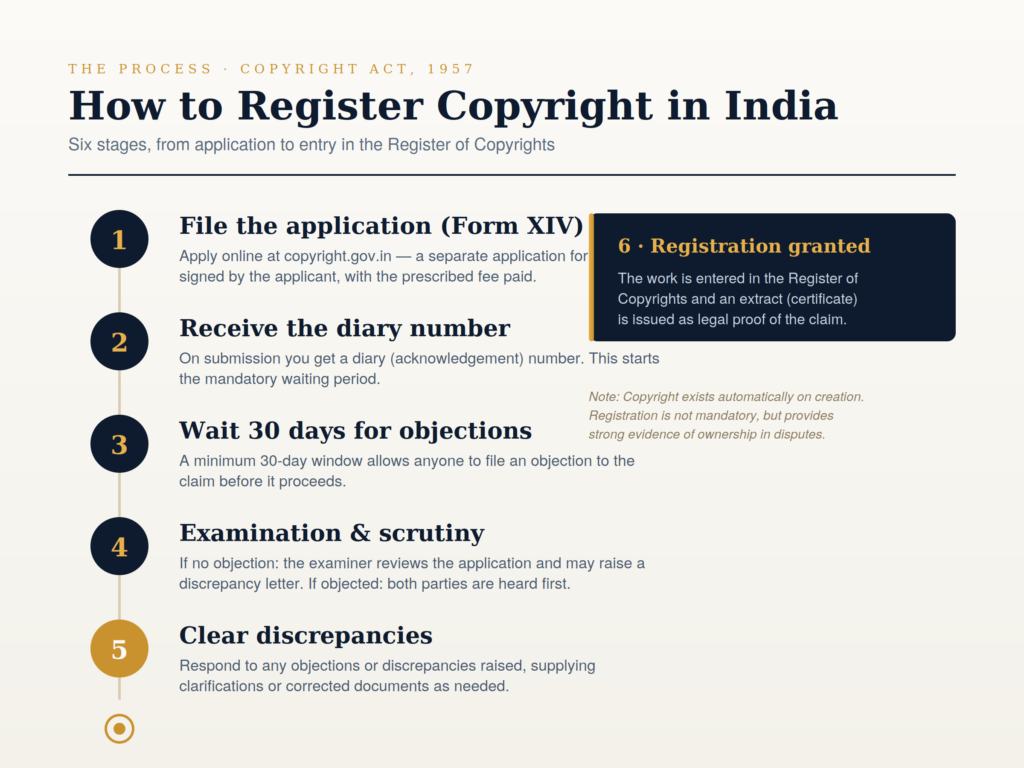
From Form XIV to certificate — the registration journey.
- File Form XIV. Create an account on copyright.gov.in and complete Form XIV with the Statement of Particulars and Statement of Further Particulars, and upload the work in the correct format (source code as PDF, content as PDF, design as image) plus identity, address, and (for companies) incorporation and authorisation documents.
- Pay & get the Diary Number. Pay the Schedule II fee through the payment gateway. The office issues a Diary Number, which marks the start of the process and lets you track status.
- 30-day objection window. A mandatory 30-day waiting period follows, during which any person may object to the claim. Examination begins only after it expires.
- Scrutineer examination. A scrutineer checks the application for discrepancies, completeness, correct categorisation, and correct fee. If objections were raised, a hearing may follow.
- Registration & certificate. If there are no issues, the Registrar enters the work in the Register of Copyrights and issues the registration certificate. As of 2026 the office has expedited processing, but the mandatory window means it still typically takes 2-4 months (longer if opposed).
Keep your details consistent. The name and address on Form XIV should match your other official records — for a company, your MCA registered office and GST details. A mismatch across filings is a common cause of scrutiny delays. Each application must also be signed by the applicant and, where an agent files, supported by a Power of Attorney or Vakalatnama.
7. Company & Employee Works
For a foreign-owned company, most copyrightable works — the code, the product, the content — are created by employees or contractors, not the company itself in the abstract. Getting ownership clean is essential, because the company, not the individual developer, should hold the IP.
The Act helps here. Under Section 17(c), where a work is made by an employee in the course of employment, the employer is generally the first owner of the copyright. So code written by your salaried developers usually belongs to the company by default. To register, an authorised signatory signs Form XIV, supported by a board resolution, and the company supplies its incorporation certificate, GST, and an authorisation letter.
This is the “work-for-hire” doctrine, and the line it draws — between an employee and an independent contractor — is where most ownership problems arise. The test is essentially one of control: an employee works under a contract of service, with the company directing the means and manner of the work, so the copyright vests in the employer by default. A contractor or freelancer works under a contract for service — hired to deliver a result — and, critically, the copyright in what they create does not pass to the company automatically, even though the company paid for it.
Two things to get right. First, even though Section 17(c) makes the employer the first owner of employee works, a no-objection certificate (NOC) from the author-employee is still recommended for a clean, unchallengeable registration. Second, and more importantly, contractors and freelancers are not employees — work they create does not automatically vest in the company, so you need a written assignment of copyright in their contract transferring ownership to the company. Missing this is one of the most common and dangerous IP gaps for young tech companies.
The contractor IP gap — the single most dangerous oversight. It is a common and costly misconception that paying a freelancer or agency for software means you own it. You do not — not without a written deed of assignment. Every software-development or design contract with an outside party should explicitly (a) designate the work as “work made for hire”, (b) assign all copyright to the company on completion, and (c) be signed before or at the start of the engagement. If a freelancer built your MVP, your logo, or your website and there is no assignment clause, the company may not legally own its own product — a gap that surfaces painfully during investor due diligence or an acquisition. Fix it with a signed assignment now, not later.
8. International Protection & AI Works
Two modern questions matter especially for foreign-owned and technology businesses: how far Indian copyright reaches across borders, and whether AI-generated work can be protected at all.
International protection — the Berne Convention. India is a signatory to the Berne Convention, which means a work that enjoys copyright in India is automatically recognised and protected in over 180 member countries — including the US, UK, EU states, and most of the world — without needing separate registration in each. For software and digital content distributed globally, this is enormously valuable: your Indian registration anchors a protection that travels with the work internationally. It is one reason foreign-owned companies are comfortable registering their India-created works domestically.
AI-generated content — a developing area. As AI tools become central to software and content creation, a genuine legal question arises: can purely AI-generated work be copyrighted? Under the current Copyright Act, copyright requires a human author, so work generated entirely by AI with no meaningful human creative input may not qualify for protection. However, where a human provides substantial creative direction, selection, and arrangement — using AI as a tool rather than the sole author — the resulting work may well be copyrightable, with the human as author. The Copyright Office has not issued formal guidelines as of 2026, so specific cases (a common scenario for modern tech companies) genuinely warrant tailored legal advice.
9. Assignment, Licensing & Commercial Value
Copyright is not just a defensive shield — it is a commercial asset you can transact. Once you own a registered copyright, you can put it to work in several ways, which matters enormously for a technology or content business whose IP is the value.
- Assignment (sale/transfer). You can assign — sell or permanently transfer — your copyright to another party. The assignment must be in writing and signed by the owner; once done, the assignee becomes the new owner and can enforce the rights. This is how IP moves in an acquisition or a group restructuring.
- Licensing (grant of use). You can license the work — granting others the right to use it on defined terms (exclusive or non-exclusive, by territory, duration, or purpose) — while retaining ownership. Software licensing is an entire business model built on this.
- Collateral & financing. A registered copyright is an identifiable asset that can be used as collateral or to support business financing, and it strengthens the IP picture investors and acquirers scrutinise.
A registered certificate makes all of this cleaner. Because ownership is on the public record and backed by prima facie evidence, an assignment or licence rests on a clear, provable title — which is exactly what a buyer, licensee, lender, or investor wants to see before they rely on it. Registration turns your code and content from something you merely hold into something you can confidently sell, licence, or borrow against.
Two small habits that pay off. First, although the copyright notice (the © symbol with year and owner) is optional under the Berne Convention, it is good practice to place it on your software, site, and content — it puts the world on notice and deters casual copying. Second, value the dated proof a certificate gives you: it is an official, dated record of creation, which is decisive if anyone ever disputes who created the work first — a frequent fight in software, where independent parties can build similar things around the same time.
10. Infringement & Remedies
The reason registration matters becomes clearest when someone copies your work. Copyright infringement in India is both a civil and a criminal matter, and the remedies are real.
On the civil side, a copyright owner can seek an injunction (a court order to stop the infringing use), damages or an account of profits, and delivery-up of infringing material. On the criminal side, the Act has teeth: under Section 63, knowingly infringing copyright carries imprisonment of six months to three years and a fine of Rs. 50,000 to Rs. 2,00,000; under Section 63A, repeat offenders face enhanced penalties; and courts can order confiscation of infringing copies and the equipment used to make them.
In all of these, your registration certificate is the lever. Because it is prima facie evidence of ownership, it lets you move quickly to an injunction and shifts the practical burden onto the infringer, rather than forcing you to first establish that the work is yours. For a digital business whose code or content can be copied in seconds, that head start is often the difference between stopping the harm early and a long, uncertain fight.
Protecting the whole picture. Copyright covers your content and code; pair it with trademark for your brand and sound corporate and compliance foundations. Talk to us about an IP strategy that fits your India entity and your global footprint.
Frequently Asked Questions (FAQ)
1. Is copyright registration mandatory in India?
No. Under the Copyright Act, 1957, copyright exists automatically the moment an original work is created in a tangible form — registration is not compulsory. However, registration is strongly recommended because the certificate is accepted by courts as prima facie evidence of ownership under Section 48, which makes enforcement, licensing, and infringement action far easier. Without it, you must prove ownership from scratch in a dispute.
2. Can software and source code be copyrighted in India?
Yes. Computer programs and source code are protected as literary works under Section 2(o) of the Copyright Act, 1957. You typically submit both source code and object code with a description of the program, and you may redact proprietary or sensitive portions of the code. Copyright protects the expression of the code — the way it is written — not the underlying idea, algorithm, or functionality, which would need a patent.
3. How do you copyright a website?
A website is not a single work — it is a bundle of separately copyrightable elements. The visual design and graphics are artistic works, the written content and copy are literary works, and the underlying code is a literary work. Depending on what you want to protect, a website may need more than one Form XIV application across these categories. A professional can advise which elements to register.
4. What does copyright protect, and what does it not?
Copyright protects the original expression of an idea — the actual code, text, design, or content — not the idea, concept, fact, algorithm, or functionality itself. It also does not protect names, titles, or slogans; those are protected by trademark. So your software’s written code is copyrightable, but the business logic or method it implements is not (that may need a patent), and your brand name needs a trademark, not a copyright.
5. What is the process for copyright registration in India?
The process is fully online at copyright.gov.in. You file Form XIV with the Statement of Particulars and Statement of Further Particulars, upload the work and documents, and pay the fee. The office issues a Diary Number, after which there is a mandatory 30-day objection period. A scrutineer then examines the application, and if there are no objections or discrepancies, the Registrar enters it in the Register of Copyrights and issues the certificate.
6. How much does copyright registration cost and how long does it take?
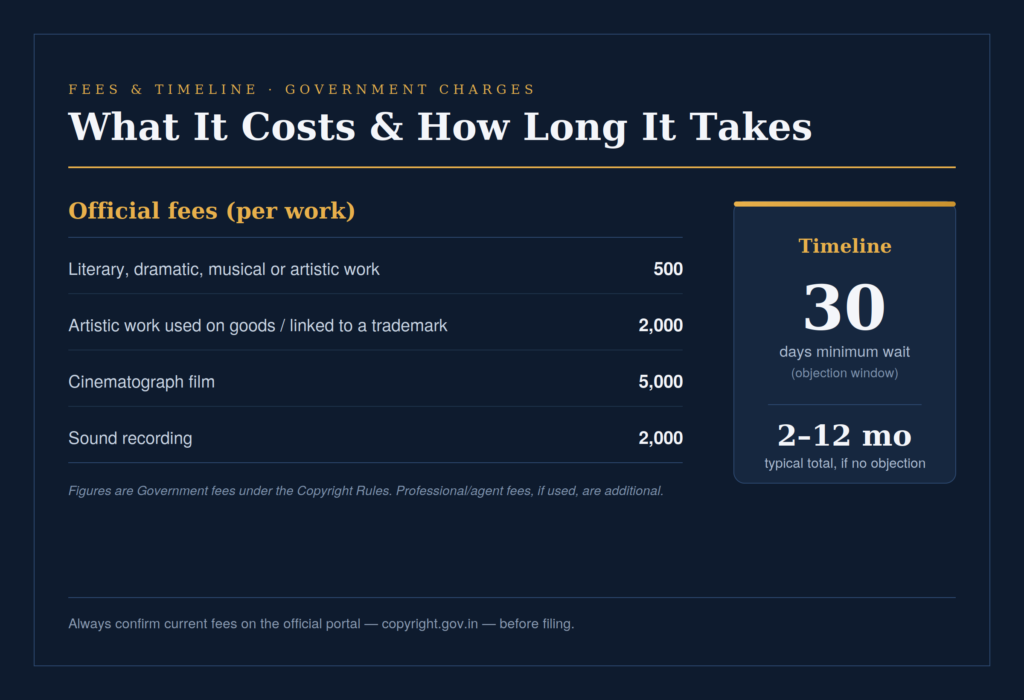
Government fees under Schedule II are modest: around Rs. 500 per work for literary, dramatic, musical, and artistic works (including software), Rs. 2,000 for sound recordings, and Rs. 5,000 for cinematograph films. Each separate work needs its own application. The timeline is typically 2 to 4 months when unopposed, and longer — often up to around six months or more — if objections are raised, owing to the mandatory 30-day objection window and examination.
7. How does a company register copyright for work created by employees?
A company can register copyright in works created by its employees or assigned to it. Under Section 17(c), where a work is made by an employee in the course of employment, the employer is generally the first owner. The application is signed by an authorised signatory supported by a board resolution, and a no-objection certificate from the author-employee is still recommended for a clean registration. For contractors, a written assignment of copyright to the company is important.
8. If a freelancer builds our software, do we own the copyright?
Not automatically. A contractor or freelancer works under a contract for service, and unlike an employee’s work, the copyright in what they create does not vest in the company by default — even though you paid for it. To own it, you need a written deed of assignment in the contract that designates the work as “work made for hire” and assigns all copyright to the company on completion. Without that clause, the company may not legally own its own product, which surfaces painfully in due diligence or an acquisition.
9. Can I sell or license my copyright?
Yes. Copyright is a transactable asset. You can assign it — sell or permanently transfer ownership — through a written, signed agreement, after which the assignee becomes the owner. You can also license it, granting others defined rights to use the work (exclusive or non-exclusive, by territory or duration) while keeping ownership yourself. A registered copyright can additionally be used as collateral for financing. Registration makes all of this cleaner by providing a clear, provable title.
10. Is Indian copyright protected in other countries?
Yes. India is a signatory to the Berne Convention, so a work that enjoys copyright in India is automatically recognised and protected in over 180 member countries without needing separate registration in each. This is particularly valuable for software and digital content distributed globally, and is one reason foreign-owned companies register their India-created works domestically.
11. Can AI-generated content be copyrighted in India?
This is a developing area. Under the current Copyright Act, 1957, copyright requires a human author, so work generated entirely by AI with no meaningful human creative input may not qualify. However, where a human provides substantial creative direction, selection, and arrangement using AI as a tool, the resulting work may be copyrightable with the human as author. The Copyright Office has not issued formal guidelines as of 2026, so specific cases warrant legal advice.
12. What are the penalties for copyright infringement in India?
Copyright infringement is both a civil and a criminal matter. Under Section 63, knowingly infringing copyright carries imprisonment of six months to three years and a fine of Rs. 50,000 to Rs. 2,00,000; repeat offenders face enhanced penalties under Section 63A. Courts can also order injunctions, damages, and confiscation of infringing copies. A registration certificate makes pursuing these remedies significantly easier by serving as ready proof of ownership.
Protect Your Software, Website & Digital Content
Delhi Legal Company handles copyright registration end to end for technology and content businesses — classifying your works correctly, filing Form XIV for software, website elements, and digital content, managing the objection and examination process, securing clean ownership through employee NOCs and contractor assignments, and advising on the wider IP strategy (copyright, trademark, and patents) for your India entity and global footprint.
☎ +91-9599332456 ✉ info@delhilegalcompany.com  delhilegalcompany.com